
LEGO has spent decades proving that plastic bricks can build anything from childhood memories to architectural masterpieces. January 2026 continues that tradition with designs that push beyond simple construction into genuine cultural commentary. These aren’t just toys gathering dust on shelves. They’re conversation pieces that bridge art history, gaming nostalgia, comedy legends, sports culture, and the maker movement into something you can actually hold.
What makes these five stand out is their refusal to play it safe. Each one takes risks with form, function, or concept. Some open to reveal hidden worlds. Others capture movement frozen in absurdity. The best designs this month understand that LEGO’s real magic lies in surprising people who thought they’d seen everything the medium could offer.
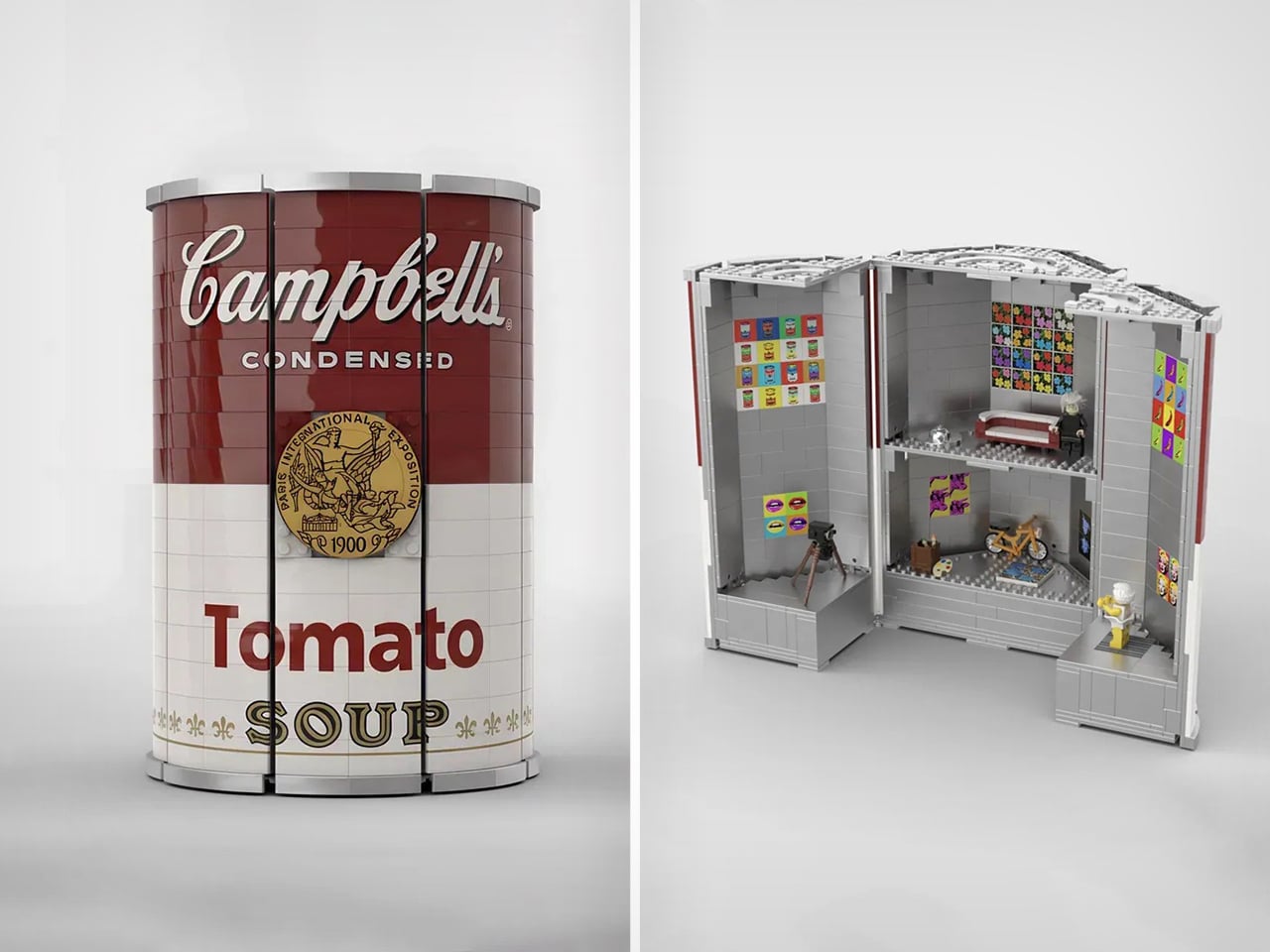
1. LEGO Campbell’s Soup Can Opens to Reveal Andy Warhol’s Factory Studio
This LEGO Ideas submission transforms Warhol’s most famous subject into an architectural achievement that honors both pop art and the artist’s creative process. The 24-stud diameter curved exterior alone represents great technical skill, but that’s just the packaging for what’s inside. Months of research went into recreating The Factory’s actual layout, visual language, and cultural significance. The printed artworks covering interior walls reference Warhol’s practice of painting on the floor surrounded by finished pieces.
The metallic interior creates a jarring contrast against the familiar red and white label, mimicking that disorienting moment when commercial design becomes fine art. Props from the actual studio populate the space: the disco ball reflecting celebrity culture, the motorcycle representing Warhol’s fascination with danger and fame, the couch where artists and socialites blurred boundaries. The silver-wigged minifigure presides over it all like a tiny curator. This works as both a display piece and an educational tool, making 1960s avant-garde culture accessible through the universal language of LEGO.
2. LEGO Editions 43019 Soccer Ball Opens to Stadium Interior
This 1,498-piece build measures 15 inches long, 10.3 inches wide, and 2.8 inches tall when fully assembled. The ball exterior alone would make a decent display piece, but cracking it open reveals the real achievement: a complete miniature stadium tucked inside curved walls. Stands, pitch, and match details occupy space most designers would leave hollow. Tiny fans populate the seating areas while players freeze mid-action on the field, capturing that electric moment before kickoff.
The engineering required to create both a recognizable ball exterior and a detailed stadium interior deserves recognition. This isn’t hollow packaging with loose pieces rattling around. Every element serves the dual design, allowing two completely different display configurations from one set. Show the closed ball for sports memorabilia aesthetic, or open it up to reveal the intricate stadium work. That versatility makes it perfect for shelves, desks, or dedicated LEGO display areas. The commitment to surprising builders at every construction stage elevates this beyond typical sports merchandise.
3. LEGO Monty Python Ministry of Silly Walks Build
John Cleese’s Mr. Teabag finally exists in brick form, complete with exaggerated proportions capturing every knee-flinging motion from the legendary sketch. The Technic joints provide genuine articulation rather than decorative suggestion, allowing precise recreation of those impossibly specific movements. This build solves a difficult problem: translating physical comedy into a static medium while preserving all the visual humor that made the original sketch memorable.
The facial expression captures Mr. Teabag’s deadpan bureaucratic seriousness with museum-quality attention to sculptural detail. That silhouette reads instantly from across any room, making it display-worthy alongside traditional LEGO architecture sets. The bowler hat and umbrella complete the aesthetic, transforming simple accessories into essential elements of British absurdist comedy. This works whether you’re a Python fanatic who can quote entire sketches or simply appreciate builds with genuine personality. The wit translates perfectly into plastic brick form.
4. LEGO Portal 2 Test Chamber Creator with Modular Design
The Portal franchise earned its legendary status through ingenious puzzles, dark humor, and an aesthetic so distinctive that orange and blue instantly evoke Aperture Science. KaijuBuilds translated that sterile-yet-sinister world into brick form with this LEGO Ideas submission. The sophisticated modular tile system features 18 unique configurations across 29 total modules, letting builders reconstruct famous chambers or design entirely new challenges. Around 1,280 pieces include Chell, Wheatley, Atlas, P-body, turrets, portals, a Companion Cube, and that infamous cake.
Attention to detail extends to overgrown tiles referencing Portal 2’s decayed facility sections, complete with a white rat nodding to mysterious Rattman. The modular approach mirrors the in-game test chamber editor, transforming this from a frozen diorama into an actual spatial puzzle playground. You can play with configurations rather than building one static scene, which captures the core Portal experience of manipulating space to solve problems. That interactive design philosophy makes this more than fan service. It’s a genuine translation of game mechanics into a physical building system.
5. LEGO Ender-Inspired 3D Printer Model
LEGO and 3D printing occupy similar creative territory, both transforming ideas into physical objects through systematic processes. Despite this natural kinship, no official LEGO model has captured the specific machine democratizing small-scale manufacturing. This fan submission fixes that gap with a recognizably Ender-inspired design capturing both the utilitarian aesthetic and basic kinematic structure of Creality’s popular printer lineup. The build doesn’t actually function like some ambitious LEGO projects, but that misses the point entirely.
Someone unfamiliar with 3D printing could assemble this and understand how Cartesian motion systems work, how hotend assembly relates to the build plate, and why vertical lead screws matter for Z-axis stability. For people who already own an Ender or similar machine, it offers nostalgia and novelty in seeing familiar hardware translated into tabletop collectible form. This bridges two maker communities that share fundamental DNA: the systematic joy of creating physical objects layer by layer, whether through molded plastic bricks or extruded filament.
The New Direction of LEGO Design
These five builds represent where LEGO culture is heading: designs that celebrate specific communities, translate complex ideas into accessible forms, and trust builders to appreciate nuance. They’re not chasing mass appeal. They’re serving passionate audiences who want their interests reflected in brick form, whether that’s pop art history, gaming nostalgia, or maker culture.
The best part is how these designs use LEGO’s constraints as creative fuel rather than limitations. Curved soup cans, modular game chambers, articulated comedy, nested stadiums, and kinematic printer structures all push the medium into new territory. January 2026 proves that after decades of innovation, LEGO still has surprises left to build.
The post 5 Best LEGO Creations of January 2026 first appeared on Yanko Design.