
LEGO has been on something of a quiet creative tear lately, and March brought a batch of sets that feel less like toy-aisle filler and more like design objects with a sense of purpose. From fan-submitted Ideas concepts to official Icons releases, this month’s standouts prove that the medium of interlocking bricks is capable of cultural commentary, mechanical ingenuity, and the kind of display-shelf presence that makes grown adults rearrange their living rooms. We picked five that caught our eye the hardest.
What connects these builds is an unusual level of ambition in how they handle subject matter. A soup can that contains an entire art studio. A sewing machine that actually functions. A 1977 computer recreated in startling fidelity. Two F1 helmets that had their real-world counterparts carried through the Melbourne paddock. And a book nook that folds shut like a novel and hides Victorian London inside. LEGO bricks have always been about building, but these five sets are also about storytelling, and each one does it with enough design intelligence to reward a closer look.
1. LEGO Campbell’s Soup Can
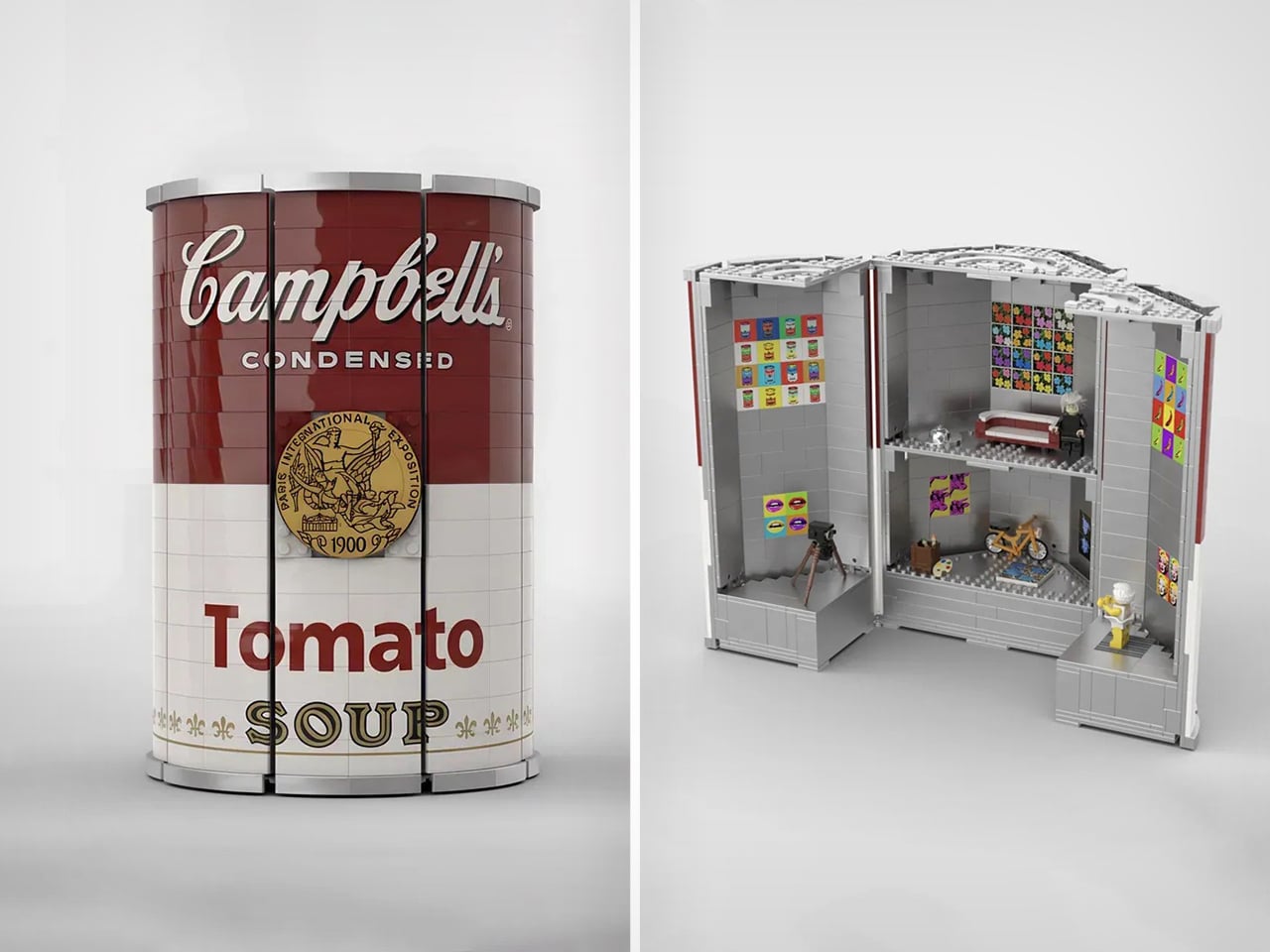
In 1962, Andy Warhol turned a grocery store staple into a cultural lightning rod. Now, a LEGO Ideas submission is translating that same iconic cylinder into a buildable object that opens to reveal a miniature recreation of The Factory, Warhol’s Manhattan studio. Building smooth curves at a 24-stud diameter in a medium designed around right angles requires serious geometric problem-solving, but the real ambition is conceptual. This is a container narrative, where the exterior tells one story, and the interior tells another.
Pop the lid, and the metallic interior walls contrast sharply with the familiar red and white shell. Printed artworks cover the floor and walls, echoing Warhol’s habit of painting directly on the ground with canvases scattered around him. The Warhol minifigure (signature silver wig included) presides over a space populated by props sourced from the actual studio: the disco ball, the motorcycle, the couch where visitors mingled. It is both a display piece and an education in pop art history, packed into a form that would sit comfortably on a bookshelf between actual art books.
2. LEGO Functional Sewing Machine
Most LEGO builds that replicate real-world machines are static approximations, capturing shape while ignoring mechanism. BrickStability’s sewing machine breaks that pattern. Turn the crank on the side, and the needle element actually moves up and down, translating rotational input into linear reciprocating motion, the same fundamental conversion real sewing machines have performed since the mid-1800s. A sewing machine that does not sew is a sculpture. One that moves when cranked is a teaching tool, and the difference between those two categories is the entire point.
The visual fidelity matches the mechanical ambition. The body is predominantly black, faithful to the color of nearly every vintage machine before white motorized models took over. Ornate gold brickwork traces the decorative detailing that Singer and similar manufacturers applied to their cast-iron machines, a design language that treated industrial tools as domestic furniture. LEGO spools of colored thread sit alongside brick-built tailoring scissors, completing a scene that feels like a small corner of a seamstress’s workstation frozen in time.
3. LEGO Apple II Computer
Steve Jobs walked through the kitchen appliance aisle at Macy’s in 1977 and decided a personal computer should feel like it belonged in a home. The result, designed by Jerry Manock and powered by Wozniak’s engineering, was the Apple II: a warm beige enclosure that communicated domesticity instead of machinery. LEGO Ideas builder BrickMechanic57 has now translated that design philosophy into 1,772 bricks, and the attention to detail rewards anyone familiar with the original.
The Pantone beige carries consistently across the computer body, monitor, and pair of Disk II floppy drives. The rainbow Apple II badge sits front and center above the keyboard, and the monitor screen is removable, offering two display states: the authentic green-on-black DOS boot screen or a clean powered-off panel. That swappable detail reveals a builder who understands the Apple II was not just a machine but an object that changed state, and capturing both conditions respects the full experience of owning one.
4. LEGO Editions Ferrari F1 helmets (Hamilton and Leclerc)
LEGO revealed these two sets at the Australian Grand Prix in Melbourne as the 2026 season opened, with both drivers carrying life-sized brick-built versions through the paddock. The consumer sets are more modest (886 pieces for Leclerc, 884 for Hamilton, $89.99 each, shipping May 2026), but the detail transfer from real helmet to brick form is where the design work lives. Both replicate the drivers’ 2025 helmet liveries using printed brick elements and a new visor piece developed specifically for this line.
Hamilton’s version uses a golden yellow base that makes Ferrari’s identity feel unexpectedly bold, with his number 44 and sponsor graphics distributed across the curved surface. Leclerc’s helmet goes the opposite direction: predominantly red and white with a cleaner, more structured layout. The #JB17 tribute at the crown honors Jules Bianchi, and a smooth white visor band reads almost architecturally, dividing the piece the way a cornice divides a building facade. Both sets include their respective driver as a minifigure for the first time, each in a red Scuderia Ferrari HP racing suit.
5. LEGO Icons Sherlock Holmes: Book Nook
LEGO’s first official Sherlock Holmes set introduces a new product concept called the Book Nook: a 1,359-piece display designed to slot between actual books on a shelf. When folded shut, the Sherlock Holmes: Book Nook (set 10351, $129.99) presents a flat, bookend-style exterior with a tiled black silhouette of Holmes against a tan background. It is restrained, intentional, and designed to sit alongside a Conan Doyle collection without looking like a toy intruding on a literary shelf.
Unfold it, and the restraint gives way to density. The interior reveals a Victorian Baker Street facade: a bookshop with a revolving display window, a shadowy terraced residence with a sliding front door, and a recreation of 221B, complete with a fireplace, a clue board, and a violin. Five minifigures populate the scene, including Holmes, Watson, Irene Adler, Moriarty, and a newcomer named Paige (whose name is almost certainly a pun). The open display measures over 8 inches high and 14.5 inches wide, giving the street and interiors enough room to breathe without overwhelming a shelf. The Book Nook concept is smart because it understands how adult collectors actually live: not everyone has a display cabinet, but most people have bookshelves.
Where LEGO Design Is Heading In 2026
These five builds share something beyond good brick engineering. Each one treats its source material with enough respect to move past surface-level recreation into something more layered: a can that contains a cultural biography, a machine that honors its subject by functioning, a computer that captures two operational states, helmets that tell a story about driver identity, and a book nook that understands how display space works in a real apartment.
March 2026 is evidence that the LEGO design community, both official and fan-driven, is thinking harder about what a build can communicate beyond its physical shape. The best sets this month are not the biggest or the most expensive. They are the ones that made us pause and look closer, which is all any well-designed object needs to do.
The post 5 Best LEGO Designs of March 2026 first appeared on Yanko Design.