
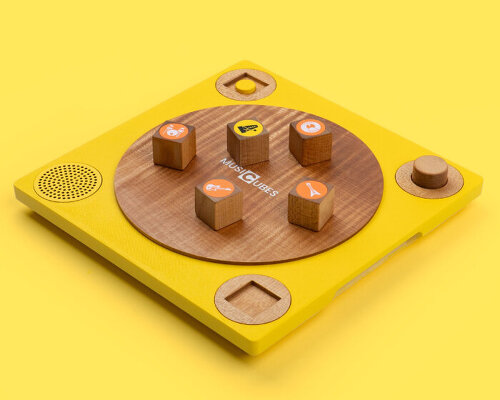
Musicubes makes music using handcrafted wooden blocks
MusiCubes comprises musical wooden cubes that produce instrumental sounds when placed on the smart vinyl-like board. Built with RFID technology, the surface reads the individually handcrafted cube and plays a sound, loop, effect, or recording as a way to give users a screen-free tool to make music. The device is based on a technology called TuneTouch, which uses passive RFID tags. Each musical wooden cube contains one RFID tag, holding information about the type of instrument or sound the block has. When the cube touches the tablet surface, the vinyl-like board detects the RFID signal and plays a sound or activates a function with low delay.
The detection works in real time, so users hear the result as soon as the cube moves, and the system needs no cables, no buttons, and no screens. The design of MusiCubes focuses on direct physical use, so users don’t tap icons or menus. Instead, they place cubes on the tablet surface. If they want to stop the music, they just remove the musical wooden cubes from the smart vinyl board. This is where the users play with their creativity because they can mix and match the cubes until they produce the kind of music they like.
all images courtesy of MusiCubes
Smart vinyl board ‘reads’ the musical wooden cubes
MusiCubes has four main cube types. The first one is the Loop cubes, which has one rhythm pattern or one melodic sound. When a Loop cube is placed on the tablet, the loop begins. The second set is for recording, or to activate the recording mode, in case the users want to register the production. Users can capture layers from Loop cubes or from live input, and when the Recording cube is removed, the recording stops. Then, there’s the series of Mic cubes for the microphone input. With these musical wooden cubes, the smart vinyl board records the users as they sing, beatbox, or record other instruments, adding a personal touch to their track.
The last is the Control cubes, which can change the audio settings. Here, users can adjust the volume, tempo, mix levels, equalizer settings, or effects of the music they’re producing, such as reverb, echo, or repeat. The RFID tag tells the tablet which parameter to adjust, and moving the cubes means applying changes to the current sound. MusiCubes works without a screen, internet, or software installation since the musical wooden cubes and smart vinyl board are fully physical. The team, comprising Hayri C. Bulman and Andy Keimach, states that future versions may support connectivity, but the current one is a stand-alone device. The device includes a library of loops, melodies, and effects that can be combined in many ways, allowing users to create long tracks, short patterns, or simple sound tests. So far, there’s no official release date for MusiCubes, but the team says that they’re launching it soon.
the surface reads the individually handcrafted cube and plays a sound
each block corresponds to a respective sound
there are several types or categories of music and function that each cube can operate
the images on the cube indicate the kind of sound to be played
the device is based on a technology called TuneTouch, which uses uses passive RFID tags
view of the vinyl- like board
project info:
name: MusiCubes
team: Hayri C. Bulman, Andy Keimach
The post musical wooden cubes produce instrumental sounds when placed on smart vinyl-like board appeared first on designboom | architecture & design magazine.