
The Living New Deal is a donor-supported nonprofit that began as a research project at the University of California, Berkeley, in 2007. Through crowdsourced research and a dedicated part-time staff, they have grown into a national enterprise that documents, maps and educates people about New Deal art and public works. In collaboration with volunteer contributors, they are creating the largest representative sample of New Deal projects and how they impacted the U.S. built environment from 1933 to 1943, tracking the creation of schools, roads, bridges, outhouses, sewer systems, post offices, hiking trails, hospitals and many other kinds of infrastructure intended to modernize the nation and provide resources for the American people. (Few people also know that during the New Deal era, the U.S. government became the largest patron of contemporary art in the world.)
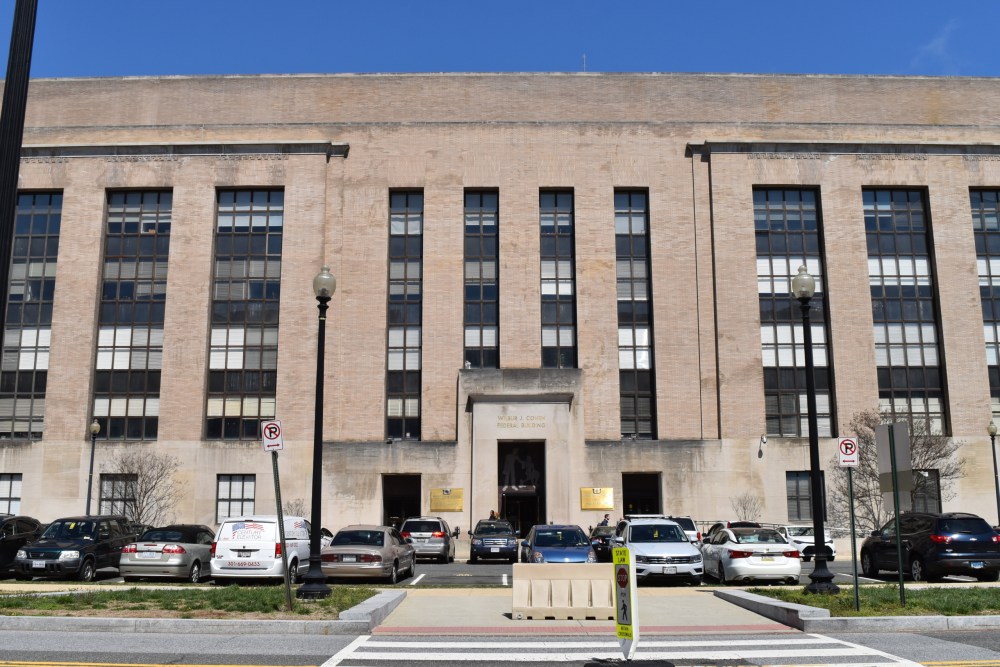
I met with Mary Okin, assistant director of the Living New Deal, to discuss the role and mission of protecting this American heritage—and the murals by Ben Shahn, Philip Guston and Seymour Fogel at The Wilbur J. Cohen Federal Building (built 1938-40 as the home of the Social Security Administration, one of the major new programs of the New Deal) in particular—before the narrative is forever altered.
Cohen Federal Building – Washington DCPhoto by: Richard A Walker© Creative Commons 2019.
How long has the Living New Deal been operating as a hub for the preservation of architecture and artifacts?
At Living New Deal, I have been leading our new Advocating for New Deal Art (ANDA) initiative since 2023 and working to raise greater awareness about surviving New Deal Art and its complex legacies. ANDA builds a professional network of scholars, curators, preservationists and others interested in New Deal art and is advised by a board of leading art historians who are helping LND support and promote new scholarship, new opportunities for convening and exchanging ideas, and new kinds of advocacy for New Deal art, including its preservation.
Ben Shahn’s ‘Meaning of Social Security’, Cohen Building – Washington DC. Photo by: Richard A Walker.
When the Trump administration gutted the Art and Architecture and Historic Preservation staff at the General Services Administration (GSA), the agency that manages the ownership and upkeep of federal art and architecture, the bulk of which is New Deal cultural heritage, and launched the GSA’s new “accelerated disposals” process, LND staff grew alarmed at the increased likelihood of losses to New Deal cultural heritage, given how many important New Deal buildings and artworks are owned by the GSA. The Cohen Building, which the founder of my organization, historian Gray Brechin, describes as a “Sistine Chapel of New Deal art,” is on the list of sites slated for disposal.
How the building is to be sold, at what cost, and with what if any historic preservation covenants is unclear. I have made it my mission to closely track what is happening at the GSA, to speak out against what has happened, and to build a public advocacy campaign raising awareness about the new accelerated disposals process and its impact on cultural heritage that belongs to all of us. While I believe that cultural heritage should remain in the hands of the American people who paid for its creation during the New Deal and intended for their investment to benefit future generations of Americans in perpetuity free of charge, I have also become convinced that well-organized private-public partnerships could be a solution for neglected heritage like the Cohen Building, whose structure and art require major retrofitting and conservation. I hope our campaign saves the building and also makes its art publicly accessible. Currently, tours are by appointment only and they have not been happening because the GSA staff was greatly reduced and did not have the bandwidth for hosting public tours.
Ben Shahn’s ‘Meaning of Social Security’, Cohen Building – Washington DC. Photo by: Richard A Walker.
Ben Shahn’s ‘Meaning of Social Security’, Cohen Building – Washington DC. Photo by: Richard A Walker.
Of the buildings and artworks commissioned under the New Deal, the Cohen Building, which was intended to be the Social Security Administration Headquarters, is among the largest and most prestigious—built within blocks of the U.S. Capitol in grand scale, over a million square feet of workspace decorated with over 1,800 square feet of murals and relief sculptures, particularly at its doorways, main lobby, central hallways, auditorium and boardroom. The artists hired to make art for the building had applied, and through a competitive, juried process administered by the Treasury Department’s Section of Painting and Sculpture, earned these commissions. These were considered the most prestigious works of New Deal art, awarded based on merit of design and quality rather than financial need and volume of production. The goals of the WPA’s Federal Project Onerhat hired out-of-work visual artists. Ben Shan and Philip Guston, who have been the subject of major retrospective exhibitions internationally in recent years, designed murals for the building that celebrate the promise of Social Security, which sadly was never administered within this headquarters building because it was immediately repurposed for the World War II mobilization effort, and then later given to Voice of America, a recent victim of drastic cuts to federal agencies that promote democracy and the arts at home and abroad.
Ben Shahn’s ‘Meaning of Social Security’, Cohen Building – Washington DC. Photo by: Richard A Walker.
What is the scope of your concerns? Is it all federal works that are threatened with demolition or dispersal?
My organization is interested in educating Americans about the New Deal public works and artworks that surround them, and that belong to all of us. While the New Deal created an enormous amount of art and architecture, a fund for preserving it was never created, and since the New Deal ended there have been significant losses to the New Deal art and architecture collection. Past losses have been devastating, and our goal is to avoid and challenge what appear to be the current administration’s priorities where historic preservation of important sites is concerned. We do not want the Cohen Building to go the way of the White House’s East Wing!
Ben Shahn’s ‘Meaning of Social Security’, Cohen Building – Washington DC. Photo by: Richard A Walker.
We understand threats to New Deal art as threats to what the American people own, often without realizing it. We have made it our mission to raise awareness of New Deal history and intervention in the built environment, not just in Washington D.C., San Francisco, Los Angeles, New York City, Chicago and other urban centers, but in rural communities across the country that were similarly prioritized by the New Deal and received major commissions of architecture and art. While our small staff cannot devote resources to saving every New Deal site, we do provide resources to local organizations who are fighting to save New Deal heritage. The Cohen Building campaign is focused on saving the “Sistine Chapel of New Deal art” in Washington, D.C., but more broadly it is working to raise awareness about deliberate attacks on New Deal cultural heritage that are more widespread, such as post office murals that may become similarly targeted for accelerated disposal and demolition. The idea is to encourage people to fight for what belongs to them and to appreciate an era of federal policy very different than our own—a time when leaders of the federal government prioritized modest investment in the arts and humanities nationally, which had substantive rippling effects for America’s leadership of the arts internationally after World War II. The freedom of expression and encouragement that artists working for the New Deal received, including artists of color, artists from immigrant communities, and artists who were women—all groups represented by the artists of the Cohen Building—differed markedly from the tragic fate and suppression of the arts in other countries during the 1930s and ’40s.
Ben Shahn’s ‘Meaning of Social Security’, Cohen Building – Washington DC. Photo by: Richard A Walker.
Is there a government connection to the Living New Deal?
The Living New Deal did receive federal support in the form of a major Digital Humanities Advancement Grant from the National Endowment of the Humanities, worth $150,000, in 2025, which was intended to support major upgrades to our open access website and database and would enable us to experiment with developing new resources for scholars and the public by adding a demographic data layer to our existing dataset of New Deal sites. Our goal was to reveal what communities were served initially and over time by New Deal projects across the country by incorporating historic census data.
Unfortunately, just a couple of weeks after news of the GSA’s Art and Architecture and Historic Preservation staff being gutted broke, our NEH grant, along with thousands of others, was rescinded.
We are very fortunate to have the support of loyal donors, however, many of whom helped us recover from our NEH grant loss. Their generosity has enabled me and other staff to campaign for the Cohen Building and build a network of likeminded advocates raising their voices against further threats to New Deal heritage nationally.
Dept. of Health and Human Services, formerly Social Security, Philip Guston, “Reconstruction and Well-Being of the Family,” 1942, fresco.
Does the Federal Government own the murals? And what has been the process of preservation and storage in the past?
While the New Deal created an immense art collection, it did not create a fund to support its upkeep and preservation. Losses to the collection have been extensive over the decades since the New Deal art programs shuttered in 1942/1943, with major scandals over the illegal sale of this art.
The GSA, established in the late 1940s, manages public ownership of all New Deal art. The GSA collection includes tens of thousands of portable sculptures, paintings and works on paper, which are either stored by the GSA in temperature-controlled facilities or placed on long-term loan to various museums and related organizations with art collections nationally. There is no New Deal art museum or similarly dedicated space for their public display.
Federal law specifies that New Deal art cannot be sold by the federal government, and even when federal buildings are purchased by private individuals, New Deal art within them remains in the possession of the American people. That has not prevented their destruction, however.
Part of the problem is that art conservation and other maintenance of historic art and architecture is expensive, and the New Deal and subsequent federal leadership did not establish a fund to preserve the thousands of artworks owned and managed on our behalf by the federal government. GSA staff has not had the bandwidth to do what we would expect a museum would do to preserve its art collection, but they have been tireless in their efforts and have done quite a lot with the resources they have. The Art and Architecture staff of the GSA, prior to Trump’s cuts to the agency in March, described themselves as a “skeleton crew,” given that they managed the circulation and preservation of a collection of art that rivals mid-sized museums, with a fraction of such a museum’s staff and resources. Now only a fraction of that fraction of staff remains at the GSA, many only recently called back to work after months of forced administrative leave. They are doing all they can to manage GSA’s art and architecture collection and to figure out how to manage the new “accelerated disposals” process forced upon them, which includes carefully handling the sale of historic buildings like the Wilbur J. Cohen Federal Building and its precious works of art.
Dept. of Health and Human Services, formerly Social Security, Philip Guston, “Reconstruction and Well-Being of the Family,” 1942, fresco.
Dept. of Health and Human Services, formerly Social Security, Seymour Fogel, “Wealth of the Nation,” 1942, fresco, detail.
What are the roadblocks you are facing?
General lack of knowledge about New Deal history is widespread among the public but also among the academy, journalists, etc. Many people have never heard of the GSA nor the Cohen Building, so the barrier to caring about this issue increases as folks simply don’t know what’s at stake if the building is lost and why we should fight to save it.
Henry Kreis bas-relief, Wilbur Cohen Building – Washington DC Photo by: Richard A Walker© Creative Commons 2019.
What can supporters of preservation do to help?
Supporters can sign our petition and tell all their close ones and networks to please do the same. They can write to their congressional representatives or call and ask that members of congress prevent what is unnecessary loss. They can also learn more about what the New Deal created in their communities and stay abreast of other endangered New Deal sites by signing up for our Fireside newsletter, which is free. Supporters with the means to do so can give to our Advocating for New Deal Art initiative and write their own editorials on the topic is historic preservation. They can also join our organization for webinars and other free events that we host (the next scheduled for today).
The post The Daily Heller: The Living New Deal’s Mission to Preserve America’s Legacy appeared first on PRINT Magazine.