
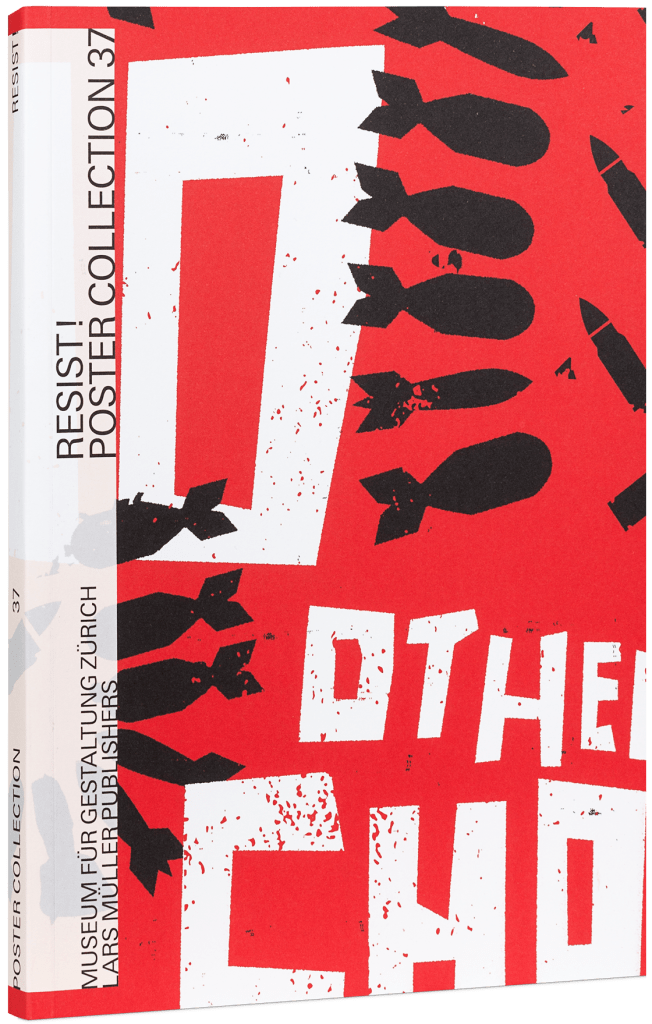
I have resisted a strong impulse to compile/edit/write yet another protest poster book. I’ve done a few over the past 40+ years and there are scores more on my shelves. I’ve hoarded many poster histories and anthologies dating back over 100 years that address critical epochs, wars and civil unrest, social justice and racial turmoil, health and medical disasters, partisan and ideological politics. This and dozens of recurring themes have been covered over and over and over and I’ve despaired rehashing the same and similar again and again and again. And it is not because they have no value or virtue. They do: For historians, scholars, activists and students of the persuasive arts, keeping this record is essential. As propaganda, understanding persuasive techniques is useful too. However, viewed honestly, how many of them have truly made an appreciable difference in altering the issues they advocate and/or protest?
Israel Palestine, Yossi Lemel, 2002. Donation, Yossi Lemel.
This question underlies the recent book Resist! Poster Collection 37 From the Musuem Für Gestaltung Zurich (Lars Müller Publishers), featuring essays by Bettina Richter (editor), Silas Munro and Lisa Bogerts. It is a well-endowed collection that almost restored my flailing hope in graphic design to make an existential difference. But not quite. Here’s why …
“Protest posters do not claim to have an immediate impact on events, nor are they a substitute for concrete action,” writes Richter.
“Protest is a well-worn subject in the history of the United States,” states Munro, adding, “Amidst a drastic shift in the U.S. government led by President Donald Trump during the early months of his second term in 2025, the protest poster is as much a part of the present as it is of the past.” Herein two of the book’s expert contributors echo my encroaching cynicism that has made its way through the heart into a semblance of articulation.
Plazm / Joshua Berger, Peter Le. [after John Heartfield], 2016. Donation, Joshua Berger.
I do like this book for what it highlights—a bunch of cleverly poignant ideas that shame the inhumane and fight against inhumanity. However, I am also annoyed that as an array of heartfelt statements, they have not shifted the world’s axis more than a smidge, if at all. Yes, I know that’s a lot to ask of a piece of paper—but it’s not impossible, since all kinds of art has changed many individual lives and cultures over the eons. As the essayists admit, while that’s not the goal, in my view it is the ideal—and what’s wrong with believing in an ideal? Does bad history always have to repeat itself? Not like it does in the movie Groundhog Day, but usually more apocalyptic each time it repeats.
See Red Women’s Workshop, 1978.
Richter makes the point that pictorial rhetoric has a longstanding place in world history and, more personally, our individual psyches: “While some posters are designed to make people reflect, others elicit an emotional reaction.” It is unrealistic to expect that all posters function at the same level of useful intensity—and many are forgotten, too.
Maciej Urbaniec, 1971.
The surprising visual impact of abstraction is more motivational than a simple realistic representation; chaos can be more relevant than a pristine work of fine design. For me the most arresting indictment in this entire poster collection is not pristine design. It’s the 1970 Mai Lai massacre photograph headlined Q: And babies? A: And babies. It literally turned the nation against the Vietnam War (although it did not end the war).
Love / “Ideological Coverup”. Bruce Kaiper, 1974.
There is much that is positive to be said about static representation. And this is a good book in that context. As a culture there is a greater expectation of movement, of motion, of change. Time for contemplation has been reduced exponentially as our computers and devices become more powerful, and especially as artificial intelligence revs up the speed in which design is accomplished. Posters, even those that are designed on and for the screen, are essentially lasting. This book and the collection it contains will last too, I hope.
Celebrate People’s History / ¡El Agua es nuestra carajo! Swoon, 2005.
The post The Daily Heller: Posters That Persist to Resist appeared first on PRINT Magazine.