
The Sky, Oscillating: an immersive study on light and atmosphere
Black Void presents its first solo exhibition, The Sky, Oscillating, at the historic Bund·City Hall as part of the 24th China Shanghai International Arts Festival. The interdisciplinary collective, founded and directed by Yixuan Cai, with partner Yuhan Xiao and core member Yun Hong, brings together practitioners from digital media, architecture, data science, and music. The exhibition gathers more than ten works developed across three years of research, using light, atmospheric data, and spatial installation to examine the relationship between natural systems and human-made infrastructures.
Set within the century-old building in Shanghai, the exhibition uses the existing architecture as an active framework. Daylight passing through the hall’s arched windows gradually shifts the atmosphere from gold to orange to blue, creating a temporal backdrop for three chapters: Stellar Solar Impulse, Extraterrestrial Life, and Atmospheric Echo. Moving shadows and projected visual layers interact with the stone surfaces, linking historical materiality with the exhibition’s focus on environmental change. The curatorial approach centers on clouds, carbon, light, and electricity, elements treated not as effects but as carriers of information. The works trace how these natural forces are reshaped by industrial production, digital networks, global energy systems, and conflict. Solar radiation becomes electrical output through silicon wafers; human activity contributes aerosols, emissions, micro-particles, and electromagnetic signals to the atmosphere; and speculative biological agents on Mars highlight future intersections between ecology and technology.
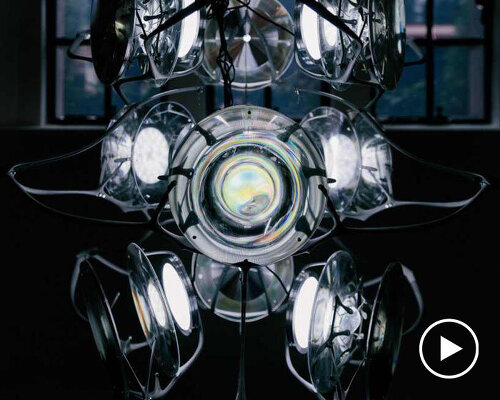
The Burning Iris, installation close-up, 2025 | all images courtesy of Black Void
Black Void Visualizes Hidden Energies Behind Our Technologies
One newly debuted work by creative studio Black Void examines the ‘politics of heat and light’ through a system that combines photovoltaic data, information-infrastructure records, and solar-activity measurements. Using ecological, energy, and computational data from Phoenix, Arizona (2014–2024), the installation presents a dual-ring structure: the inner ring responds to photovoltaic generation and data-center electricity consumption, while the outer ring visualizes sunspot activity and temperature. The system reflects the dependency of digital operations on environmental conditions, illustrating how solar power, heat waves, and sandstorms can affect energy supply and communication systems. Another work draws from glassblowing processes, likening the stress patterns within cooled glass to the distribution of heat and light in natural systems. Under optical devices, each piece refracts the tension generated between hot and cold states, suggesting parallels with cycles of energy dissipation in living organisms. A separate installation investigates Martian fungi through digital simulation, ecological modeling, and speculative archaeology. Using generative software, the team imagines fungal forms adapting to radiation, electromagnetic waves, and mineral substrates. The piece includes a digital growth system, 3D-printed sculptures, a Martian meteorite (Shergottite, provided by 4.5B Interstellar Lab), and a film set within an orange-red environment.
The Burning Iris, installation, 2025
Rendering Global Climate Shifts in Color, Motion, and Mist
The exhibition concludes with a chapter that shifts attention from outer space back to Earth’s atmosphere. Based on Copernicus satellite data, the work analyzes atmospheric changes during events such as the Amazon wildfires, the Russia-Ukraine war, and Los Angeles smog episodes. Using ten years of data from 300 global cities, including greenhouse-gas concentrations, aerosol levels, humidity, and geolocation, the design team generates digital cloud sculptures that translate atmospheric conditions into form, color, and motion. This final section also includes a multimedia theater piece combining indoor cloud-generation techniques, microclimate control, and audiovisual components. Thermal sensors and controlled airflow operate as spatial tools, producing clouds that accumulate and disperse in response to environmental parameters.
Throughout the exhibition, Black Void positions natural elements as information systems. Clouds register environmental change through condensation cycles; sunlight interacts with technological infrastructure via photovoltaic surfaces; and computational processes release heat back into the environment. By examining these exchanges, the collective highlights the interdependence between natural instability and technological regulation. Black Void’s research extends beyond the exhibition venue, involving fieldwork at solar-thermal facilities in Delingha (Qinghai), the Daya Bay Nuclear Power Station, and Shenzhen’s mangrove reserves, as well as collaborations with meteorological institutions, photovoltaic networks, and meteorite laboratories. This cross-disciplinary approach forms the foundation of The Sky, Oscillating, positioning the exhibition at the intersection of environmental data, spatial installation, and material research.
The Burning Iris, installation, close-up, 2025
‘Phoenix, Flowing into the Mouth of Computation’ Solarcene series, data-driven generative video installation, 2025
‘Phoenix, Flowing into the Mouth of Computation’ Solarcene series, data-driven generative video installation, 2025
‘Phoenix, Flowing into the Mouth of Computation’ Solarcene series, data-driven generative video still, 2025
Biosphere 3, Installation, The Sky, Oscillating exhibition, 2025
Biosphere 3, film, The Sky, Oscillating exhibition, 2025
Twin Cloud-London, Digital Art, Black Void, 2024
The Sky, Oscillating exhibition, Clouds Memoir, Video Poem Still, Black Void
Twin Cloud, Video Still, Black Void, 2022-2025
The Sky, Oscillating exhibition, Clouds Memoir, Video Poem Still, Black Void
Clouds Memoir, Video Poem Still, Black Void
project info:
name: The Sky, Oscillating / Solo Exhibition
artist: Black Void | @bv_blackvoid
event: The 24th China Shanghai International Arts Festival
venue: Bund Former City Hall, 223 Hankou Road, Shanghai, China
dates: October 31st – November 23rd, 2025
designboom has received this project from our DIY submissions feature, where we welcome our readers to submit their own work for publication. see more project submissions from our readers here.
edited by: christina vergopoulou | designboom
The post black void’s shanghai exhibition visualizes a planet in flux through digital cloud installations appeared first on designboom | architecture & design magazine.