
‘Claw’ machines with parts made of recycled food waste
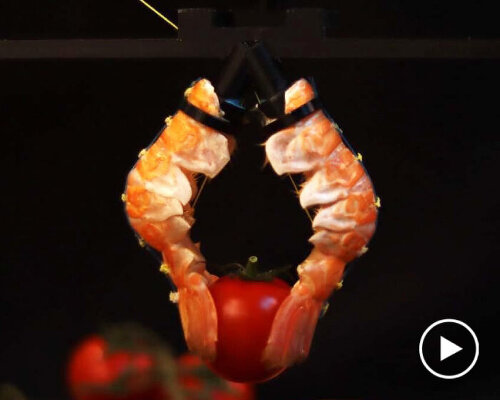
Scientists at EPFL have recycled food waste like shells from langoustines into functional, robotic claw machines that can hold onto objects. In a study by CREATE Lab, the team has tested whether crustacean shells could work better for some robotic tasks instead of the usual metal, plastic, or other synthetic materials. The scientists say that crustacean shells can function well because they are hard and rigid in some places, which gives them strength, and they are also flexible in other places, which allows them to bend. This mix of hard and soft parts lets the animals move fast and with high power in water, the same properties that can be useful for functional machines.
The researchers recycle food waste into machines by taking the langoustine abdomens, the tail sections, and modifying them with synthetic parts. They put an elastic material inside the shell to control how each segment moves. Then they attached the shell to a motorized base, which is a machine that can move and change how stiff or loose the shell becomes. Finally, they covered everything with a silicon coating to make it last longer. This process combines three things: the natural shell for structure, elastic materials for movement control, and the motorized base for power and precision. After the robotic system is used, the shell and the synthetic parts can be taken apart, and most of the synthetic components can be used again for other projects.
all images courtesy of EPFL and CREATE Lab
Robotic grippers made of crustacean shells can pick up objects
The team at EPFL has created three different robotic systems. The first was a manipulator, a robotic arm that could pick up and move objects weighing up to 500 grams. The second was a pair of grippers that could hold and pick up things of different sizes and shapes, from a highlighter pen to a tomato. The third was a swimming robot with two shell fins that could move through water at speeds up to 11 centimeters per second. As seen in the video, the tests show that the recycled food waste can potentially grip objects as functional claw machines. However, the main problem with this method, as the scientists describe in their study, is that natural shells are not exactly the same.
Each langoustine tail has a slightly different shape, and even when the team made two-fingered grippers, one side would bend a little differently than the other side because the shells were not identical. Luckily, the researchers have found a way to solve this, and that is by producing better synthetic parts that can be adjusted and tuned for each shell’s unique shape and properties. So far, the team has tested their method and believes that when they recycle food waste into machines, this could lead to new applications beyond grippers and swimmers, including using them for biological materials in medical implants or systems that monitor biological processes.
scientists at EPFL have recycled food waste like shells from langoustines into robotic claw machines
crustacean shells can function well because they are rigid in some places and flexible in other parts
view of the machine made of recycled food waste
the robotic grippers can hold onto objects that weigh up to 500 grams
an elastic material inside the shell controls how each segment moves
project info:
name: Dead Matter, Living Machines: Repurposing Crustaceans’ Abdomen Exoskeleton for Bio-Hybrid Robots
team: Sareum Kim, Kieran Gilday, Josie Hughes
institutions: CREATE Lab, EPFL | @epflcampus
study: here
The post scientists recycle food waste into robotic claw machines that can grip objects appeared first on designboom | architecture & design magazine.