
studiolowe design reuses denver’s republic tower
Denver’s built environment faces a daunting contradiction presently in 2025: a surplus of empty office high-rises coexisting with an acute deficit of affordable housing. With nearly 40% of downtown office space vacant and a housing deficit of 30,000 units, the need for creative solutions is paramount. The problem, however, is that 90% of underutilized commercial towers are ineligible for easy residential conversion due to deep floorplates that restrict natural light. This is where StudioLowe Design intervenes with its proposition, Well-Ness Affordable Housing, prototyping a systematic approach to convert large commercial high-rises into high-quality housing.
all images and videos courtesy of StudioLowe Design
adaptive reuse of underutilized commercial towers
The conventional solution to adapt deep floorplates — extracting floor area from upper floors to create a central light well — is costly and undermines the goal of increasing housing supply. StudioLowe Design’s Well-Ness Affordable Housing concept offers two innovative solutions, prototyped for Republic Tower, a 134,000-square-foot building that was nearly foreclosed in 2023. It advocates for the excavation of lateral light wells from existing floorplates, complemented by the conversion of all horizontal extensions into mirrored heliostatic surfaces. These strategically distributed, multi-story light wells optimize conditions for residential units, facilitating improved natural light and ventilation while preserving every square foot of rentable space.
a before and after image of the Republic Tower’s Well-ness transformation
The concept aims to reduce costs and increase revenue. Adaptive reuse can decrease construction time by six to twelve months and achieve cost savings of up to 30% compared to new builds. Unlike conventional conversions, the Well-Ness approach preserves the building’s full floor area ratio (FAR), using a moderate 10-foot cantilever to replace floor area extracted for the light wells. Structural costs are minimized by using existing concrete slabs and introducing sustainable, modular mass timber structure to the newly revealed envelopes lining the light wells. The conversion of just the top 30 stories of Republic Tower can yield as many as 780 new one- and two-bedroom dwellings.
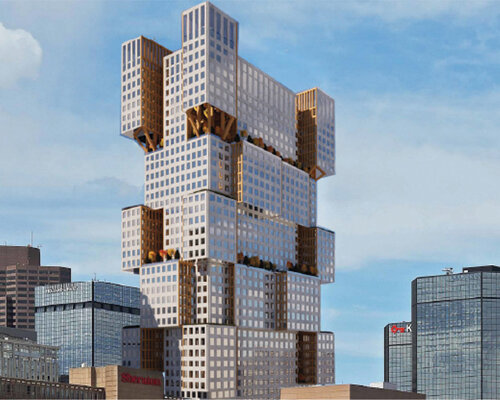
perspective of the transformed facade within the Denver skyline
Beyond the impressive unit count, Well-Ness Affordable Housing corrects the aesthetic pitfalls of previous affordable housing models. It provides an alternative to both the uniform stigma of modernist housing and the ubiquity of the superficially differentiated ‘Lego building’ aesthetic. The modification of the tower, which occurs only along the top 30 stories (where neighboring buildings do not obstruct light), creates functional and formal variation. Each well-ness atrium forms outdoor plazas, providing exceptional communal spaces for residents and transforming a late modernist behemoth into a model of resilient, architecturally distinguished, high-quality affordable housing.
layered outdoor plazas and patios created by the Well-ness transformations
perspective on a sky plaza created by intersecting light wells
a second elevated plaza created by the intersecting Well-ness atria
view looking down into the intersecting lateral light-wells
axon detail of mass timber additions to the floor plate modifications
three sample floor plans
project info:
project name: Well-Ness Affordable Housing
designer: StudioLowe Design
designboom has received this project from our DIY submissions feature, where we welcome our readers to submit their own work for publication. see more project submissions from our readers here.
The post studiolowe design adapts foreclosed denver tower into well-ness affordable housing appeared first on designboom | architecture & design magazine.