
WES ANDERSON recreates joseph CORNELL’S studio in gagosian paris
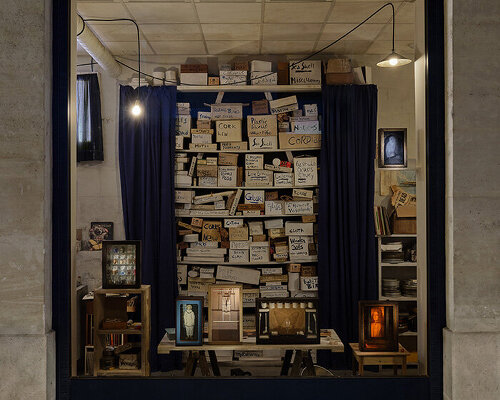
The House on Utopia Parkway: Joseph Cornell’s Studio Re-Created by Wes Anderson transforms Gagosian Paris into a reconstruction of the artist’s Queens basement workspace. Conceived by curator Jasper Sharp in collaboration with the American filmmaker, the exhibition, which runs until March 14th, 2026, marks Cornell’s first solo presentation in Paris in more than forty years, translating his private world of boxes, fragments, and found materials into a life-size environment that sits somewhere between installation, archive, and cinematic set.
Rather than presenting Cornell’s work through a conventional gallery display, the exhibition begins with the space itself. Anderson, working with several longtime collaborators and exhibition designer Cécile Degos, reimagines the modest studio Cornell maintained in his family home on Utopia Parkway, Queens. Shelves of whitewashed boxes, tins, and drawers are filled with more than three hundred objects drawn from the artist’s own collection, including prints, feathers, marbles, maps, toys, shells, and paper scraps, what Cornell once called his ‘spare parts department.’
all images courtesy of Gagosian Paris
COLLECTING, SORTING, AND IMAGINATION TAKE SPATIAL FORM
Joseph Cornell (1903–1972) is often described through negation, as he did not draw, paint, or sculpt and had no formal art education. Yet working almost entirely from this basement studio, and never traveling beyond the United States, he produced one of the most influential bodies of work of the twentieth century. Paris, in particular, occupied a central place in his imagination, accessed through postcards, guidebooks, and conversations with Marcel Duchamp. Dozens of his works reference French poets, architecture, and historical figures, forming a mental geography built from images rather than experience.
Within the reconstructed studio in Gagosian Paris, several of Cornell’s shadow boxes anchor the exhibition. Pharmacy (1943), modeled after an antique apothecary cabinet and once owned by Teeny and Marcel Duchamp, brings together glass bottles filled with paper cuttings, pigments, and found materials. Untitled (Pinturicchio Boy) (c. 1950), from the Medici series, layers reproductions of a Renaissance portrait behind amber-tinted glass alongside maps and wooden toys, while A Dressing Room for Gille (1939) references Watteau’s Pierrot, held just blocks away at the Louvre. Blériot II (c. 1956) looks to early aviation, honoring the French inventor who first crossed the English Channel by plane. Together, these works read less as isolated objects and more as nodes within a wider system of references, obsessions, and quiet rituals.
a reconstruction of the artist’s Queens basement workspace
THE HOUSE ON UTOPIA PARKWAY and the act of assembly
The House on Utopia Parkway also includes loans from the Joseph Cornell Study Center at the Smithsonian American Art Museum, among them unfinished boxes that expose the artist’s working method. These partial works disrupt the sense of preciousness often associated with Cornell, emphasizing instead trial, rearrangement, and contingency. Seen within the recreated studio, they underline how his practice relied as much on patient sorting and revisiting as on moments of poetic resolution.
Visible through the street-facing window of the gallery, the installation turns Gagosian’s storefront into a life-size Cornell box, softly lit from within. The display recalls the hours Cornell spent working late into the night, alone with his materials, while also echoing Anderson’s own interest in constructed worlds and carefully framed interiors.
Cornell’s first solo presentation in Paris in more than forty years
a life-size environment that sits somewhere between installation, archive, and cinematic set
the exhibition begins with the space itself
Joseph Cornell’s studio in the basement of his family home in Queens, New York, 1971 | image © Harry Roseman
Joseph Cornell Pharmacy, 1943 Glass-paned wood cabinet, marbled paper, mirror, glass shelves, and twenty glass bottles containing various paper cuttings (crêpe, tissue, printed engravings, and maps), colored sand, pigment, colored aluminum foil, feathers, paper butterfly wing, dried leaf, glass marble, fibers, driftwood, wood marbles, glass rods, beads, seashells, crystals, stone, wood shavings, sawdust, sulfate, copper, wire, fruit pits, paint, water, and cork, 15 ¼ × 12 × 3⅛ inches (38.7 x 30.5 × 7.9 cm) © 2025 The Joseph and Robert Cornell Memorial Foundation/Licensed by VAGA at Artists Rights Society (ARS), New York. Photo: Dominique Uldry
Joseph Cornell A Dressing Room for Gille, 1939 Paint, printed paper, mirror, cork, cotton thread, textiles, ribbon tape, wire mesh, and glass-paned wood box construction, 15 × 8¾ × 6 % inches (38.1 × 22.2 × 16.8 cm) © 2025 The Joseph and Robert Cornell Memorial Foundation/Licensed by VAGA at Artists Rights Society (ARS), New York. Photo: Owen Conway
Joseph Cornell Untitled (Medici Series, Pinturicchio Boy), c. 1950 Wood, glass, metal, printed paper, and ink in wood and printed paper box construction, 15 ¾ × 12 × 4 inches (40x cm) © 2025 The Joseph and Robert Cornell Memorial Foundation/Licensed by VAGA at Artists Rights Society (ARS), New York. Photo: Owen Conway
Chambre Gothique Moutarde Dijon Pour Aloysius Bertrand ‘Sulphide’, 1950
Joseph Cornell, Flemish Princess, c. 1950, Wood, printed paper, wood balls, cork, and tinted glass-paned wood box construction, 17 3/8 x 10 1/4 x 2 5/8 inches (44.1 x 26 x 6.7 cm), © 2025 The Joseph and Robert Cornell Memorial Foundation/Licensed by VAGA at Artists Rights Society (ARS), New York, Courtesy Michael Rosenfeld Gallery and Gagosian
drawers are filled with more than three hundred objects drawn from the artist’s own collection
Joseph Cornell (1903–1972) is often described through negation
conceived by curator Jasper Sharp in collaboration with Wes Anderson
project info:
name: The House on Utopia Parkway: Joseph Cornell’s Studio Re-Created by Wes Anderson
location: Gagosian Paris | @gagosian, 9 rue de Castiglione, Paris
dates: December 16th, 2025 – March 14th, 2026
designer: Wes Anderson
artist: Joseph Cornell
curator: Jasper Sharp
exhibition design: Cécile Degos
The post wes anderson rebuilds joseph cornell’s legendary studio inside gagosian paris appeared first on designboom | architecture & design magazine.