
PROS:
Rear wheel drive architecture – Traditional chassis balance in an AWD-dominated segment
Cohesive visual identity – Flare Yellow package unifies exterior and interior design
Mechanical limited slip – Torsen differential enhances predictable corner exits
Daily performance tuning – Comfort-biased chassis suits real-world use
CONS:
Fuel economy penalty – Significant consumption costs for daily driving
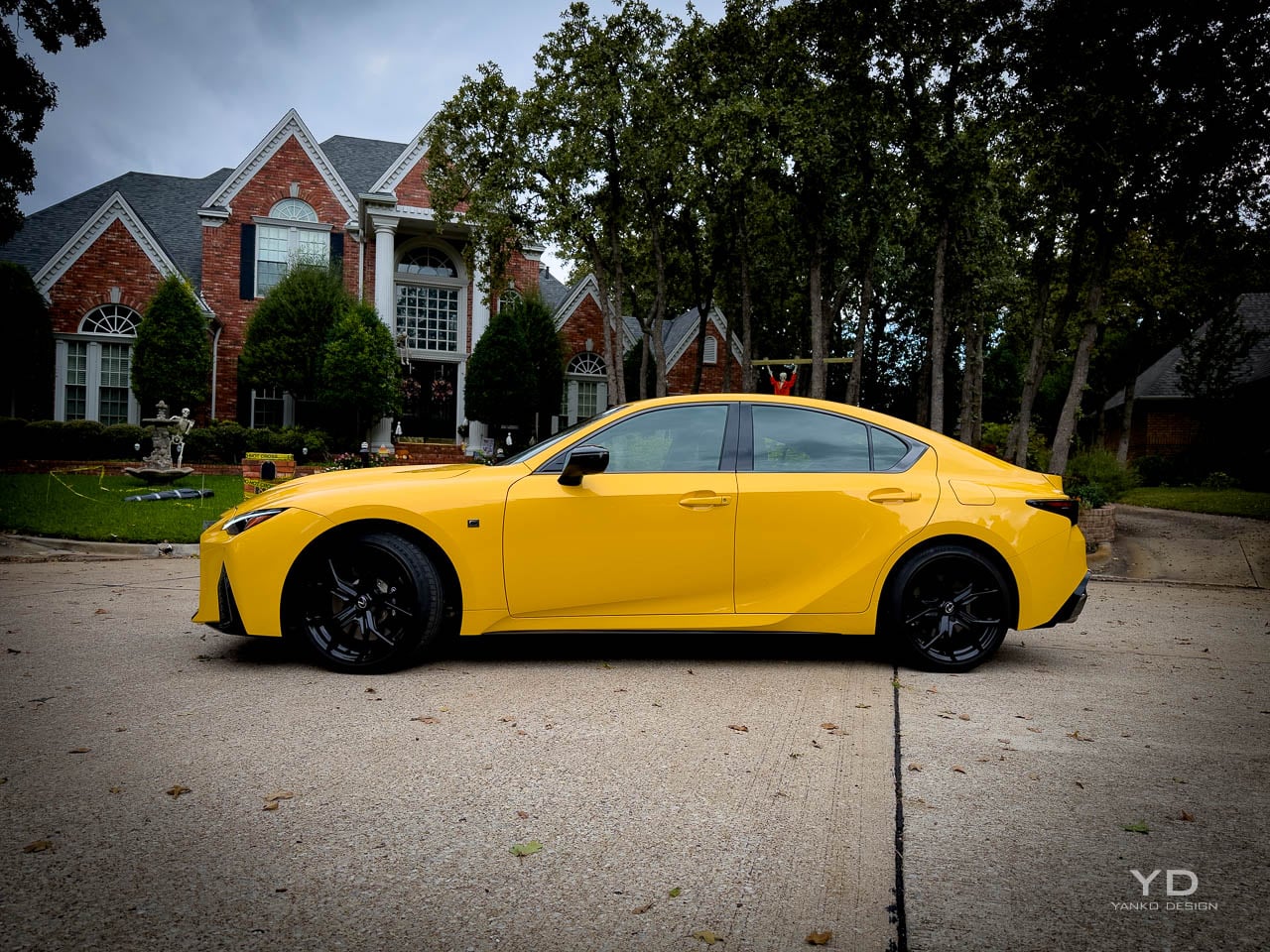
Flare Yellow bodywork catches parking garage fluorescents like a warning flare. Quad exhaust tips broadcast displacement before you turn the key. The 2025 Lexus IS 500 F SPORT Performance Premium arrives unapologetic while most luxury sedans in 2025 spend their energy explaining away downsized engines and turbocharger compromises. In a market segment that has largely abandoned both of those choices, this combination reads less like a product strategy and more like a design philosophy made physical. The sedan occupies a strange position: compact luxury dimensions wrapped around powertrain architecture that most competitors retired years ago. That tension between contemporary shell and analog holdout defines every interaction with the car, from the first ignition cycle to the hundredth highway merge.
Designer: Lexus
Flare Yellow is not simply a paint option here. Lexus positions it as a complete appearance system, bundling 19 inch black forged alloy wheels, Ultrasuede interior inserts with yellow stitching, matching seatbelts, illuminated door sills, and coordinated floor mats. The color becomes a unifying thread that connects exterior surfacing to cabin touchpoints, transforming what could be a single aesthetic choice into an integrated material language. At $4,050 for the package, the investment purchases coherence rather than mere visibility.
Exterior Form Language
Aggression arrives through geometry rather than applied decoration. The spindle grille dominates the frontal view, its lattice pattern creating depth and shadow that shifts with viewing angle and ambient light. Triple beam LED headlamps flank the grille, their layered optical elements suggesting technical complexity even at rest. The overall stance sits low and wide, with wheel arches that fill their openings without the exaggerated flaring that characterizes some performance variants.
Moving rearward, the roofline descends in a continuous arc that terminates at a ducktail spoiler integrated into the trunk lid. Quad exhaust tips emerge from the rear diffuser, their stacked arrangement serving as the primary visual signal of the V8 beneath. The proportion relationship between greenhouse and body mass reads as deliberately compact, the cabin volume compressed relative to the sculptural surfaces surrounding it. This creates the impression of a machine built around its mechanical core rather than a passenger compartment with propulsion attached. The 19 inch wheels and aggressive fender surfacing work to visually manage nearly 4,000 pounds, making the car read lighter and wider than the scales suggest.
Interior Material Hierarchy
Inside, tactile engagement takes priority over digital spectacle. NuLuxe trimmed seats provide the primary contact surface, their bolstering firm enough to communicate sport intent without creating discomfort during extended use. The Ultrasuede inserts in the Flare Yellow package introduce texture variation that catches fingertips differently than the surrounding synthetic leather, establishing a sensory hierarchy across the seating surfaces.
The steering wheel arrives wrapped in leather with a heated element, its rim diameter and grip circumference calibrated for hands that expect direct mechanical feedback. Aluminum pedals replace the standard rubber units, their knurled surfaces providing positive purchase under aggressive inputs. Satin trim accents break up the interior darkness, creating visual rhythm without the reflective distraction of polished chrome.
The Mark Levinson audio system occupies the acoustic environment with authority. Its 17 speakers deliver the kind of spatial imaging that justifies the premium trim designation, filling the cabin with presence that matches the V8’s mechanical drama.
The interface through which that system operates represents the cabin’s most significant temporal artifact. A 10.3 inch touchscreen accepts finger input but also responds to a trackpad controller mounted on the center console, a legacy interface element that creates immediate friction. Reaching for the screen to tap a climate shortcut feels natural until you remember the trackpad exists; defaulting to the trackpad means dragging a cursor across a surface designed for touch. Two design eras compete on the same console, and neither fully wins.
Powertrain as Sensory Design
Numbers tell part of the story: 472 horsepower at 7,100 rpm from a 5.0 liter V8. What matters more is how that power arrives. Natural aspiration means throttle response arrives without the intervention of turbocharger spool, creating a direct relationship between pedal position and acoustic output. The engine announces its presence through a broadband exhaust note that builds intensity with engine speed, the quad tips providing the exit path for a sound that functions as the car’s primary experiential feature.
The sprint to 60 arrives in the mid four second range, figures that place the IS 500 behind several turbocharged competitors on paper. The gap narrows in lived experience because the V8 delivers its power in a linear curve rather than a turbocharged surge, allowing the driver to modulate output with precision that boost dependent systems struggle to match. The eight speed automatic transmission shifts cleanly in sport mode, though it lacks the dual clutch immediacy that defines the segment’s sharper offerings.
Rear wheel drive completes the mechanical architecture, a configuration increasingly rare in this segment where all wheel drive has become the default assumption. The Torsen limited slip differential, a helical gear system that transfers torque mechanically rather than through electronic intervention, manages power distribution to the rear axle. Its purely mechanical operation provides predictable behavior at the adhesion limit, sending power to whichever wheel has grip without the response lag of clutch pack systems. Exiting a tight corner under throttle, the result is smooth, progressive traction rather than the sudden electronic clamp of stability nannies fighting for control. Adaptive suspension and upgraded brakes with enhanced cooling address the chassis requirements of the additional powertrain mass, though these systems tune toward comfort rather than track aggression.
Dynamic Compromise
Nearly 4,000 pounds announces itself the moment the road curves. The IS 500 weighs approximately 3,973 pounds in tested configuration, mass that reveals its presence during direction changes and hard braking. Push beyond street driving limits and understeer arrives predictably, the front tires reaching their grip threshold before the rear can rotate the chassis. The steering provides adequate weight but filters road texture in ways that prioritize refinement over information density. These are characteristics of a car tuned for daily use rather than weekend autocross, a calibration choice that aligns with the comfort of the seats and the isolation of the cabin.
The brake pedal requires calibration of expectations, its initial travel soft before building resistance. This tuning prioritizes smoothness during traffic deceleration but reduces confidence during aggressive threshold braking. Stability control intervention arrives earlier than competitors allow, limiting the exploration of chassis dynamics even when the driver seeks that engagement.
On a fast two lane road at seven tenths, the character clarifies. The V8 pulls cleanly out of corners while the chassis absorbs mid corner bumps that would unsettle lighter, stiffer competitors. Push harder and the front washes wide, but within the envelope of spirited street driving, the balance feels deliberate rather than deficient.
These compromises reflect a deliberate design decision: Lexus tuned for the commute, not the canyon. That calibration disappoints enthusiasts seeking sharper responses but serves the owner who wants to live with a V8 daily. The IS 500 prioritizes living with the V8 rather than extracting its maximum potential, a choice that makes the powertrain accessible across driving contexts rather than demanding specific conditions for enjoyment.
Value Positioning and Market Context
At $69,539 as tested, including destination and the Flare Yellow appearance package, the IS 500 positions itself against both four cylinder luxury sedans and more focused performance machinery. The competitive landscape has shifted around this car: BMW offers turbocharged inline sixes, Mercedes deploys electrified four cylinders, and Alfa Romeo provides sharper dynamics at similar price points. Against this field, the IS 500 competes on differentiation rather than specification superiority.
Fuel economy penalties are explicit and substantial. The EPA rates the powertrain at 17 mpg city, 25 highway, and 20 combined, figures that translate to approximately $3,200 in annual fuel costs. Over five years, that adds roughly $6,500 more than average. Environmental ratings land at 4 out of 10 for both fuel economy and smog, reflecting the consequences of maintaining natural aspiration while competitors optimize for regulatory compliance.
The value proposition depends on what the buyer prioritizes. Powertrain character over lap times. Exhaust note over efficiency. Mechanical simplicity over technological sophistication. For those criteria, the IS 500 delivers experiences its competitors have abandoned. The car exists because Lexus chose to preserve something rather than optimize everything.
Design Intent Realized
As a design object, the IS 500 F SPORT Performance Premium prioritizes a specific experience over balanced capability. The naturally aspirated V8 in rear wheel drive configuration represents a powertrain topology that market forces are eliminating, preserved here in a package refined enough for daily use. Flare Yellow demonstrates how color can function as a design element rather than a decorative choice, unifying interior and exterior into a coherent material statement.
Limitations and character prove inseparable. The weight that softens handling also supports the sound deadening that makes the V8 a companion rather than an assault. The infotainment system that frustrates also maintains the physical controls and clear hierarchy that digital native interfaces have abandoned. Fuel consumption that punishes the wallet finances the displacement that creates the acoustic experience.
Assembled in Tahara, Japan, the IS 500 wears a five star safety rating from NHTSA across all categories. It arrives as a complete product rather than a work in progress. Its design intent is preservation: holding space for a powertrain philosophy while the industry accelerates toward electrification. Whether that intent justifies the compromises depends on what the buyer believes is worth keeping alive. That Flare Yellow paint catching light in a parking garage announces the same thing the V8 announces at redline: this machine refused to apologize. For the driver who values mechanical tactility over interface novelty, the IS 500 answers a question the rest of the segment stopped asking.
The post 2025 Lexus IS 500 F SPORT Performance Review: Designing Space for a V8 in an Electrified World first appeared on Yanko Design.