
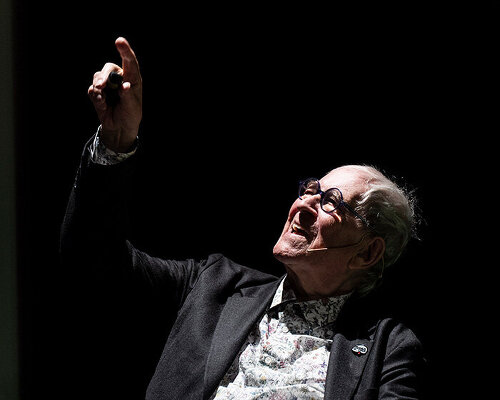
DESIGNBOOM IN CONVERSATION WITH SIR PETER COOK
‘I don’t really agree with the idea of utopianism,’ Sir Peter Cook tells designboom editor-in-chief, Sofia Lekka Angelopoulou, during our live conversation at the stage of the Basque Country International Architecture Biennial, Mugak/2025.
Curated by architect, researcher, and curator María Arana Zubiate, the biennial unfolds under the theme of Castles in the Air, or How to Build Utopia Today, exploring whether visionary thinking still has a place in an age dominated by pragmatism. The legendary architect and co-founder of Archigram participates in the exhibition with two projects – Plug-in City from 1964 and the more recent Filter City – presented as part of the section Escape Utopias alongside New Babylon by Constant, and Exodus and Hyperbuilding by Rem Koolhaas.
Although many of his projects, including the Kunsthaus Museum in Graz, Austria, and the Drawing Studio for Arts University Bournemouth, have been realized, Cook’s most important tool remains drawing. Through fantastical, colorful drawings that express his visionary ideas of what cities could look like, he has influenced and inspired architecture and architectural thinking over the past six decades.
Sir Peter Cook and Sofia Lekka Angelopoulou at the stage of Mugak/2025
from ‘pie-in-the-skY SCHEMES’ to architectural reality
The British architect does not perceive the imaginary visions of his drawings as something separate to what might be buildable. ‘It is usual to say that there is the utopian world, and put a box around it, and then there’s the real world,’ he explains during our conversation. ‘In a lot of architecture schools, the professor will say, don’t look at that, it’s just a utopian idea, it has nothing to do with what can be done. And I think professors are often the worst offenders, because the fact that it might be buildable makes them slightly nervous. What do we tell the kids then?’
‘I don’t think there’s any dividing line. One day, I was chatting in the street with Rem Koolhaas, who used to live near me, and we were going through all the people we remembered at the Architectural Association who had been dismissed, including ourselves, as drawers. Drawing people who made these pie-in-the-sky schemes. And we listed about 20 of them, including ourselves, who had built. But it was very comfortable to say there’s utopia, and then there’s proper building.’
Here, Cook returns to a recurring theme in his thinking, that the distance between speculation and construction is far thinner than most assume.‘Had something like the Kunsthaus Museum in Graz been shown as a drawing, people would say, ah, yes, but it’s not a real building. And then it’s there, you can walk inside it, have a pee inside it, and put an exhibition inside it. It’s a building, like buildings are.
You can say that there are certain parts of it that are very normal, but there is no dividing line. And I still feel that quite vehemently. Just as it amused me to do the drawing that showed the Play Pavilion in London as a piece of Instant City. Because you could have taken that pavilion, put it in the Instant City drawing and say, oh, yes, that’s just a piece of it. I‘m not saying absolutely every drawing is 100% buildable, but it’s a bloody sight more buildable than people like to give it room for. And I think the connection is important.’
Kunsthaus Graz, bird’s-eye view | image Zepp-Cam. 2004/Graz, Austria
DRAWING AS CONTINUUM, NOT ESCAPE
Cook repeatedly returns to the danger of isolating speculative work from architectural practice. ‘If you categorize it as utopian and then declare that this is one thing and that is another, it becomes very, very dangerous,’ he warns. History, he observes, is full of ideas once dismissed as fantasy that eventually materialized. ‘There’s a whole history throughout civilization of things that were dreams that suddenly somebody was surprised by and said, oh, bloody hell, it’s there,’ he adds.
For Cook, the value of speculative work lies precisely in its proximity to reality. ‘Most of the buildings, even the sort of weirder things or imaginative things, have an arrangement of parts,’ he mentions. Whether inserting structures into a hillside or drawing something nearly abstract, he insists he always carries a clear sense of ‘the size of it and how you would access it and what you would make it from.’ His refusal to separate visionary thinking from architectural logic is consistent: ‘There is no dividing line.’
Plug-In City versus Kunsthaus Graz, drawing versus pavilion – for Cook, these are variations of the same continuum. Even projects that appear whimsical are rooted in architectural intent. This attitude extends to how he approaches teaching. He sees drawing as a space for testing architectural thinking. ‘We’re investigators,’ he tells us. ‘And you can investigate with a paintbrush or with a computer or with a measuring rod… we’re still in the doing-it business.’
Kunsthaus Graz, view from the Schlossberg | image Universalmuseum Joanneum/N. Lackner
OPTIMISM, COMPUTATION, AND THE FUTURE
When the conversation shifts to the future and whether optimism is still relevant, Cook’s response is immediate: ‘Oh, absolutely.’ But he is careful to distinguish optimism from naivety. He describes the pandemic as having become ‘a great excuse for gloomers,’ fuelling a culture of resignation he finds unhelpful. Instead, he places his hopes in the emerging generation of computational designers. ‘The people who are doing wonderful things with computational architecture do have the fire in their eyes. They still have the fire in their eyes.’ Geographically, he sees momentum shifting away from Europe. ‘I think the new architecture is coming from the far East,’ he suggests. ‘Not because of cultural ideology, but because they seem not quite so nervous.’
In response to the question about whether his works reflect escapism, Cook resists the idea. ‘There might be, but I would see that as a weakness,’ he replies. For him, these drawings are probes into alternative ways of living. His reflections drift toward the in-between spaces of the urban fabric, suburbs, valley towns, and industrial sheds threading through landscapes. ‘There are many forms of utopia… many forms of the device directed towards a notion,’ he notes.
What fascinates him is how environments stitch themselves together: ‘The notion of how you knit a city interests me tremendously.’ He describes flying over Spain, observing towns splintering into ‘shed, shed, shed,’ and becomes animated about the hidden intelligence within Chinese shophouses: ‘Is it a shop? Is it an industry? Is it family? Is it extended?’ These hybrid conditions, he argues, are not utopias at all but the material of architecture itself: ‘We’re in the let’s-see-how-you-do-it business.’
Filter City (2020s) | ink, color pencil, watercolor on paper, 50 x 50 cm | © Peter Cook
‘LOOK, LOOK, LOOK’: advice for the next generation
Invited to share what guidance he would offer to a younger generation intent on imagining beyond the ordinary, Cook answers without hesitation: ‘Look. I always say look.’ He illustrates the point with an anecdote about a talented AA student designing a bus station from an American reference rather than her own daily commute. ‘Do you remember getting off the bus?’ he had asked her, a question that, for him, exposes how easily designers rely on ‘packaged information’ instead of lived experience.
True understanding, he insists, comes from attentive observation, noticing how ‘the houses on the cliff’ shift into ‘a smart town,’ where ‘the tourists don’t go,’ and ‘where the backyard industry’ hides. ‘It has to do with looking,’ he emphasizes. ‘The keyword is look. Look, look, look. Watch how you get out of the bus if you’re going to design a bus station. Not what it tells you in a manual.’
Listening to Cook, it becomes clear that utopia isn’t elsewhere. It sits in the sketchbook, in the act of looking, in the split second when a drawing becomes a proposition. The future of architecture is all about staying curious enough to keep on drawing.
Sir Peter Cook revolutionized modern architecture with visionary projects
installation view: Peter Cook, Cities, Richard Saltoun Gallery London, 2023 © the artist | image courtesy Richard Saltoun Gallery London and Rome
Plug-in City (1970/2012) | ink, color pencil, watercolor on board, 79 x 164 cm | © Peter Cook
colorful drawings express his visionary ideas of what cities could look like
The Play Pavilion, designed by Peter Cook (Peter Cook Studio Crablab), in collaboration with Serpentine and the LEGO Group © Peter Cook (Peter Cook Studio Crablab) | image by Andy Stagg
Filter City (2020s) | ink, color pencil, watercolor on paper, 50 x 50 cm | © Peter Cook
his vision aligns with the theme of the Mugak/ Biennial
Drawing Studio for Arts University Bournemouth | image courtesy of CRAB Studio
installation view: Peter Cook, Cities, Richard Saltoun Gallery London, 2023 © the artist | image courtesy Richard Saltoun Gallery London and Rome
for Cook, the value of speculative work lies precisely in its proximity to reality
WU Department of Law and Central Administration | image courtesy of CRAB Studio
sir Peter Cook continues to inspire generations of architects
Filter Cities (2023) | VR | © Peter Cook
project info:
name: Designboom in conversation with British architect | @sirpetercookatchap
event: Mugak/ International Architecture Biennial 2025 | @mugakbienal
location: Basque Country, Spain
theme: Castles in the Air, or How to Build Utopia Today
curator: María Arana Zubiate
The post ‘I don’t agree with the idea of utopia’: sir peter cook on optimism and the power of drawing appeared first on designboom | architecture & design magazine.