
inside the curatorial vision shaping noor riyadh
For Noor Riyadh 2025, designboom spoke with curatorial lead Mami Kataoka, and curators Sara Almutlaq and Li Zhenhua to understand how they shaped the fifth edition of the world’s largest light art festival. Their collective vision traced a journey along Riyadh’s metro line, from historical districts to contemporary transit hubs, turning the city into a living canvas where art became accessible to all. Through their perspectives, the theme ‘In the Blink of an Eye’ emerged not only as a reference to light and speed, but also to the city’s rapid transformation and its deeper cultural timelines. The curators describe the festival as a public encounter with memory, imagination, and everyday life, revealing how light can connect communities across generations and geographies.
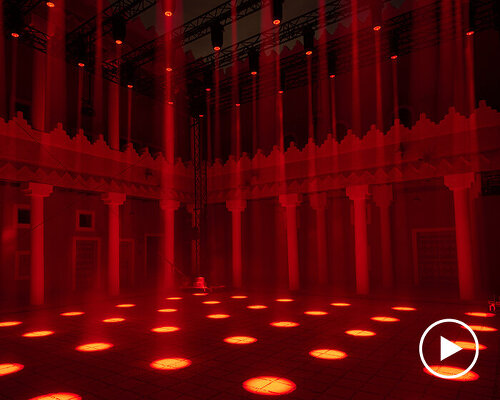
Troppo Fiso! by Traumnovelle | all images courtesy of Noor Riyadh
from historical sites to the most updated metro stations
The curatorial narrative began in Qasr Al Hokm, the birthplace of Riyadh. Here, contemporary artworks responded to centuries-old architecture and textured urban memory, inviting reflection on the city’s origins. The curators approached the site with sensitivity, ensuring that new interventions remained in dialogue with the mud-brick structures rather than competing with them. This opening chapter grounded the festival in Riyadh’s historical depth, offering a counterbalance to its accelerating urban development.‘I think it’s very well interwoven to move through a landscape that spans historical sites to the most updated metro stations. It really shows different ideas of time and different ideas of light, and by bringing artists from different regions, everyone brings a different approach to the concept,’ Mami Kataoka explains, discussing the importance of this layered approach, stating.
Meanwhile, Sara Almutlaq reflects on the emotional tone of this first site, stating that ‘the first site is really the most historic one—it’s the birthplace of the city. It was built in the 1930s and is where King Abdulaziz used to live. In terms of the artworks here, there’s a sense of longing for the past that shapes how people experience the space.’
From a commissioning perspective, Li Zhenhua emphasizes the importance of letting the site lead: ‘We have to think carefully about balance – what kind of artwork belongs in each place. With this location, we visited together as curators and felt it was a beautiful space. We wanted artists to respond with new ideas, because many of the works are new commissions, and the festival proudly includes a lot of them.’
The Vision Grid by Vali Chincisan
‘curation is understanding how people move through each place’
The Noor Riyadh journey continued at the King Abdulaziz Historical Center, home to the National Museum and the country’s archival memory. Positioned between past and future, the site became a space for artworks that explored belonging, record-keeping, and cultural continuity. Here, light operated as a medium that revealed, preserved, and transformed collective narratives. M.Kataoka frames this duality as central to Riyadh’s identity, explaining that, ‘the festival speaks to a fast-growing, developing city like Riyadh and Saudi Arabia, but at the same time there is an ancient history and an ancient sense of time. The coexistence of Islamic time and the Gregorian calendar already creates a duality that people live within every day.’
‘When you hop onto the metro, you move into the future and arrive at the King Abdulaziz Historical Center. Built in the 1980s, it houses the National Museum and is really the archival powerhouse of the nation. The artworks here explore ideas of memory, belonging, and archive,’ says S. Almutlaq, situating the site within the festival’s larger journey. For L. Zhenhua, curation at this stage is deeply tied to spatial awareness: ‘Curation is about understanding each place—how people move through it, how the architecture shapes experience, and what kind of work should be there. It’s about contextualizing the artwork and making sure each piece is thoughtfully situated.’
The Light To Home by Zhang Zengzeng
The final movement unfolded at stc Metro Station, where the festival turned toward Riyadh’s technological horizon. This site showcased works that use drones, projection mapping, kinetic systems, and algorithmic design—immersing visitors in an environment shaped by speed, networks, and digital perception. For the curators, situating art in an active metro hub ensured the festival met people where they are: on commutes, in transition, or moving between daily routines. ‘This light festival, and even the concept of ‘in the blink of an eye,’ is metaphorical. It can be about light, but it can also be about speed,’ describes M. Kataoka. ‘You finally arrive at the stc Metro Station, and it’s really a place where we’re looking at the future through technology. I love this site—it’s very close to me—because it allows you to see technology as an art form, used by a wide range of artists, both local and international,’ adds S. Almutlaq.
L. Zhenhua expands on how the theme translated into lived experience, sharing that for him, ‘In the Blink of an Eye can mean a millisecond, a second, or ten years. We shouldn’t say, “This is art, you have to look at it.” You can close your eyes and still enjoy the moment—feeling the light coming from above, shining on you.”
Le Silence Des Particules by Guillaume Cousin
Across all locations, interactivity became a defining curatorial tool. Many artworks invited people to move, sense, or even shape the installation’s behavior, emphasizing that public art is not something to be looked at from a distance but something to be felt. For the curators, participation strengthened public ownership of the festival and transformed artworks into shared social experiences. ‘There are many interactive works where you can actively engage. It’s not something you’re disconnected from—you can relate to the work, understand it better, and think about how you contribute to change, rather than only watching it happen,’ exclaims M. Kataoka.
Working with heritage sites adds another layer of complexity. S. Almutlaq addresses this tension directly saying that ‘There’s always a balance when working with historical sites. You need to respect the buildings and their history, while still creating space for contemporary artworks. That balance is both the challenge and the strength of working in these locations.’ Meanwhile, L. Zhenhua highlights how technologically driven works can remain deeply human: ‘Even works that appear purely technological often talk about particles, community, and invisible things around us—things that usually go unseen, but are made visible through light.’
Intersections In Light and Sound by Edwin van der Heide
Throughout their conversations with designboom, the curators emphasized that ‘In the Blink of an Eye’ refered not only to immediacy but to long-term transformation. Riyadh is developing at extraordinary speed, yet the festival positions this moment within a broader cultural arc – one that values heritage, time, and collective memory. ‘This is a very interesting moment for Riyadh and Saudi Arabia, with so many new festivals, museums, and artists emerging at once. It’s a good moment to think about where you want to be in ten or twenty years. For me, this is a 10–20 year project.’ Mami Kataoka states. ‘It’s really a movement from the birthplace of the city toward its technological future, following the metro line as a narrative thread,’ says Sara Almutlaq, framing the festival as an urban journey.
‘We can’t stop the fast-changing world and lifestyle, but we should be aware of it. “In the blink of an eye” puts the human back at the center—it’s about choice, awareness, and presence,’ concludes Li Zhenhua, reflecting on the human dimension of rapid change.
Center by Ivana Franke
Keep your Eyes On The Light by Fatima Abdulhadi
Clockwise Invitations by Alex Schweder
Petrichor by Robert Seidel
The Shadow Within by Ziyad Alroqi
Aura_Photo by atelier oï + WonderGlass
Cosmic Birds by Shun Ito
In Light Together by Alexandra Gelis
REDUKTOR by Tonoptik
project info:
name: Noor Riyadh 2025 | @noorriyadhfestival
organization: Riyadh Art
curation: Mami Kataoka, Li Zhenhua, and Sara Almutlaq
dates: 20 November – 6 December, 2025
location: Riyadh, Saudi Arabia
The post how the curatorial team of noor riyadh 2025 turned the city into a journey of light and time appeared first on designboom | architecture & design magazine.