
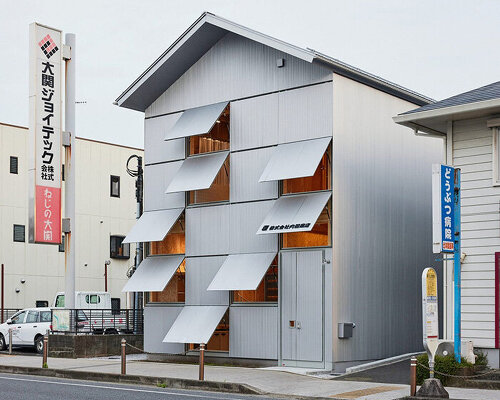
schemata architects reworks the machiya typology in japan
Jo Nagasaka-led Schemata Architects completes the head office for Uchida Shōten, a hardware manufacturer with a 160-year history in Fujisawa City, Kanagawa Prefecture, Japan. The team roots the two-story wooden structure in the spatial logic of the historic town that surrounds it. The site sits along the former Tōkaidō road, once Fujisawa-juku, the sixth post town of the Edo period, where narrow, elongated plots shape a distinctive townhouse culture that still structures the area today.
The building draws from the machiya model, an architectural style of traditional Japanese wooden townhouses, characterized by their narrow, deep layouts, wooden latticework, and integration of living and working spaces. For a manufacturer whose business revolves around building components, the project introduces a disruption to routine, while offering Fujisawa a small but active space for cultural circulation along the old Tōkaidō road.
The structure reflects budget constraints and conceptual clarity. A series of frames forms a single, large box, avoiding expressive formal gestures in favor of flexibility and longevity. Awning windows on the north facade open toward the street, letting light, movement, and the presence of people filter outward.
all images by Ju Yeon Lee
turning a former shopfront into Uchida Shōten head office
Urban memory becomes the main architectural reference of the project. During the Edo period, frontage taxation encouraged minimal street widths and deep plots, which were then subdivided into retail zones to the front, living quarters to the rear, and storage or sleeping spaces above or behind. Uchida Shōten’s previous buildings on both sides of the road followed this logic, with offices or shops facing the street and more private or utilitarian functions tucked away behind. While the initial plan was to renovate the historic main residence across the road, structural deterioration and seismic concerns shifted priorities. The new head office was built first, establishing a contemporary foothold that could continue to anchor activity on the site.
Tokyo-based Schemata Architects respond by reimagining the machiya model for present-day use. The building maintains a similar scale to the former office, as staff numbers remain unchanged, but reorganizes its program to introduce a layer of public and cultural engagement. An artist-in-residence space occupies the front of the building, directly addressing the street, while offices are placed toward the rear. This front space functions daily as the entrance and communal area of the area, but also opens to external users, artists, designers, students, and international creators, for production and exhibition. Behind typically closed shutters, a compact living area known as the ‘nedoko’ (berth) includes basic residential facilities and a generous loft accessed by a spiral staircase, allowing temporary stays on site.
project info:
title: Uchidashoten New Head Office
architects: Jo Nagasaka / Schemata Architects | @schemataarchitects
location: Fujisawa, Kanagawa, Japan
total floor area: 351.07 square meters
project team: Shoichi Sato
photographer: Ju Yeon Lee | @juyeonlee__
The post schemata architects transforms japanese machiya townhouse into flexible workspace appeared first on designboom | architecture & design magazine.