
an Early 1970s-era Beach House on long island
Newly captured photographs reveal a fresh look inside the Norman Jaffe-designed Osofsky House on Long Island, New York. Well-known for his sculptural beach houses, the modernist architect built the home in 1971 along the coast of Shelter Island, a region whose residential edges were once shaped by experimental postwar architecture.
Over the decades, many such houses have been replaced with larger constructions, but during the 1960s and 1970s, Shelter Island offered a different setting. The pace was slower, and architecture avoided ostentatious displays of luxury.
Here is a lasting midcentury modern example — the Osofsky House, designed in 1971 by Norman Jaffe for fashion executive Meyer Osofsky. These newly released photographs accompanying the home’s listing reveal a structure shaped by low horizons, continuous materials, and a sustained attention to how the house meets the coastline.
images © Geir Magnusson / Sotheby’s International Realty
Norman Jaffe’s house of stacked planes
Norman Jaffe’s Osofsky House was commissioned by Meyer Osofsky, whose fashion label Aileen took its name from his wife. The project emerged during a period when Shelter Island supported a quieter form of architectural ambition, visible in modest scale and careful placement rather than display. The house occupies a gently sloping parcel, with living spaces oriented toward water views through bands of glazing.
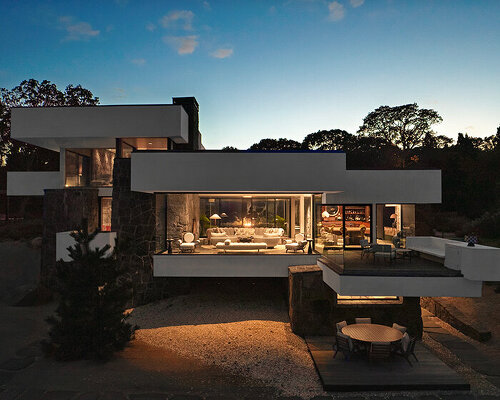
From the exterior, the building presents as a series of stacked planes rather than a single volume. Rooflines remain low and extend outward, tempering light and framing sightlines toward the bay. The approach sequence remains indirect, with entry partially obscured by landscape and structure working together at close range.
Shelter Island’s Osofsky House is a modernist beach home completed in 1971
open interiors of cedar and stone
Inside the Osofsky House, the newly released images reveal Norman Jaffe’s spatial framework organized around wood ceilings, exposed beams, and continuous flooring. The main living area reads as one long room, with a rhythmic structure, rather than partitions, defining the space. This space opens broadly toward the coastline as glass walls slide open toward terraces.
Materials remain consistent across rooms, which include 6 bedrooms, 8 full baths, and 2 half baths. Cedar surfaces extend from exterior to interior, paired with stone flooring that carries through shared spaces. Built-in seating, shelving, and storage appear integrated into the architecture, reducing the need for added furniture and maintaining a measured visual field.
Norman Jaffe designed the house with a low horizontal profile set parallel to the shoreline
Light enters the house laterally through wide openings rather than from above. This produces a steady illumination that shifts across the day without dramatic contrast. Bedrooms and private rooms branch from the main axis, maintaining separation while preserving visual connection to the landscape through carefully placed windows.
Mechanical systems and service spaces remain visually recessed, allowing structure and material to stay legible. Ceiling planes accommodate lighting and ventilation with minimal interruption. New photography shows these elements with unusual openness, offering a clear sense of how the house continues to operate as a working residence.
new photographs offer a rare look inside the house as it enters the market
The house, now listed by Sotheby’s International Realty, comprises 6,715 square feet of interior space, with a fully finished lower level measuring 1,626 square feet. Recent updates were directed by the current owner, a designer by training, with changes handled through a close reading of the original structure. Contemporary finishes, upgraded systems, and shifts in color and pattern register throughout the interiors, reflecting present-day use and maintaining a visual connection to the house’s 1970s origins.
cedar cladding and extended rooflines define the exterior composition
interiors are organized around exposed structure and continuous materials
light enters primarily through wide bands of glazing rather than overhead openings
built-in furnishings remain integrated with the architecture
project info:
name: The Osofsky House
architect: Norman Jaffe
location: 4 Dawn Lane, Shelter Island, New York
photography: © Geir Magnusson / Sotheby’s International Realty
The post take rare look inside norman jaffe’s modernist ‘osofsky house’ on shelter island, NY appeared first on designboom | architecture & design magazine.