
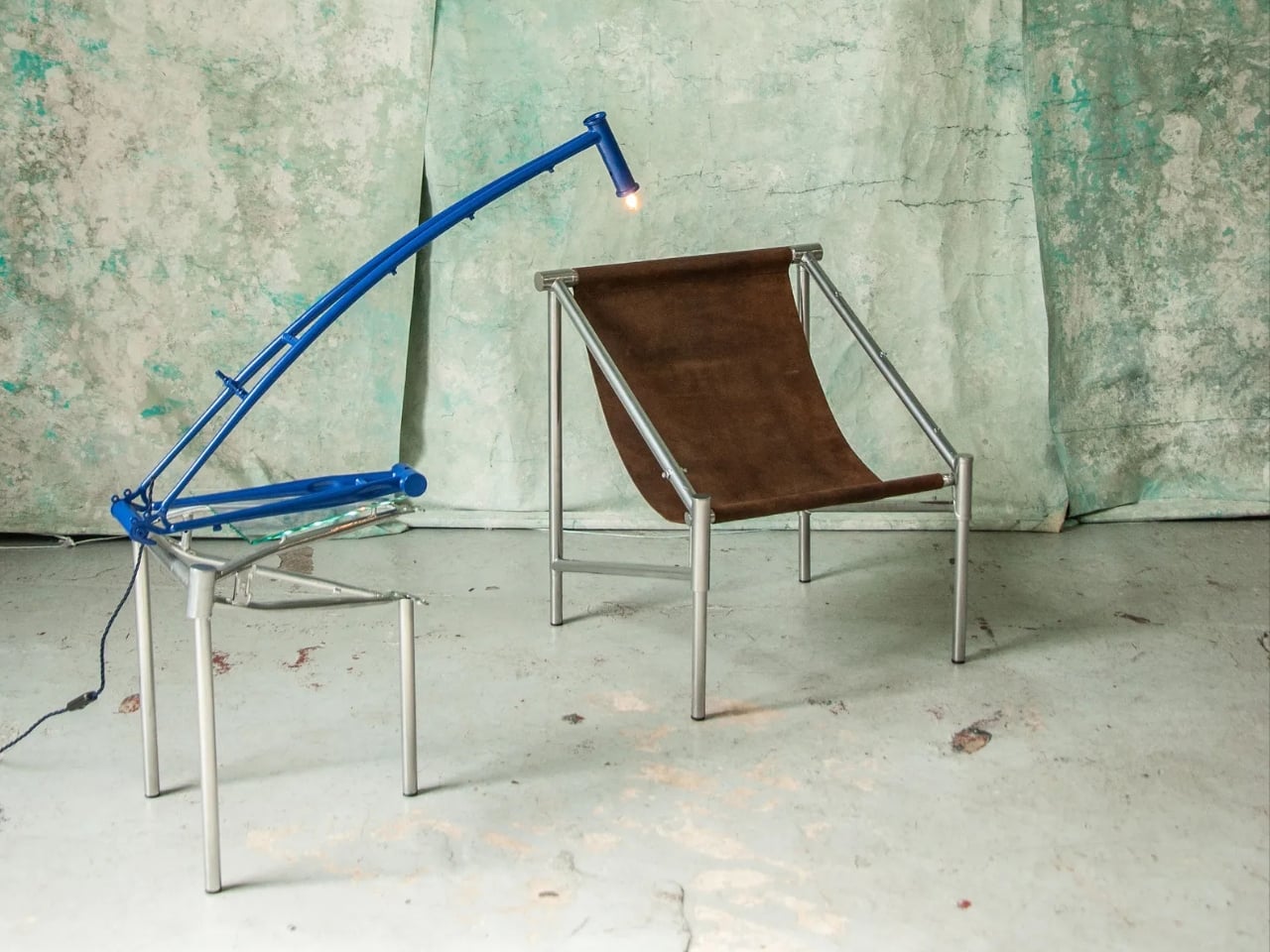
There’s something poetic about seeing a lonely bicycle chained to a pole, slowly rusting away in the rain. Most of us walk past these urban ghosts without a second thought. But Dublin-based designer Cara Campos sees something entirely different: potential.
Her Objects from Frames collection, which has earned her recognition as a Wallpaper* Future Icon for 2026, transforms abandoned bicycle parts into sleek, minimalist furniture that looks like it belongs in a design museum. And honestly? It’s kind of genius.
Designer: Cara Campos
Campos didn’t grow up in Dublin. Raised in Saudi Arabia to a French father and Irish mother, she brings a multicultural perspective to her work that makes it feel both globally conscious and locally grounded. Now based in Ireland, she’s developed a design philosophy rooted in sustainability, adaptability, and what she calls “the lives of objects.” It’s this last bit that makes her work so compelling. She’s not just recycling materials. She’s honoring their stories.
The Objects from Frames collection started, like many great ideas, as a university project. Campos kept noticing abandoned bicycles scattered across different cities, slowly deteriorating, and wondered if she could give them a second act in Dublin. The bicycle, after all, holds a special place in human innovation. American writer William Saroyan once called it “the noblest invention of mankind,” and Campos clearly agrees. Why let such noble machines end their days as scrap metal?
What she’s created is a collection of furniture that feels impossibly light and modern while celebrating the inherent beauty of industrial design. Her Steel Lounge Chair incorporates front triangles from road bikes, transforming the most recognizable part of a bicycle into something you’d want in your living room. There are also table lamps and side tables, each piece maintaining the elegant lines and structural integrity that made bicycles such revolutionary machines in the first place.
But here’s what makes Campos’ approach different from your typical upcycling project. She’s adamant that her work goes beyond simply repurposing discarded materials. As she explains it, the collection “pays homage” to the intangible value these objects carry. Each bicycle frame has history. It carried someone to work, helped a student get to class, maybe even facilitated a first date. That emotional and practical legacy doesn’t disappear just because the bike gets abandoned. Campos captures it, preserves it, and gives it new purpose.
The technical execution is impressive too. Steel is one of the most recyclable materials on the planet. More steel gets recycled annually than aluminum, paper, glass, and plastic combined. It’s a true cradle-to-cradle material, which means it can be recycled infinitely without losing its properties. By working with bicycle frames specifically, Campos taps into structures that were already engineered for strength, lightness, and efficiency. She’s not starting from scratch. She’s remixing existing excellence.
The collection also arrives at a perfect cultural moment. We’re increasingly aware of how much waste our consumption habits generate, and we’re hungry for alternatives that don’t require us to sacrifice style for sustainability. Campos proves you can have both. Her furniture looks contemporary and sophisticated, not like something cobbled together from trash. The clean lines and minimalist aesthetic would fit seamlessly into any modern space, and the origin story only adds to the appeal.
There’s also something refreshingly honest about furniture that wears its past life openly. In an era of mass production and throwaway culture, these pieces stand as quiet rebellion. They celebrate repair, reuse, and reinvention. They ask us to look differently at the objects around us and consider what else might be hiding in plain sight, waiting for transformation. Campos’ work joins a growing movement of designers who see waste not as an endpoint but as a starting point. Her approach reminds us that good design doesn’t always mean creating something entirely new. Sometimes it means recognizing the potential in what already exists and having the vision to set it free.
So next time you pass an abandoned bicycle slowly oxidizing in the weather, maybe you’ll see it differently. Maybe you’ll see a future lamp, a potential chair, a table waiting to happen. That’s the gift of designers like Cara Campos. They don’t just make beautiful things. They change how we see the world.
The post This Designer Turns Abandoned Bikes Into Museum-Worthy Furniture first appeared on Yanko Design.