
a self-built production model for wooden architecture in japan
Studio Cochi Architects establishes its own woodworking studio in Gushichan, rural Okinawa, Japan. The compound combines the firm’s office and a production facility for wooden sashes and fixtures, elements they consider essential to the spatial and tactile quality of their buildings, yet increasingly difficult to source locally with consistent craftsmanship, precision, and timelines.
The compound sits about five minutes from the firm’s former home-office, Tamagusuku House, on a sloping plot surrounded by forest and farmland. The architects chose a steel-frame structure for its openness, speed, and economy, typical of industrial buildings. Construction unfolded in two phases. The workshop came first, followed by the office, whose fittings were fabricated on-site using the newly operational facility. The volumes step along the slope, responding to shallow bedrock conditions and minimizing excavation.
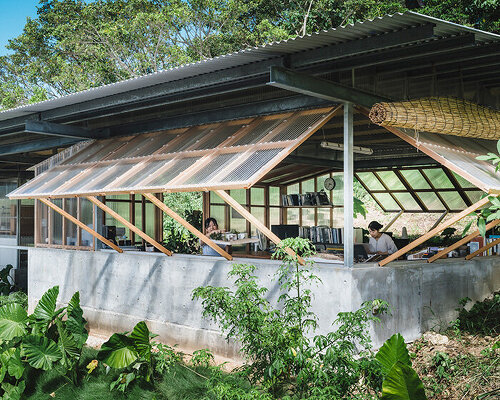
A semi-outdoor garden forms a buffer between the noisy, dusty production zone and the quieter office areas. This intermediary space extends the surrounding forest into the site, creating a gradual transition rather than a hard division. Ventilation plays a critical role throughout the project, since air conditioning is impractical for a woodworking shop. The building is designed to open almost entirely, using a double-skin system made from insect netting and roll-up vinyl sheets, materials commonly found in Okinawan agricultural greenhouses. The system allows air to flow freely while providing protection from sun, rain, and typhoons.
all images courtesy of Studio Cochi Architects
why studio cochi brings wooden production in-house
In Okinawa, reinforced concrete structures paired with standardized aluminum sashes have become the norm. For the Japanese architects at Studio Cochi, however, openings are interfaces between body, climate, and space. They have long specified wooden sashes for their warmth, texture, and capacity to age gracefully. The decision to build their own workshop emerged from the scarcity of skilled woodworkers on the island, along with the lack of continuity between workshops, which made it hard to refine details, build long-term knowledge, or improve designs through iteration.
By internalizing production, the studio now controls the full cycle of design, fabrication, installation, and maintenance, allowing them to test new joinery systems, adjust details based on real-world performance, and respond more flexibly to the schedule of each project. Equally important is the proximity between designers and builders. Drawings and prototypes coexist in the same space, enabling constant dialogue between intent and material reality.
the office–workshop compound is embedded within dense subtropical vegetation
testing materials through use, maintenance, and iteration
Inside the office, simplicity prevails. Sliding doors are fitted directly between steel structural members, and polycarbonate corrugated sheets are used to reduce the weight of the fixtures. Throughout the project, the architects deliberately turned to materials and construction logics from outside conventional architectural practice, particularly agriculture. These everyday techniques, they argue, are often more climatically intelligent than standardized architectural solutions.
Studio in Gushichan is presented as a working prototype. Because the architects themselves will maintain the building, it becomes a testing ground for alternative materials, details, and construction methods. Through this hands-on process, Studio Cochi Architects explores how architecture in Okinawa might evolve by reinterpreting local practices, climates, and labor cultures into new spatial forms.
operable facades allow the building to open almost entirely to the landscape
the porous double-skin envelope allows light and air to pass through
wrapped in a translucent double-skin of insect netting and vinyl sheets
operable wooden panels tilt outward
a continuous roof unifies office and workshop beneath a shared shaded canopy
the semi-outdoor garden weaves between volumes
the garden acts as a spatial hinge between fabrication areas and quieter office spaces
a semi-outdoor workspace opens directly onto the garden buffer
translucent polycarbonate panels and sliding wooden frames define a lightweight interior envelope
maintaining protection from rain and debris
the open-plan office is organized beneath a lightweight steel structure
hinged wooden sashes frame views of the surrounding forest
sliding wooden frames and translucent polycarbonate panels create a layered transition
agricultural building systems inform the envelope
project info:
name: Studio in Gushichan
architect: Studio Cochi Architects | @studiocochiarchitects
location: Gushichan, Okinawa, Japan
The post studio cochi architects wraps okinawa workspace in double-skin of insect netting and vinyl appeared first on designboom | architecture & design magazine.