
A critical yet under-examined children’s book genre is set for the spotlight at the Eric Carle Museum of Picture Book Art from Jan. 17–June 7. CLICK! Photographers Make Picture Books, curated by children’s book historian Leonard Marcus, features more than 90 works from more than 20 rare children’s books dating from the 1890s to now. Artist/authors include George Ancona, Peter Buckley, Nina Crews, Saxton Freymann, Tana Hoban, Marcel Imsand, Susan Kuklin, Roger Mello, Abelardo Morell, Ken Robbins, Shelley Rotner, Charles R. Smith Jr., William Wegman, Walter Wick, Mo Willems, Peng Yi, and Ylla (Camilla Koffler), known for her compelling animal comedies.
“Photographer-illustrators have long trained their camera eye with young people in mind,” says Marcus. “Their inventive, at times magical creations, can be just what children, with their fascination both for real and imaginary worlds, crave.”
Here, Marcus talks more about the importance of photographic literacy and its impact on children … and parents and artists, too.
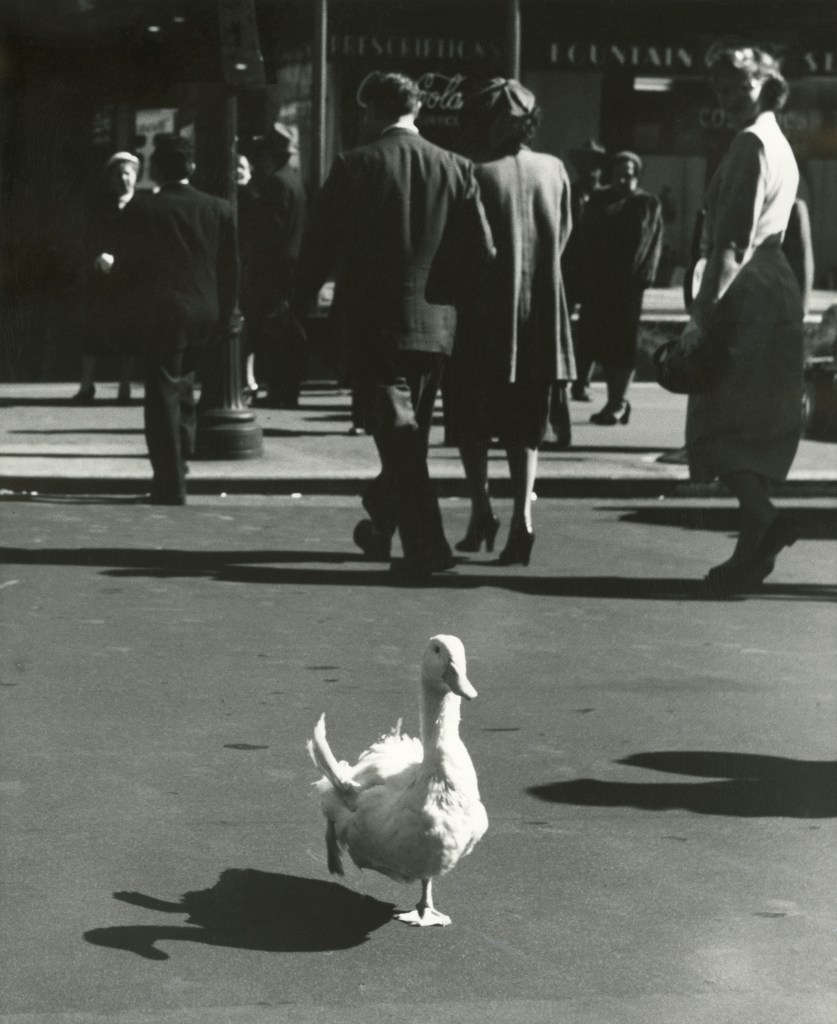
Ylla, for The Duck by Margaret Wise Brown, 1953. Courtesy of the Estate of Camilla ‘Ylla’ Koffler. © Pryor Dodge
Although I’ve owned a few of the books in your exhibition, I don’t usually think of photography as a medium for children’s books. What triggered your concept for this exhibition?
As a child I read almost nothing but nonfiction, mostly biography and history. For reasons probably having to do with what psychologists call “temperament,” it mattered to me if a story was “true,” and I decided early on that photographs were the nonfiction of the visual realm. On through my teens, I collected picture postcards and pored over the weekly issues of Life. During the ’70s and ’80s, after I’d moved to New York and begun piecing together children’s book history for myself, I was fascinated to find out that in 1930 Edward Steichen had illustrated a children’s book, and volunteered to put together a small exhibit about The First Picture Book at the Central Children’s Room of the New York Public Library, which had a few barebones showcases. The best thing was that Steichen’s daughter Mary, who had masterminded the book, was still living in the city at the time, in her new life as Dr. Mary Calderone, pioneering advocate for responsible early sex education. I contacted her, she agreed to lend me a number of photos and other special things for the show, and we became friends. In the years that followed, as I did more and more book reviewing, I always had my eye out for photographically illustrated picture books. Recently, I found a large box full of those books that had I had been keeping in deep storage. So, the Carle exhibition was percolating for years and years.
Roger Mello, for Contradança (Companhia das Letrinhas). Collection of Roger Mello. © 2011 Roger Mello
What is the thesis in organizing this exhibition?
The first photographically illustrated children’s books appeared less than two decades after the invention of photography, which is usually traced to 1839. By 1900, such books were in good supply as holiday gifts—and critical reaction to them had begun to form around the complaint that photographs, being pulled from the world of fact, could not possibly have much to offer children by way of imaginative nourishment. To this day, no photographer has won the Caldecott Medal. Might that mistaken but persistent old notion about the medium help to explain why?
Anyone can take a bad photograph but the images in the remarkable books I have come to know are all the work of some person’s distinctive aesthetic intelligence. To highlight the artistic integrity of the books, I decided to arrange the exhibition—which consists of 97 framed prints by 17 photographers and just over 20 showcased rare books—in three groups, each representing a distinctive use of photography in children’s books. The most obvious use is documentary, for picture book photo essays on themes of likely interest to young readers: the Mexican Day of the Dead, the natural history of the red-eyed tree frog, the life of a very young ballerina. A second use is for “concept books,” which visualize a first childhood lesson or basic concept such as the alphabet, numbers, the idea of up and down or large and small. The third are examples of what I call “photo theater,” for which photos are either staged for the camera in the traditional way or created digitally, sometimes by combining photographic elements with bits of drawing, painting or whatever else. Showing the photographs and books within this framework helps to highlight the photographers’ varied points of view both toward their subjects and the medium itself.
Peter Buckley, illustration for Cesare of Italy: An Around the World Today Book, 1954. Peter Buckley Papers and Photography Collection, Harry Ransom Center, The University of Texas at Austin. © Estate of Peter Buckley
When I stumbled across a copy of Mary Steichen Martin’s My First Picture Book, I was very surprised. It reminded me of books coming from Europe during the Bauhaus period. This was my personal favorite book using photos. What was your first photographic book?
The first photographically illustrated children’s book I knew about was a Little Golden Book that I received as a hand-me-down when I was four or five. It’s called Laddie and the Little Rabbit and is about a brother and sister (something like my sister and me) who had a pet rabbit and springer spaniel to play with at home. My mother would not allow us to have pets, so I really envied those kids! Not only that, I dreamed about them. As I remember it, I literally dreamed my way into the color photographs in the book, physically removed the boy from each scene, and put myself in his place. That’s how much I wanted a dog. Years later, when I saw Buster Keaton’s Sherlock Jr. and watched the projectionist climb inside the onscreen image, I completely understood the impulse
The photographs and text of Laddie were by Willam P. Gottlieb. In 2007, when Random House was about to publish my history of Golden Books, Golden Legacy, I gave a talk for some librarians in which I said that my one regret was not having been able to learn anything about the author of Laddie. Afterward, a librarian in the audience approached me with the news that her best friend was Bill Gottlieb’s widow. A week later, I met Delia Gottlieb, who told me her husband had done the book on a busman’s holiday while working as a performing arts photographer for The Washington Post. His favorite subjects were jazz greats like Billie Holiday and Duke Ellington. The springer spaniel had been the Gottliebs’ own dog; in real life, he answered to the name James Thurber!
Shelley Rotner, for Love Is a Big Feeling (Holiday House). Courtesy of the artist. © 2025 Shelley Rotner
It is interesting to me that Lewis Hine’s famous “Men at Work” photos fill a children’s book. Was this an offshoot of his original documentary work?
Hine by then was already famous for his powerful child labor photos. He was hired to take most of the images in Men at Work—those that document the construction of the Empire State Building—by the Empire State Corporation, which financed the epic project. I don’t know exactly how Men at Work came about, but I do know that Hine had been an assistant teacher at the Ethical Culture School in Manhattan, which belonged to the circle of progressive schools that also included the Bank Street School, where experiential learning was emphasized and the city itself was considered a natural extension of the traditional classroom. Hine’s editor, Louise Seaman Bechtel, headed the juvenile books department at Macmillan, had close ties with Bank Street, and felt a strong commitment to its founder’s idea that children longed to know all about the world they found themselves in, and especially how it worked. So, Men at Work was pure Bank Street—even if today it is mostly remembered as a classic work of documentary photography rather than as children’s nonfiction.
Nina Crews, for The Neighborhood Mother Goose (Greenwillow Books). Courtesy of the artist. © 2004 Nina Crews
How do you define a photographic picture book? Could it be an entity that did not start intentionally for children?
As a child, I thought of Life magazine as a kind of picture book. The late illustrator Jerry Pinkney told me that he did, too. Probably millions of American children felt that way. So, my definition of photographic picture book is a bit open-ended. But having said that, all the books in the Carle Museum exhibition were published expressly with young readers in mind, and there was no shortage of “material.” Photographic illustration won favor in the children’s book world for a variety of reasons. During the Postwar baby boom years, school libraries opened and expanded across the U.S. and photography often seemed well-suited to illustrate non-textbooks designed to bolster school curricula. Authors like Seymour Simon, who specialized in the sciences, and Russell Freedman, who wrote history and biography, began turning to public photo archives such as the Library of Congress and NASA to illustrate their books. As the picture book gradually grew in status as an artform during those years, accomplished photographers were among the artists from virtually every medium who decided it was worth their while to at least dip a toe in the picture book genre.
William Wegman, for Cinderella (Hyperion). Courtesy of the artist. © 1993 William Wegman
I see how William Wegman’s photos for Cinderella are made for children to enjoy. But are there any in the exhibition that had to be twisted to fit the demographic?
Not really, because over the last hundred or so years there have always been at least a few editors working within the children’s book field who recognized the illustrative potential of photography and were game either to pursue tried-and-true projects that came their way (a photo essay, say, about life on a farm, or an ABC featuring animal subjects) or to experiment with someone’s offbeat new idea. Robert Doisneau, Ylla, Jill Krementz, Tana Hoban, Ken Robbins and George Ancona were among the picture-book photographers who had prior experience as editorial or commercial photographers. They all quickly figured out how to recast their work from a child’s perspective, sometimes by placing a child protagonist at the center, other times simply by photographing subjects that a child was most likely to identify with on some level. As photo magazines like Look and Life vanished from the scene, the children’s picture book became a viable alternative for some.
Saxton Freymann, for How Are You Peeling? by Saxton Freymann in association with Joost Elffers (Scholastic). Courtesy of the artist. © 1999 Play With Your Food, LLC
Saxton Freymann’s “Play With Your Food” books, which transformed fruits and veggies into characters, were a big hit when published in the early 2000s. Did anthropomorphic techniques take off in the field in the wake of this?
I think Saxon Freymann has had that specialty all to himself. After all, how could anyone hope to top what he has done? But in a more general way, staged photographic illustration has definitely had a resurgence. A few examples: Abelardo Morell’s photographs for Alice’s Adventures in Wonderland (1998), Here Comes the Garbage Barge by Jonah Winter and Red Nose Studio (2010), and the Brazilian author-artist’s Contradança (2010).
Walter Wick, for I Spy: A Book of Picture Riddles by Jean Marzollo (Scholastic). Courtesy of the artist. © 1992 Walter Wick
Mary Bartlett for Mother Goose of ’93,1893.
During the course of your curation, what did you find that truly surprised you, and why?
One surprise was that almost from the invention of the medium, photographers began looking for clever ways to break out of the default position of simply recording the scene in front of them. The earliest example of this in the Carle Museum show is by a Chicago-based photographer named Mary Bartlett, who exhibited her book at the 1893 World’s Columbian Exposition. For Mother Goose of ’93, Bartlett assembled a mostly child cast of characters, dressed them up in charming, lacey costumes, and posed them in scenes meant to illustrate classic nursery rhymes like “Little Miss Muffet” and “Hush-a-bye, baby.” I think visitors to the exhibition will enjoy seeing this book alongside photographic prints by contemporary artist Nina Crews, from her very different take on the familiar old rhymes in The Neighborhood Mother Goose, which was created digitally in 2003 and set in Brooklyn.
Tana Hoban, Illustration for Exactly the Opposite (Greenwillow). Collection of The University of Southern Mississippi, Special Collections, de Grummond Children’s Literature Collection. © 1990 Tana Hoban
Peng Yi, for Children of the Tsaatan Reindeer Herders (Jieli Publishing House). Collection of Peng Yi. © 2018 Peng Yi
With the advent of AI, do you believe there will be more books done in this manner?
Most likely. But I don’t think that AI-generated images can achieve the same astonishing level of craftmanship that lies behind, say, the “I Spy” photographs by Walter Wick, or the quality of attention with which Tana Hoban infused her photographs of everyday street scenes and children at play. Paradoxically, although photographs are made with the use of a machine, the best photographers have always brought something irreducibly particular of themselves to their work that makes their books and pictures worth a second look and more.
Mo Willems, for Knuffle Bunny Too, A Case of Mistaken Identity (Hyperion). Collection of Mo and Cher Willems. © 2007 Mo Willems
The post The Daily Heller: Looking at Children’s Books From Different Lenses appeared first on PRINT Magazine.