
Rest as Architecture: Translating Sabbath into Built Form
Sabbath as Resistance is a student center proposal for Gordon College in Wenham, Massachusetts, developed by Yena Jung as an architectural exploration of rest as a spatial and cultural condition. The project draws on theological scholarship by Walter Brueggemann, particularly his book Sabbath as Resistance, which frames rest as a countercultural practice that interrupts systems of constant productivity, consumption, and efficiency.
Brueggemann characterizes Sabbath as both resistance and alternative: a disruption of economic and social structures that prioritize output over presence. Within this framework, rest is understood not as leisure or escape, but as a deliberate suspension of continuous labor and performance. The project translates this conceptual position into architectural form, using space, material, and sequence to support moments of pause, reflection, and communal presence.
The design positions art and architecture as practices aligned with Sabbath principles. Like Sabbath, artistic production resists strict quantification and optimization, creating space for contemplation, slowness, and non-instrumental experience. In this context, architecture is treated not as a tool for maximizing efficiency, but as a medium for shaping alternative rhythms of use and occupation.
Gordon College and student center site plan | all images courtesy of Yena Jung
A Campus Retreat Shaped by Collective and Shared Rest
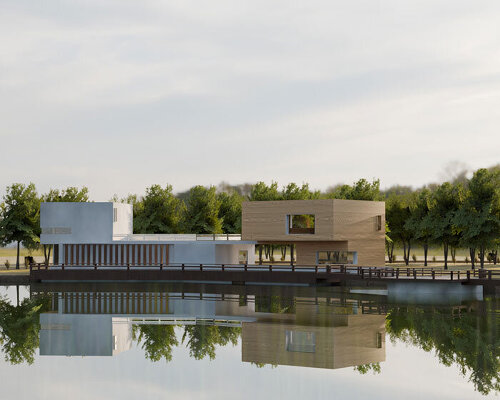
The proposed student center is located near Coy Pond within Gordon College’s wooded campus landscape. The site’s proximity to water, trees, and pedestrian paths informed the project’s emphasis on withdrawal from academic intensity and reorientation toward rest. The building is organized to support both solitary and collective activities, accommodating quiet reflection as well as informal gathering.
Spatially, the project balances enclosed rooms designed for silence and individual recalibration with more open areas intended for shared use and social connection. This duality reflects the understanding of rest as both personal and communal. Material contrasts are used to reinforce these conditions, differentiating spaces intended for retreat from those intended for interaction. The approach to the building is designed as a gradual transition, allowing movement through the landscape to function as a preparatory sequence. The path leading to the center establishes a spatial and psychological shift from productivity-oriented campus routines toward a slower, more reflective mode of engagement.
Overall, Sabbath as Resistance: A Student Center at Gordon College positions architecture as a framework for reconsidering contemporary relationships to work, time, and rest. In a world that profits from exhaustion, for the designer Yena Jung, choosing to rest is a rebellious act, one that allows us to recover presence, intention, and the possibility of genuine human flourishing.
Sabbath as Resistance proposes a student center that frames rest as a spatial condition
space, material, and sequence support moments of pause and reflection
floor plans
rest is framed as a deliberate spatial practice rather than inactivity
project info:
name: Sabbath as Resistance: A Student Center at Gordon College
architect: Yena Jung
location: Wenham, Massachusetts, US
designboom has received this project from our DIY submissions feature, where we welcome our readers to submit their own work for publication. see more project submissions from our readers here.
edited by: christina vergopoulou | designboom
The post student proposal reframes campus life around rest and pause at gordon college appeared first on designboom | architecture & design magazine.