
Pacarizi Studio rethinks the Albanian single-family home
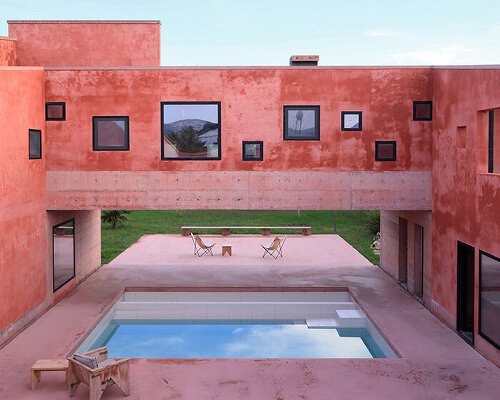
Set within a large agricultural garden in a coastal village near Lezhë, Albania, Red House by Pacarizi Studio explores how a single-family dwelling can respond to changing social structures, climatic conditions, and local building cultures. Designed by Gezim Pacarizi, the 350-square-meter home is organized around an open, partially covered courtyard with a pool at its center. The project approaches domestic architecture as a sequence of perceptual experiences shaped by light, movement, and framing, an idea articulated by the architects themselves. ‘What you see through a window can be a landscape, a tree, or architecture itself,’ they note.
Its basic structure is concrete, while the exterior walls are made of local hollow bricks. Thermal insulation is produced using a mixture of straw, sand, and lime, bound with casein, a milk protein traditionally used in natural building techniques. This same mixture is applied as plaster across the surfaces, with cement replaced entirely by casein. Red iron oxide is added directly into the material, giving the building its distinctive reddish-pink tone. The color becomes part of the material itself, intended to age without the need for repainting.
all images by Gezim Pacarizi
red house is shaped by light, time, and perception
Pacarizi Studio places the courtyard at the heart of the Red House. All major living spaces open toward this central void, transforming it into a living room on warmer days. The courtyard becomes a place for circulation, rest, observation, and gathering, mediating between the home and its surrounding orchard of olive, pomegranate, and orange trees. From here, a grand stair continues the spatial sequence upward to the roof, opening long views toward both the immediate garden and distant landscapes.
Windows reveal fragments of the house, a stair, a wall, another opening. The building becomes its own visual subject, creating layered perspectives that change throughout the day. As light shifts, surfaces deepen or flatten, shadows stretch or dissolve, and reflections appear across water and plaster. Nothing remains visually fixed. The experience of space is defined by this continuous transformation, echoing the Prizren-based architects’ reflection: ‘Nothing is ever the same because light, like water, is constantly changing, you can never bathe in the same water twice.’
wrapped around a square courtyard
Low-tech sustainability through material intelligence
Single-family houses make up more than half of Albania’s building stock. Migration, aging populations, and shifting patterns of work and mobility have redefined how these houses are occupied. Pacarizi Studio positions Red House as a response to this transformation, proposing a domestic architecture that can adapt to fluctuating patterns of use while remaining rooted in local climatic and material realities.
Lime was produced locally, and casein was sourced from nearby farms. Floors are finished in local pinkish marble and wood. The construction process generates almost no waste, relying on simplified detailing and local labor teams. Sustainability here is not framed as a matter of building culture, working with what is available, minimizing dependency on imported systems, and prioritizing long-term durability. Large fixed windows frame views and bring in daylight, while smaller operable openings regulate natural ventilation. Thick walls help stabilize interior temperatures, and the courtyard acts as a climatic buffer, collecting cool air at night and shading the surrounding rooms during the day.
the red-toned exterior volume opens onto the surrounding orchard
a pool acting as the core of the courtyard
a grand stair unfolds along the courtyard edge
the stepped terrace forms a continuous surface that connects the courtyard to the upper level
thick walls and deep reveals create shaded thresholds between interior and exterior spaces
square apertures punctuate the facade
the pool reflects the surrounding volumes
the stepped platform transforms the courtyard into a theatrical, inhabitable landscape
the central stair functions as both circulation and social seating, facing the pool
covered outdoor areas mediate between interior rooms and the agricultural garden beyond
interior circulation unfolds through a series of framed views across the courtyard
living spaces are defined by thick walls, deep window reveals, and filtered daylight
project info:
name: Red House
architect: Pacarizi Studio | @gezimpacarizi_architect
lead architect: Gezim Pacarizi
location: Lezhë, Albania
site area: 2,000 square meters
total gross floor area: 350 square meters
The post square openings punctuate the facade of courtyard-centric red house in albania appeared first on designboom | architecture & design magazine.