
JumpingHouseLab completes playful cat-like retreat in China
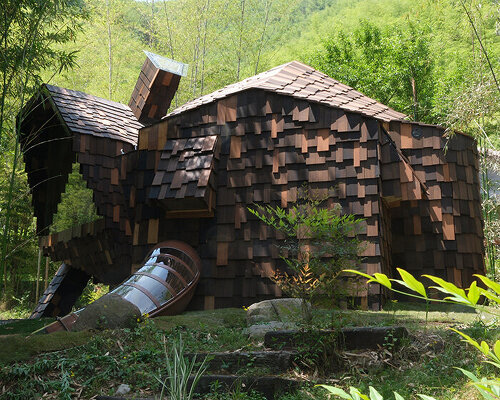
Tucked into a forested campground in Anji, Zhejiang, China, Cat House is a 30-square-meter standalone guest room by JumpingHouseLab. Shaped like a creature stretching toward distant water and mountains, the project transforms a compact accommodation into an experiential micro-architecture, complete with a slide integrated into its ‘tail’ and a raised body that both frames views and preserves privacy. Built as part of a broader effort to upgrade aging tents at the site, the small structure proposes a more durable and engaging way of inhabiting the outdoors. JumpingHouseLab approaches Cat House as something that shifts, bends, and adjusts in relation to its surroundings.
Located in a bamboo-producing region, the architects opt to clad the structure in bamboo tiles. To keep costs low and minimize waste, they reused discarded tiles from a local factory. Initially, a batch of dark, carbonized bamboo suggested a monochrome ‘black cat’ aesthetic. But when supplies ran out, the team mixed in tiles of varying shades, resulting in a mottled, patchwork exterior. What could have been a compromise became a defining feature. The ‘spotted cat’ facade introduces visual texture and unpredictability, qualities that align with the playful intent of the project.
all images by Wang Tiantian, unless stated otherwise
a creature-like response to privacy and landscape
The client’s brief stemmed from a clear problem, as traditional tents offer privacy but often block outward views. JumpingHouseLab responds by lifting the structure slightly off the ground and orienting it toward the most scenic direction, eliminating the need for perimeter walls. In doing so, the Chinese architects began to see the form take on a life of its own, less a static building and more an organism adapting to its environment.
This creature-like posture became the conceptual backbone of the project. The architects describe it as akin to a cat subtly adjusting its body, shifting, stretching, and curling in response to what surrounds it. That metaphor is not applied superficially but embedded into the building’s massing, circulation, and section.
The interior is organized through level changes that mirror the sculpted form of the exterior. These shifts create three distinct zones that include an entry area, a central bedroom-living space, and a raised bathroom oriented toward the view. The entrance contains the most functional elements, including washing and toilet facilities, and connects directly to the slide, concealed behind a cabinet-like door. The middle zone becomes the most cocooned and intimate, while the highest point opens up into a playful bathroom where children can bathe while looking out at the landscape. These transitions are subtle, but they guide movement intuitively, turning a tiny footprint into a layered spatial sequence.
Cat House is a 30-square-meter standalone guest room by JumpingHouseLab
prefabrication as a narrative and strategy
The architects at JumpingHouseLab trace the concept back to a real memory of a white cat named Beibei, who, despite her temperament, could navigate cluttered surfaces without disturbing a single object. Her ability to adapt her posture continuously, soft, precise, and quiet, became a lesson in spatial intelligence. This idea of constant micro-adjustment is translated architecturally into Cat House. The building subtly shifts in height, orientation, and openness, allowing it to fit into the forest rather than dominate it.
To make use of the nearby factory’s leftover materials efficiently, Cat House was split into three segments and prefabricated to 80 percent completion before being transported from Hangzhou to Anji. This logistical decision also shaped the narrative of the building itself, which the architects describe as a long journey, with the ‘cat’ eventually settling into its forest home. This off-site fabrication allowed the team to maintain precision while keeping costs manageable, highlighting how small-scale architecture often requires as much strategic thinking as large projects.
For JumpingHouseLab, Cat House represents more than a playful experiment—it reflects how even the smallest commissions can carry emotional and conceptual depth. Now affectionately renamed Meow House by the client, the structure is meant to be lived with, climbed, slid through, and remembered.
In an era where hospitality architecture often leans toward spectacle or standardization, Cat House proposes something quieter and more intimate: a space that behaves less like a product and more like a companion—curious, adaptable, and gently integrated into its surroundings.
a more durable and engaging way of inhabiting the outdoors | image by Yuanqixiaoshuke
complete with a slide integrated into its ‘tail’ and a raised body that frames views
the team opts to clad the structure in reused discarded bamboo tiles
the team mixed in tiles of varying shades | image by Leo
image by Leo
image by Leo
image by Leo
image by Leo
image by Leo
image by Leo
project info:
name: Cat House
architect: JumpingHouseLab
location: Anji, Zhejiang, China
building area: 30 square meters
lead architects: Wang Tiantian, Luo Yanqin
associate designer: Huang Weiqian
soft furnishing design: Xiaohangkeng × JumpingHouseLab
client: We Flow · Xiaohangkeng Eco-Campsite
construction: Zhejiang Runzhu Technology Co., Ltd. / Hu Jing, Zhou Chungui
on-site coordination: Xiaohangkeng Campsite staff
photographer: Leo, Wang Tiantian, Yuanqixiaoshuke
The post bamboo-clad guest room stretches like a cat toward water and mountains in chinese forest appeared first on designboom | architecture & design magazine.