
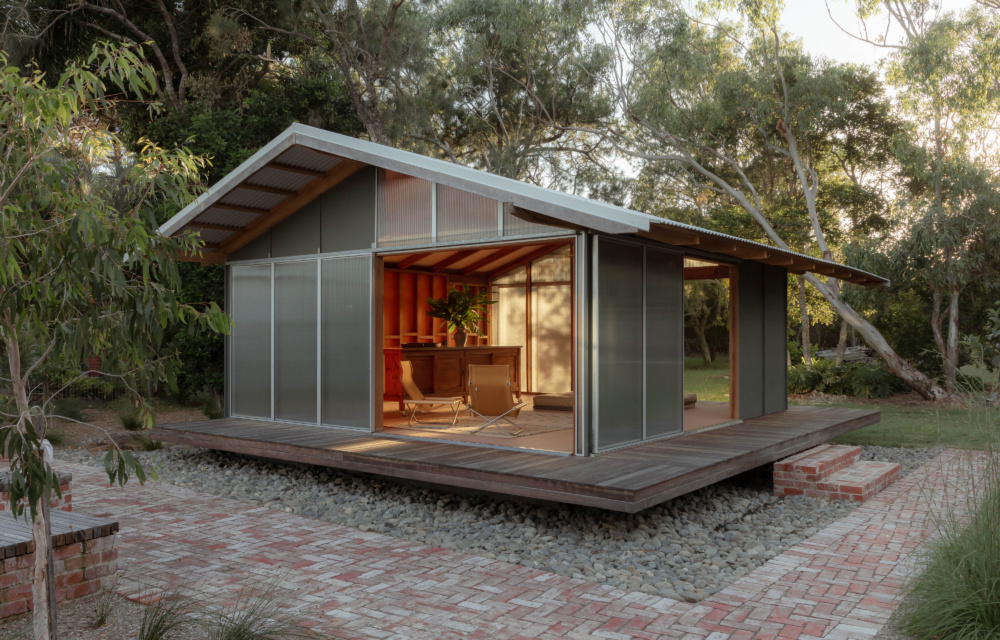
A Garage-Turned-Garden Pavilion In Fingal Head
Interiors
Owner/designers Crick King and Nigel Chouri transformed their garage into a garden pavilion.
The structure was inspired by their time spent in Japan.
The material palette consists of cement sheeting, ironbark, corrugated iron, and stainless steel fixings.
Inside is simple, with tiled floors and an open vaulted ceiling.
The interior is left blank, allowing the space to become what the owners need it to be.
It recedes into the garden, surrounded by native plants.
The main house sits at the front of the property.
The two buildings are separated by a red brick ‘plaza’.
Cal Somni is also available as short-term accommodation.
Tucked quietly behind a modest 1950s coastal house in Fingal Head, NSW, this backyard pavilion feels less like an addition and more like a destination in its own right.
Cal Somni is a holiday home owned by Crick King and Nigel Chouri, used by the pair alongside friends and family, and also available for short-term stays. They purchased the property three years ago and have recently undertaken a careful renovation of the home and garage that resists excess in favour of restraint.
‘We wanted to create a space without a defined use,’ Crick explains. ‘So it could be whatever we wanted it to be — extra bedroom, yoga studio, lounge room, dining room, office, or party space.’
The decision to convert the existing rear garage into a pavilion, rather than extending the house, was both pragmatic and philosophical. Avoiding the need for a development application meant working strictly within the site’s existing footprints and volumes, but it also opened up the possibility of something more generous in spirit — a building free from the expectations of a ‘room’, and instead designed around experience.
Pre-renovation, the house was in poor condition, suffering from water damage, termites, dry rot and a subsiding concrete floor. Yet its simple construction — concrete base, timber stud walls and asbestos sheeting — proved an advantage, allowing Crick and Nigel to dismantle and reassemble the home with relative ease. The original footprint and volume were retained almost entirely, with the only additions being a suspended timber verandah off the bedroom and a properly enclosed laundry.
The pavilion, meanwhile, was designed to sit in dialogue with the house — distinct, but clearly related. This visual connection is achieved through a shared material palette of cement sheeting, ironbark, corrugated iron, tiled floors and stainless steel fixings. Subtle differences, however, preserve each building’s character. The pavilion’s interior is lighter, with exposed structural timber that contrasts gently with the house.
Colour plays a key role, too. Both buildings are clad in varying shades of dark green, allowing them to recede into the growing native garden. Recycled brick paving forms pathways and a central ‘plaza’ between the two structures — a gesture inspired by 20 years living in Spain — while the pavilion’s floating verandah nods to time spent travelling in Japan.
Sustainability is woven quietly throughout the project, with solar panels and a battery installed, and a non-water native coastal garden replacing what was once grass and concrete.
For Crick and Nigel, the greatest success is deeply personal.
‘On a personal level, the most successful part of the project has been the creation of a home that makes us feel content, calm and slow,’ says Nigel. ‘Walking around barefoot, washing off sea salt in the outdoor shower, falling asleep in the pavilion during the day surrounded by trees and the sound of kookaburras.’
Ultimately, the home and pavilion have had an outsized impact — a reminder that less can indeed be more.