
Solidity and Openness Intersect in Casa Ailes by Jaime Guzmán
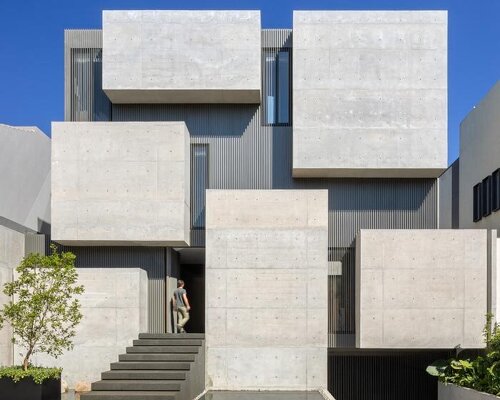
Casa Ailes is a residential project by Jaime Guzmán Creative Group, located in an exclusive gated community in Mexico City. Conceived as a refuge, its proposal stems from the idea of developing a blind facade as an expressive element, defined by six extruded concrete volumes that protrude and shape playful spaces from the void created within. Its design responds to the immediate context with a dual strategy: a hermetic facade facing the street that ensures privacy, and a controlled openness toward the garden and city views. As a result, the architectural composition is characterized by the contrast between solidity and lightness, both in the spatial distribution and in the application of materials. At the main entrance, a reflecting pool frames the access and mirrors the concrete volumetry, creating a visual effect that accentuates the geometry.
all images by Rafael Gamo
Central Patio and Vertical Circulation Organize interior layout
The design process of Jaime Guzmán Creative Group begins with a methodological analysis of the client’s activities and needs, allowing the development of creative and specific solutions for each project. In the case of Ailes, the clients requested open, interconnected social spaces, as well as a gathering area completely independent from the private zones, where their teenage daughters could meet freely. To address this need, a basement was designed to house a speakeasy with direct street access, allowing guests to enter independently without interfering with family dynamics. This level also includes a large parking area and service spaces, whose distribution responds to the structure of the upper floors. Upon entering the ground floor, one arrives at a vestibule covered by smoked-glass bridges that connect the upper levels and reinforce a sense of vertical spaciousness. The horizontal connection follows a similar principle, with a series of social spaces intertwined around a central patio that acts as the organizing axis of the house, ensuring a balanced distribution of natural light and cross-ventilation. In this patio, which is positioned half a level above the living room, a vertical concrete block houses an elevator, integrated into the design to guarantee that the parents, now in their fifties, can comfortably inhabit the home for years to come. A corridor connects the entrance to the garden through subtle level changes, articulating the ground floor with vertical circulations and distributing access to the office, family room, living area, and kitchen. Wide-opening glazing dissolves the boundaries between indoors and outdoors, constantly integrating the social areas with the open-air space. The living room relates both to the central patio and the main terrace, the latter open to the garden and sheltered from Mexico City’s climate by a large concrete cantilever.
On the upper level, this element houses the master bedroom and is resolved with concrete wall-beams, a structural solution that ensures stability and formal continuity. The landscaping is carefully integrated, with vegetation framing access points and terraces, providing natural shade, improving air quality, and generating a sense of respite within the city. Access to the second floor is through a solid block of stairs clad in marble on both floor and ceiling, leading to the glass bridges supported by a steel structure. At the northwest end, the younger daughter’s room takes advantage of the extruded volume of the main facade to integrate storage spaces, bookshelves, and resting areas, while at the southwest end, the master bedroom opens onto the garden, featuring a large walk-in closet and a bathroom that allows exterior views from a ceramic bathtub. This level also includes a laundry room for the management of linens and clothing, optimizing household operations. The third floor functions as an independent apartment within the house, providing the eldest daughter with the degree of autonomy her parents envisioned. It is accessed via a staircase that, as it rises, brings in natural light and frames the western cityscape. The eldest daughter’s room is located on the main facade, while on the opposite end is the main family room, with access to a terrace surrounded by vegetation that offers a panoramic view. This space incorporates a steel lattice with a folding screen system, designed to flexibly modulate privacy, light, and temperature. Its mechanism allows it to be fully opened or closed, adapting to the desired interior atmosphere. The materials used in the project emphasize the contrasts of the architectural concept through a sober and timeless palette that conveys balance, modernity, luxury, and comfort.
Jaime Guzmán’s Holistic Approach to Material and Comfort
Exposed concrete dominates Casa Ailes, providing a rough yet expressive texture with a uniform tone in both interiors and exteriors, one of the project’s main challenges. This cold material contrasts with the warmth of wood applied to floors and ceilings, creating a homely feel. Steel forms part of the structural system and is integrated into interior details, contributing solidity while also imparting a sense of lightness and precision in visible elements. The interior design, led by Mariana Rivera, complements the architecture with a precise selection of furniture and art. Pieces by Mexican and Italian designers were incorporated, achieving a coherent chromatic and material balance. A central piece stands out in the living room: a Japanese kimono intervened with gold paint on a lead canvas by artist Mayte Guzmán. Beyond its artistic value, this work reinforces the zen and wabi-sabi influence in the home’s aesthetic.
Jaime Guzmán Creative Group’s Casa Ailes integrates advanced systems of energy efficiency and sustainability. Hydronic heating ensures an optimal indoor climate without drying the environment, while a smart home system allows lighting and entertainment to be controlled from mobile devices, simplifying the management of comfort. The residence also includes a rainwater harvesting system for reuse in reflecting pools, irrigation, and car washing, along with solar panels that help reduce electricity consumption, moving the house closer to energy self-sufficiency. These systems improve the home’s energy performance and reflect both the clients’ and the studio’s commitment to sustainability and environmental respect. Casa Ailes is a testament to the holistic design approach of Jaime Guzmán Creative Group, resulting in a work that transcends its residential function. The quality of its spaces, the meticulous attention to material transitions, and its profound connection to the lifestyle of its inhabitants make this residence a carefully executed architectural work, one that reflects a design philosophy valuing harmony with the environment and the well-being of its users.
project info:
name: Casa Ailes
architect: Jaime Guzmán Creative Group | @arq.jaimeguzman
location: Mexico City, Mexico
photographer: Rafael Gamo | @rafael_gamo
designboom has received this project from our DIY submissions feature, where we welcome our readers to submit their own work for publication. see more project submissions from our readers here.
edited by: christina vergopoulou | designboom
The post six extruded concrete volumes sculpt brutalist villa’s facade in mexico city appeared first on designboom | architecture & design magazine.