
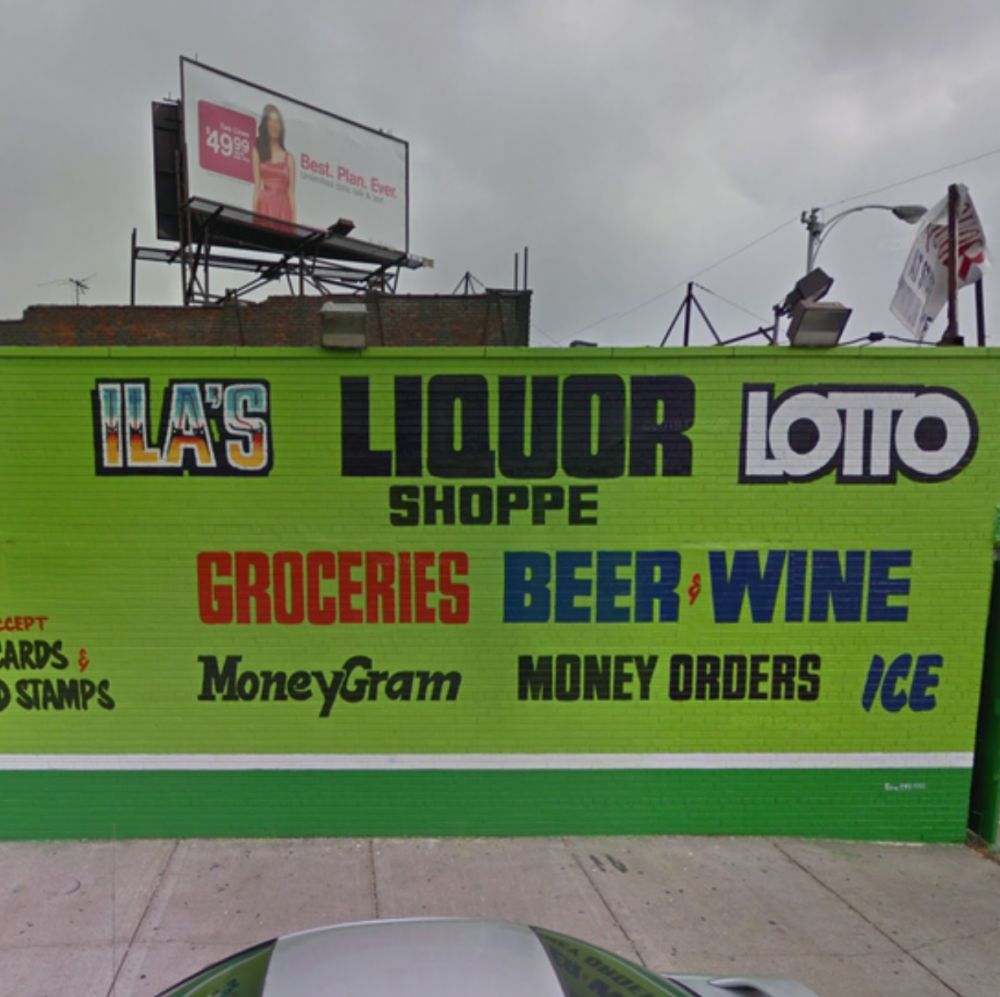
You just never know what you’re going to find when putzing around on Google Street View. Memphis-based film photographer Andrew Anderson uses the tool for site scouting, but sometimes he gets pulled down rabbit holes into directions and to places he didn’t expect. One such instance came last year when he was perusing Detroit, and first came upon the unmistakable work of the local sign painter there who goes by Ron Signs.
Not knowing who exactly was responsible for these signs at first, Anderson began taking screenshots of them, incidentally starting somewhat of an archive. In time, he identified the artist as Ron Miller, and put his collection of about 250 Google Street View screenshots of his signs dating back to 2009 on his website. He also created a virtual Ron Signs map plotting out all of them throughout the city, and published a Twitter thread to share his findings that began to amass attention around Detroit and beyond.
After the project when somewhat viral, even people like me all the way out in Los Angeles discovered Anderson’s Ron Signs archive and got exposure to the Detroit legend’s work. Obviously I needed to learn more, and was able to speak to Anderson directly about his process. Our conversation is below, edited lightly for clarity and length.
When and how did you first discover Ron Miller’s work, and what was it about his signs that captivated you so much?
I started the Ron Signs project in mid-2025. For my photography practice, I use Google Maps for location scouting with Google Street View to see what different areas and towns look like so I know what I’m getting myself into. But I also like to use Google Street View to check out what’s going on in a different part of the country or a different part of the world. Since I’m originally from Ann Arbor, Michigan, outside of Detroit, I like using Google Street View to see changes to Detroit from the earliest legible photos that go back to around 2009.
I have an appreciation for vernacular art and vernacular sign painting, especially murals in places where you wouldn’t think murals would be. I like finding that stuff, so I kept collecting these screenshots from the major boulevards and streets around Detroit comparing 2009 to the present day, and I kept seeing all of these signs that looked to be made by the same person. Ron’s style is definitely identifiable— the chrome lettering, the block letters, he has his own typology. His A’s all look the same, his number 7’s all look the same. In the back of my head I was thinking it’d be interesting to know who painted all of these. Then I found a tire place that’s no longer there with a painting of Obama on it and the Detroit skyline wrapped around the side. It had everything that Ron’s work has, right down to the chrome lettering, paintings of people’s faces, a car tire with a big rim on it. Then below Obama’s head it said, “Ron” and Ron’s phone number.
I did some sleuthing online and found an Instagram post from this guy named Jordan Zielke, a sign painter in Detroit who goes by Motown Sign Co., who was a mentee of Ron’s. So I finally had a face to the name of this guy who’s done all of this amazing stuff.
I decided to call the number of Ron’s that I’d found, and Ron picked up! I talked to him very briefly, it was probably about a five to ten-minute phone call. He said he’s from Detroit, he briefly went to the University of Michigan, and he started sign painting in around 1978. At that point I had already put together this Twitter thread laying everything out, and then it really blew up. I had people from the Detroit News and the Detroit Free Press wanting to talk to me, I did an interview with Michigan Public Radio. Everybody was reaching out to me wanting to talk to Ron so I became Ron’s publicist there for a couple of weeks, but I didn’t want to give out Ron’s number. He doesn’t have an email address, he doesn’t have a website. He operates by word of mouth and he’s got his van that has his number on it that he drives around Detroit.
Do you and Ron still chat? Is he still working? Do you know what he’s up to now?
I haven’t talked to Ron since probably October, but we were talking every day when the Twitter thread first blew up. Some time in late 2024 he broke his leg after falling off of a ladder while he was painting. He has apprentices that work with him so he has them up on the ladders. So recently he’s been mostly airbrushing on the side of cars and T-shirts. He’s had tons of apprentices over the years, and he was seemingly an apprentice too for this group of Black Detroit sign painters. He sent me all of these photos from his archive from this barbecue of Black Detroit sign painters they had every year, pictures from his snapshot camera going back into the 80s and 90s of stuff around Detroit that’s no longer there. Part of the reason I’m going back to 2009 in Google Street View is because a lot of these buildings have either been painted over or torn down. I’m not an archivist or anything, but I think Ron’s work is so unique and so definitive of Detroit visual culture, but nobody has ever written anything on him. So that’s also what made me want to dig into this project and devote so much time to it.
In mid-August when I posted the Twitter thread originally, business owners in Detroit began reaching out to me, asking to hire Ron to do stuff on the inside of their businesses, on the outside, tons of stuff. So I think he’s taken advantage of that. The buzz helped in getting his name out there and helped get him more work after he fell off of his ladder.
What is it specifically about Ron’s painting style that you is so intriguing to you and so many others?
Everything he did is so varied. Not just numbers and letters and his chrome styling, but he painted car parts, painted people’s faces, painted food. He is clearly an incredibly talented guy, and I couldn’t believe there was no writing about him. I couldn’t believe that a writer in Detroit, someone for the Detroit Free Press or the Detroit News had never done a story on him. Even looking back on newspapers.com I couldn’t find anything on Ron.
Since this project has taken off have you traveled to Detroit to meet Ron or see his work in person yet?
I want to very, very badly. I was back in Michigan for Thanksgiving and I was going to try to go into Detroit one day, but it did’t work out (I’ve got an eight-month-old son!). But next time I go back to Detroit I want to give Ron a heads up, grab him lunch, and then take some photos. I just need to find the time, it keeps slipping away from me!
Do you see a next chapter for your Ron Signs project? I know you’ve already amassed around 250 screenshots from Google Street View, do you have any ambitions to convert this collection into a book, for example?
Right now I’m pleased where it is. I invested a lot of time into this project in a short amount of time. I have a kind of obsessive thing where I get really into something, and then go all in. This was hours and hours and hours of going down Gratiot Ave. and Seven Mile and Six Mile, and Eight Mile from 2009. And got to talk to Ron! But I would definitely love to, one, meet Ron in person, finally, and two, I’d love to take some photos of his work myself.
I feel a bit uncomfortably myself publishing any book of this project because it’s Ron’s work, even though I would be taking photos of it. A lot of his work his gone already, permanently, like I said. Easily around 50% of those images from Google Street View is of work that is no longer there. So a book would be incomplete with current day 2026 photography. But Ron has his own archive of photos, and he told me that he’s interested in doing a larger book of Black Detroit sign painters. He doesn’t just have an archive of his own work, he’s got all the guys that he did the yearly barbecue with and that apprenticed under him, and that he apprenticed under, so he’s got a huge archive. If it’s his desire, I want Ron to fulfill putting together a book of that work, and if I can be of any help in any way, I would love it. But it’s Ron’s work, so I want him to be the who decides what gets to happen with it.
What I hope is that my work here is the first step in getting his work more widely known in an archival or book form. Something a bit more steady than Google Street View images on some guy’s website.
The post Andrew Anderson Has Compiled an Online Archive of the Detroit Legend Ron Signs appeared first on PRINT Magazine.