
A Mobile Cultural Pavilion Informed by Bogotá’s River Systems
La Memoria del Río is a modular cultural pavilion developed as a reversible urban infrastructure for the city of Bogotá, Colombia. Designed by Alsar-Atelier in collaboration with SDRD, the project draws conceptual and formal references from Bogotá’s river systems, proposing a flexible architectural framework capable of supporting cultural activity without permanently altering its surroundings. The pavilion is conceived to appear and disappear across different urban contexts, establishing a decentralized model for public cultural space.
Positioned between public art and ephemeral architecture, the project operates as a temporary structure intended to reactivate underused urban sites through cultural programming. Commissioned by the Secretaría Distrital de Recreación y Deporte (SDRD), the initiative promotes temporary intervention as a strategy to distribute cultural activities across multiple neighborhoods rather than concentrating them in fixed locations. This approach allows the pavilion to be deployed repeatedly in diverse areas of the city, adapting to local conditions while maintaining a consistent architectural identity.
The conceptual framework is informed by Bogotá’s hydrological systems, particularly its rivers, which originate in the eastern mountain range and traverse varied topographies before reaching the savanna. These systems are understood as dynamic, adaptive infrastructures shaped by time, movement, and context. This understanding translates into a modular roof structure characterized by flexibility, expandability, and fluid formal expression. Rather than reproducing literal representations, the design abstracts the spatial and phenomenological qualities of water and flow.
La Memoria del Río Pavilion | all images courtesy of Alsar-Atelier
A Reversible Modular Unit that responds to wind and light
Based on these principles, the design team, formed by El Líder S.A.S., INGEACERO, and Alsar-Atelier, developed a modular unit measuring 6 meters in length, 8 meters in width, and 5 meters in height. The module features a vaulted elevation and unidirectional expandability, allowing it to be combined or subdivided depending on site requirements. The construction system relies entirely on dry connections, enabling rapid assembly and disassembly without permanent foundations. This allows installation in a wide range of urban settings, including streets, plazas, sports courts, and heritage areas, without causing irreversible impact.
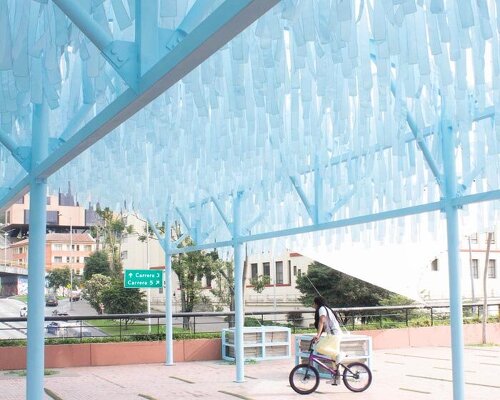
The interior atmosphere further reinforces the project’s conceptual basis through an abstract interpretation of water movement. Suspended beneath a transparent polycarbonate roof, approximately 15,000 blue fabric fragments are distributed across the ceiling. Their motion, activated by wind, creates shifting patterns of light, shadow, and transparency that recall the behavior of flowing water. This element establishes a spatial experience that changes continuously with environmental conditions, reinforcing the pavilion’s temporary and responsive nature.
La Memoria del Río is a modular cultural pavilion designed as reversible urban infrastructure in Bogotá
Temporary Architecture as a Tool for Urban Cultural Exchange
Parque Bicentenario, located between Parque de la Independencia and the Museo de Arte Moderno de Bogotá and designed by Giancarlo Mazzanti, served as the project’s initial site and testing ground. The pavilion adapts to the park’s variable topography and lack of a rigid spatial order, responding to the site in a manner comparable to how a river occupies a valley. Constructed over a four-week period, the structure has hosted a range of cultural events, including gastronomic festivals, circus performances, and theatrical and artistic programs.
During the first half of 2026, La Memoria del Río will remain at this initial location before being redeployed across different areas of Bogotá. Through its modularity, reversibility, and mobility, the project establishes a repeatable cultural infrastructure that operates at an urban scale. Rather than functioning as a permanent building, La Memoria del Río positions architecture as a temporary spatial device, one that facilitates cultural exchange while referencing the city’s overlooked natural systems through form, material, and spatial experience.
the pavilion is conceived to appear and disappear across different urban contexts
the design draws formal and conceptual references from Bogotá’s river systems
rivers dynamics inform the pavilion’s flexible and expandable roof structure
vaulted geometry allows unidirectional expansion and subdivision
the pavilion by Alsar-Atelier supports cultural programming without permanent site alteration
the project operates between public art and ephemeral architecture
approximately 15,000 blue fabric fragments are suspended beneath the roof
the installation creates an abstract spatial interpretation of flowing water
construction
project info:
name: La Memoria del Rio
architect: Alsar-Atelier | @alsar_atelier, SDRD
location: Bogotá, Colombia
models and diagrams: Sebastian Pineda | @sebaspinedah
designboom has received this project from our DIY submissions feature, where we welcome our readers to submit their own work for publication. see more project submissions from our readers here.
edited by: christina vergopoulou | designboom
The post blue fabric fragments dance with the wind on modular cultural pavilion in colombia appeared first on designboom | architecture & design magazine.