
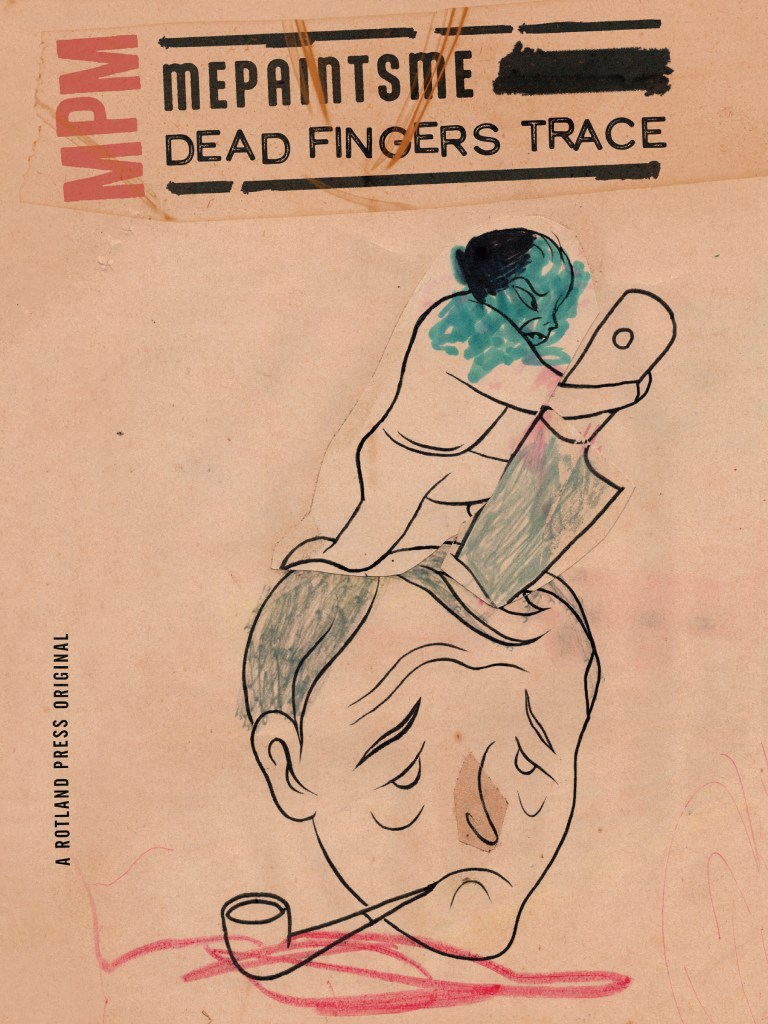
DEAD FINGERS TRACE—an unnerving monograph of anxiety-infused drawings and collages by an artist who goes by the name MEPAINTSME—has just been released by the Detroit indie Rotland Press. The anonymous “MEPAINTSME” handle is also the eponymous title of their virtual contemporary art platform founded in 2022 to sell works on paper steeped in the visual textures of Midcentury printed matter and injected with anxiety and horror. “These drawings elicit an aura of mortal fragility with every bit of folding, foxing, staining, tearing and yellowing within them,” says Ryan Standfest, Rotland’s publisher/editor. An essay by artist and psychiatrist Martin Wilner and an in-depth interview with MEPAINTSME addresses the rationale (or ir-rationale) of what is contained therein. For preordering the 92-page full-color volume before Feb. 14, customers recieve VATIS SPECIES, a 20-page chapbook that collects a series of meticulously drawn portraits—a grouping of ghosts from a bygone era created on antique notebook papers, book covers and stamp-saver booklets.
I asked Standfest to shed some light on MEPAINTSME and why, after four years of not publishing anything, Rotland decided to reenter the market of image and ideas with this l’art brut colection.
Rotland’s publishing schedule is irregular. What prompted you to publish this now?
After 15 years of publishing, I’ve slowed down a bit, nurturing projects over a longer stretch of time. As the editor, I balance my time between being an active artist and a professor of art at Oakland University (in a suburb of Detroit). That being said, in the queue of forthcoming Rotland Projects, DEAD FINGERS TRACE moved to the fore, as the work of MEPAINTSME expresses a degree of horror and anxiety that fits the moment we find ourselves living in in the U.S.
Who is MEPAINTSME? Where has their work appeared? How did you find them?
MEPAINTSME is the pseudonym for an artist and curator. I know his real name, but I cannot reveal this. I have spoken to MPM over the phone, but have never met him in person. There is much about him that I do not know, which makes for a fascinating collaboration. He is an artist whose work has been exhibited quite a bit in NYC, most recently at the (now-defunct) Jack Hanley Gallery. In my interview with him, it was revealed that he was an assistant to Helen Frankenthaler in New Mexico, and once worked for the Marlborough Gallery in NYC. MPM has a very active social media presence, primarily on Instagram, where he curates the page MEPAINTSME—an image repository of surprising finds by known and relatively unknown artists. He also runs an online gallery at mepaintsme.com with his partner, which is equally well-curated and consistently fresh. This is how I found him: through the modern wonder of social media.
What about this work is so transfixing for you?
The combination of innocence and horror and despair. It feels like the work of someone crushed and fearful of the world at large, powered by anxiety. I can relate to this. There is a fragmented nervous system at work. Its visual textures move me, appearing as if from another era, rescued from the depths, and yet firmly of this time. The collaged, torn, cut and layered fragments of stained, yellowed, decaying paper speaks to me as an antidote to the clean, backlit digital imagery mediated through chemically-treated screens that we are awash in. It is a reassertion of the human. The work feels American to me, in its frenetic, cartoon imagery, and yet shot through with a European existentialism.
How do you categorize his vision?
In my preface to DEAD FINGERS TRACE, I reference the J. Hoberman essay “Three American Abstract Sensationalists,” from his book Vulgar Modernism, in which he looks to the films of Samuel Fuller, the Dick Tracy comic strips of Chester Gould, and the crime photography of Weegee to define an shocking American pulp sensibility based in vulgar, raw stylization. Hoberman classifies this as a “prole expressionism.” I consider MEPAINTSME to be an “abstract sensationalist.”
As an aside, the title DEAD FINGERS TRACE is a nod toward the William S. Burroughs novel DEAD FINGERS TALK (1963), where sections from Burroughs’ Naked Lunch, The Soft Machine and The Ticket That Exploded were completely remixed into a new narrative. The collage novel was re-collaged.
When you describe him as Midcentury in his imagery, are you speaking of a style or a philosophy?
Stylistically. The bulk of the work in DEAD FINGERS TRACE references Midcentury coloring books. It’s also about the use of line, and the simplification of form that connects to caricature and cartooning. The drawings in the chapbook VATIS SPECIES, a supplement to the DFT, lean heavily into Midcentury caricature, nodding toward the work of Chester Gould, Charles Addams and American noir/horror film characters from the mid- to late 1940s.
Philosophically, MPM punctures, cuts and wounds his imagery—whether physically or conceptually, by disturbing the innocent minimalism of Midcentury imagery, undercutting it with anxiety. This reminds me of J. Hoberman’s concept of “vulgar modernism” (which he located in the work of animator Tex Avery and cartoonist Will Elder), as it traffics in self-awareness and irony in undermining a cleanliness of Modernist form with acts of sheer hysteria.
The post The Daily Heller: Art That Fits the Anxiety of the Moment appeared first on PRINT Magazine.