No one’s doing it quite like Jana Frost. It’s hard to put the multi-media collage artist into any sort of box, and she’d probably just deconstruct that box to use it in one of her installations anyway. Based in London, Frost creates immersive, surrealist worlds primarily out of paper works she assembles herself from her humble, at-home A3 paper printer. Preoccupied with the handmade and tactile, Frost looks to collage as a medium of discovery and surprise, allowing her to build and unearth worlds and ideas she’d otherwise never find. Frost elaborates on her practice, ethos, and collage philosophy below.
You have such a clear POV as an artist— how would you describe your distinct aesthetic? How did you develop it?
My aesthetic sits somewhere between a dream and real life— nostalgic, surreal, and just slightly unsettling. I’ve always been drawn to imagery that feels fragile but intense at the same time, and collage became the perfect medium to hold that tension. I love blending elements from the past and reshaping them into something new, which creates a sense of distorted time. You’re never quite sure whether what you’re looking at was made yesterday or a hundred years ago.
I’ve always been drawn to imagery that feels fragile but intense at the same time, and collage became the perfect medium to hold that tension.
Over time, my aesthetic developed quite organically through the things I’m naturally drawn to: old cinema, antiques, imagery from encyclopedias, curiosity cabinets, and the study of symbols, dreams, metaphysics and philosophy. What started digitally as small-format collages has gradually expanded into animation, and now into large-scale installations, but the core idea has remained the same. I’m constructing worlds and turning them into escape spaces for people who want to explore their unconscious.
I’m constructing worlds and turning them into escape spaces for people who want to explore their unconscious.
What have been your biggest influences as an artist?
Cinema has always been the main inspiration to my practice, especially early cinema and its roots in theatre. I’m fascinated by the moment when film was still borrowing heavily from theatrical language, using static sets, practical props, and in-camera effects rather than digital manipulation. That approach to making worlds physically and visibly constructed has stayed with me.
Visually, I’m deeply inspired by artists like Hilma af Klint, particularly her use of symbolism and spiritual abstraction, as well as the surrealist collages of Max Ernst. I’ve also been heavily influenced by the linocuts of the Estonian artist Peeter Allik. I spent hours studying his work when I was younger.
And, of course, music has also played a major role in shaping my visual imagination. Even though I don’t make music myself, I’m endlessly fascinated by how sound can trigger images and emotional landscapes, often becoming the starting point for new visual ideas. Overall, my influences are tied together by a shared interest in symbolism, atmosphere, and the ability of art to create immersive inner worlds.
How did you come to collage as your main medium?
I didn’t originally train as a collage artist. I studied art with a strong focus on ceramics and sculpture. But because I moved countries frequently and was often renting, working with clay and large sculptural materials became increasingly unsustainable. At a certain point, the logistics of the medium were actually stopping me from making work at all. Collage emerged as a solution. It was accessible, easy to store and transport, and allowed me to keep creating regardless of where I was living. Even early on, I was drawn to collage not just as an image-making tool, but as a way of thinking about space, composition, and tactility. Over time, those small, static collages naturally evolved into cut-out animations, and from there into layered moving images. I began combining cutout animation with liquid lights (another analogue process) which I then collage back into the work, creating a dialogue between different handmade techniques. Eventually the work pushed itself out of the screen. As the digital world started to feel overwhelming, I felt a strong need to bring my collages into physical space again, turning them into large-scale installations and environments.
My practice sits somewhere between digital and installations, and I’m using both to construct immersive worlds.
Today, my practice sits somewhere between digital and installations, and I’m using both to construct immersive worlds. Collage allows me to move fluidly between mediums while keeping the same core language, making my inner visions tangible in whichever form feels most honest at the time.
Can you elaborate on your process as a collage artist? How are you using collage to bring your visions to life?
My process usually begins with extensive research and image collecting. I work through large archives and libraries of scanned material, gathering elements that resonate with me intuitively. From there, I start composing collages using multiple sources (sometimes ten, sometimes many more) but my aim is always to give them a unified visual language. I want the final image to feel cohesive enough that it almost tricks the eye into believing it existed that way from the beginning. I’m not interested in the viewer focusing on the mechanics of collage or noticing where one element ends and another begins. Instead, I want the technique to disappear so the emotional content of the image can come forward.
I’m drawn to that liminal space where an image feels both unsettling and comforting at the same time, because I believe that’s where new meanings and unexpected beauty can emerge.
A big part of my practice is subtly disrupting familiar forms, proportions, and physical logic, but just enough to create a sense of unease without tipping into discomfort. I’m drawn to that liminal space where an image feels both unsettling and comforting at the same time, because I believe that’s where new meanings and unexpected beauty can emerge. When I build physical sets and installations, the process becomes almost performative. The people within these spaces (models, performers, etc.) interact with the collage elements, rearranging or activating parts of the set in ways I couldn’t have fully predicted. That element of chance often leads to new compositions and visual discoveries, allowing the work to stay open, alive, and responsive, rather than fixed. Collage, for me, is not just about assembling images, but about creating conditions where unexpected moments can happen.
Collage, for me, is not just about assembling images, but about creating conditions where unexpected moments can happen.
Why do you find the collage medium so compelling creatively? What does the medium of collage allow you that other art forms don’t?
For me, collage is a deliberate restraint or a “box” I choose to work within. While I could paint or create any composition from scratch, I find that having limitless tools often feels more paralyzing than liberating. Collage gives me a set of boundaries, and within those boundaries I can think more freely. When I begin a piece, I usually have an idea or emotional direction I want to communicate, and then I enter a process of research and image-hunting, searching for visual elements that can collaborate with that story. I don’t always find exactly what I’m looking for, and that’s where the medium becomes exciting. Instead of forcing an image to match a preconceived idea, collage invites a kind of dialogue between my imagination and the images that already exist in the world. That conversation often leads me somewhere unexpected, opening up new meanings and directions I couldn’t have planned in advance. Collage allows me to work with history, chance, and limitation at the same time, turning restriction into a creative engine rather than an obstacle.
Instead of forcing an image to match a preconceived idea, collage invites a kind of dialogue between my imagination and the images that already exist in the world.
What sort of tools are you using for your practice? I know a paper printer is central to your production. Can you say more about how you make a paper printer work for you?
My practice combines digital tools with very hands-on, analogue production methods. On the digital side, I work primarily with Adobe Creative Suite, which I use for composing collages, preparing animations, and building layered visuals before they move into physical space.
What’s more unusual is that a standard A3 home-use paper printer has become central to my process. Rather than working with large-format industrial printers, I chose to take production into my own hands after a few frustrating experiences that made me realise I wanted more control over the outcome and the pace of my work. I design my compositions at full scale, resize them to life-size dimensions, and then break the image down into hundreds of A3 prints. These are then assembled by hand like a large puzzle using a technique I developed, combining layered taping and gluing so the seams almost disappear. While the process is time-intensive, it allows me to work independently, experiment freely, and respond quickly without outsourcing production. So being so hands on became my way of translating digital images into physical, sculptural objects that can exist in real space.
Can you elaborate on some of your projects that you’re proudest of?
Some of the projects I’m proudest of mark important turning points in my practice rather than single finished works. One of those moments was being selected as one of artists to create work representing the Negroni cocktail as part of its 100-year anniversary. The project challenged me to translate something cultural and symbolic into a visual language that still felt personal, and it affirmed that my collage practice could exist comfortably within a broader cultural conversation.
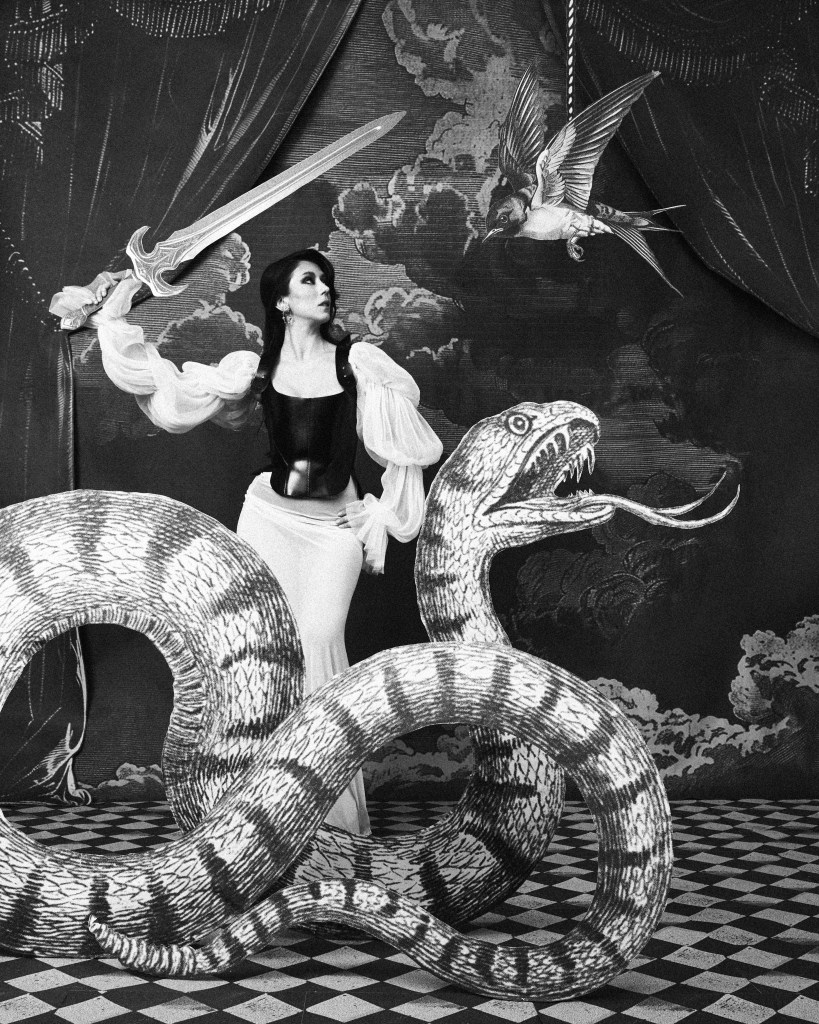
Another pivotal moment was building my very first physical life-size 4×3.5m set, the first time I ever saw one of my collages exist in real space. It was created as part of an artist portrait project and functioned as a kind of self-portrait in itself. That process was deeply emotional and full of trial and error; I didn’t fully know what I was stepping into, but it fundamentally changed how I understood my work. Seeing a collage move off the screen and into the physical world opened up an entirely new direction for my practice and gave me the confidence to keep working at scale.
Ultimately, my goal is to keep expanding the ways my work can exist— across film, installation, and image-making without losing the handmade, tactile quality that defines it.
What are your goals as an artist? What sort of projects would you like to work on with your unique collage style?
I tend to set one major goal for myself every half year and then leave space around it for exploration, because I believe that’s where the most interesting things happen. Right now, my main focus is slowly transitioning into a more directorial role. I recently debuted my first music video, which I directed and built the sets for, and it was an important milestone for me. Especially knowing the entire project came together in just two weeks, from the initial idea to filming.
Storytelling has always been at the core of my practice, so directing feels like a natural extension of the worlds I’ve been building through collage. Moving forward, I want to continue developing this direction through short-form visual pieces, while pushing my cut-out animation work even further. At the same time, I’m not stepping away from fashion or collaborative projects; I see them as spaces where my collage language can keep evolving and intersecting with different industries. Ultimately, my goal is to keep expanding the ways my work can exist— across film, installation, and image-making without losing the handmade, tactile quality that defines it.
The post Jana Frost Unlocks Handmade Worlds Through Collage appeared first on PRINT Magazine.