
PENG & PARTNERS treats Marble as architectural medium
Dreamer Stone House is a spatial project by PENG & PARTNERS that examines marble as an architectural medium rather than a surface finish or display material. Conceived as an immersive environment in Shenzhen, the project repositions stone as an active element shaping spatial rhythm, atmosphere, and sequence. Instead of presenting marble as a static object, the design integrates it into a continuous architectural narrative that unfolds through movement and perception.
The project departs from the conventional showroom typology by prioritizing spatial experience over product display. The design is structured as a gallery-like environment in which architectural composition, material transitions, and sensory engagement guide the visitor. Marble operates as the primary material framework, informing proportion, texture, and visual continuity throughout the interior.
The spatial organization combines a rational, axial layout with a restrained atmospheric approach. Influences drawn from Milanese modernism inform the clarity of circulation and symmetry, while Eastern spatial principles introduce subtle transitions and layered separation. This dual strategy allows the space to balance formal order with perceptual depth, positioning marble as both structure and surface.
all images by Jack Qin, Zuxi Huang, Si Yu
Dreamer Stone House is a gallery-like sequence of spaces
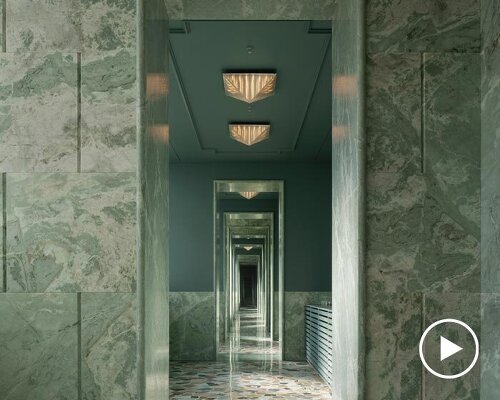
The spatial journey begins at a controlled entrance threshold and unfolds through a sequence of aligned corridors and interconnected rooms. Symmetry, axial alignment, and repetition establish orientation and rhythm, while variations in scale, transparency, and light create moments of pause and transition. Deep openings, translucent partitions, and layered sightlines support continuity without full visual exposure.
The design team at PENG & PARTNERS calibrates material selection and detailing to moderate the visual weight of stone. Wood veneers, copper elements, glass, and controlled lighting are introduced to soften contrasts and articulate joints. Natural light plays a key role in revealing surface textures and enhancing the spatial depth of the stone applications.
Stone is treated as a curated architectural element rather than an exhaustive display. Materials with restrained veining and balanced coloration were selected to align with the spatial composition and to maintain coherence across different programmatic areas. Craftsmanship is emphasized through variations in finish, scale, and assembly.
marble is treated as an architectural medium rather than a surface finish
retail showroom positions stone as a narrative material
In circulation zones, green marble is used across wall surfaces and fragmented floor inlays to establish continuity with subtle variation. Meeting rooms employ gray stone in both split-face and polished finishes, highlighting contrasts between texture and refinement. In the kitchen area, a Brazilian meteor stone island with a natural split-face surface functions as both a tactile focal point and a working element. Technical detailing, surface treatment, and lighting were carefully resolved to ensure durability, usability, and material stability.
The project situates natural stone within a broader contemporary material context, acknowledging the increasing presence of engineered alternatives while emphasizing the distinct qualities of geological material. Rather than competing on replication or efficiency, natural marble is positioned as a medium defined by material specificity, temporal depth, and visual uniqueness.
Through controlled composition, reduced visual mass, and precise detailing, stone is presented as a flexible architectural element capable of conveying lightness, continuity, and spatial clarity. Minimalist strategies and calibrated lighting allow the material’s inherent variation to emerge without excess emphasis. Dreamer Stone House operates as a spatial study in material-driven design. By aligning architectural order, sensory experience, and material expression, the project explores how stone can function as an active agent in contemporary interior architecture, supporting narrative, atmosphere, and spatial cohesion through design rather than display.
the project reframes stone as an active element shaping spatial rhythm and sequence.
an immersive interior replaces conventional showroom display strategies
marble defines proportion, texture, and visual continuity throughout the project
the interior is conceived as a gallery-like sequence of spaces
axial planning establishes clarity, symmetry, and spatial order
aligned corridors create rhythm through repetition and symmetry
variations in scale and light generate moments of pause and transition
natural light reveals surface textures and material depth
stone selection favors restrained veining and balanced coloration
craftsmanship is expressed through variations in finish and assembly
marble and stone unify walls and fragmented floor inlays in circulation zones
split-face and polished stone surfaces contrast texture and refinement
a natural stone partition functions as both tactile object and bookcase
the project positions stone as a narrative material within contemporary interiors
project info:
name: Dreamer Stone House
architect: PENG & PARTNERS
location: Zone B, Design Commune, Vanke Cloud City, Shenzhen
area: 245 sqm
chief designer: Wang Peng
project director: Li Yuan
art director: Lv Qing
furnishings consulting: P Projects
construction: Maili Digital Technology (Hangzhou) Co., Ltd.
suppliers: MOORGEN, SAVOIA, COSY SPACE COIN, NÍNG, MENGLV, SHANGMEI, V-ZUG, SEGGI, KBH, CETTIGA, SINGCHAN, TABU, ALPI
photographers: Jack Qin, Zuxi Huang, Si Yu
video: Chen Qiuquan
designboom has received this project from our DIY submissions feature, where we welcome our readers to submit their own work for publication. see more project submissions from our readers here.
edited by: christina vergopoulou | designboom
The post green marble clads gallery showroom’s immersive interiors in shenzhen appeared first on designboom | architecture & design magazine.