
a home on rocky antiparos overlooks the aegean
A new summerhouse by Biris-Tsiraki Architects rises above a rocky cape on Antiparos, facing the open Aegean and the island of Despotiko across the water. Set into a steep slope and exposed to northern winds, the house addresses sea, sky, and terrain with a measured architectural language shaped by orientation and movement.
From the approach, the building reads as a composition aligned to horizon and topography. Westward views extend toward sunset and the distant silhouettes of Sikinos, Sifnos, and Serifos, while the presence of Despotiko introduces a sense of deep time. Ancient ruins remain visible from the site, and the rawness of the landscape establishes a demanding context that informs scale, massing, and material choice.
images © Mariana Bisti
Biris-Tsiraki plans a cross-shaped dwelling
The design by Biris-Tsiraki Architects emerged through close observation of the hillside during early site walks. The team conceptually inscribes two perpendicular axes into the slope as a spatial framework aligned with the cardinal directions. This gesture organizes the house while maintaining a direct relationship with wind, light, and terrain.
The east to west axis follows a gradual outdoor sequence from arrival toward sea and sunset, ending at a cantilevered pool deck that frames the horizon. Crossing it, the north to south axis connects the exposed upper ground to a more sheltered southern edge overlooking Despotiko. This route guides circulation from open air through semi-covered zones and into enclosed interiors, offering protection from prevailing winds.
the summerhouse sits on a steep rocky cape in Antiparos facing the open Sea
two stone volumes shaped by the terrain
Along these axes, the residence takes shape as two primary stone volumes. One extends horizontally across the slope, its irregular form shaped by terrain, and houses private rooms for children. Its mass and material recall fortified coastal structures while remaining contemporary in detail and proportion.
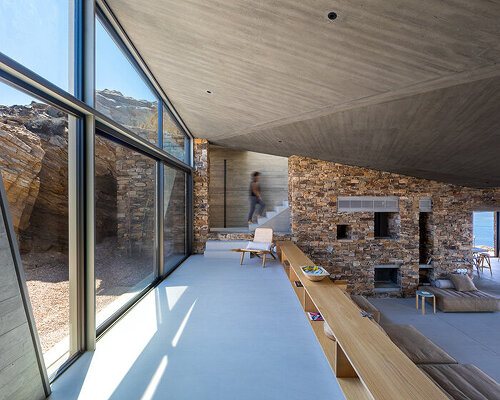
Intersecting this wing, a taller stone volume rises vertically to contain the main bedrooms and kitchen. Between them sits the shared living space, conceived as an inward-focused room with the presence of a courtyard. Inspired by the ancient Greek aithrion, this central area is covered by a folded concrete roof that follows the incline of the land. One side presses against exposed rock, while the opposite side opens fully to the sea through large glazed surfaces.
the site looks west toward sunset and across the water to the island of Despotiko
The formal expression of the summerhouse is direct and legible. Horizontal slabs, cubic masses, and the inclined roof define a clear structural order, punctuated by skylights that draw daylight deep into the interior. The vertical volume marks the upward edge of the composition, extending the spatial reading toward the sky.
A separate guesthouse introduces a deliberate shift within this order. Placed along the original path used during the first explorations of the site, the freestanding cubic volume appears during ascent or descent, allowing the body to register landscape and distance. Its placement reinforces movement across the slope and preserves the memory of arrival.
a folded roof slab follows the land and introduces daylight through skylights
Material choices reinforce continuity with place. Structural concrete elements remain exposed, paired with rough local stone laid in dry-stone technique both inside and outside. The stone comes from the excavation itself, tying the building physically and visually to the hillside. Steel details introduce precision, while wood surfaces add warmth to interior spaces.
Natural light shapes daily experience throughout the house. Skylights cut into the folded roof admit shifting bands of sun, while carefully proportioned openings frame sea and land. The interplay of light, stone, and shadow defines a distinctly Mediterranean atmosphere, suited to long summer days on Antiparos and attentive to the conditions that surround the dwelling.
a horizontal stone wing follows the terrain and contains private family spaces
the central living space acts as a protected communal interior with expansive sea views
a vertical stone volume rises to house the main bedrooms and kitchen
local stone, concrete, steel, and wood lend a restrained material palette
project info:
name: Summerhouse in Antiparos
architect: Biris-Tsiraki Architects | @biris_tsiraki_architects
location: Antiparos, Greece
completion: 2025
photography: © Mariana Bisti | @murplejane
design team: Sofia Tsiraki, Tasos Biris
collaborating architects: Magda Champaloglou, Sofia Tzavella
design team (study): Alkiviades Oikonomidis, Panos Niarchos
structural engineer: Nikos Detsis
mechanical engineer: Nasos Aronis
construction: Parostec
site manager: Panos Niarchos (on behalf of parostec)
construction supervision: Sofia Tsiraki, Tasos Biris, And Sofia Tzavela, Magda Champaloglou
furnishing: Belgies Anan
landscape: Sofia Tsiraki, Garoufalia Mariannou, Karolos Chanikian & Manolis Oikonomou
lighting: Ifi Company
The post biris-tsiraki architects sculpts greek summerhouse like an ancient ruin on antiparos appeared first on designboom | architecture & design magazine.