
luca poian and frade arquitectos turn to madrid
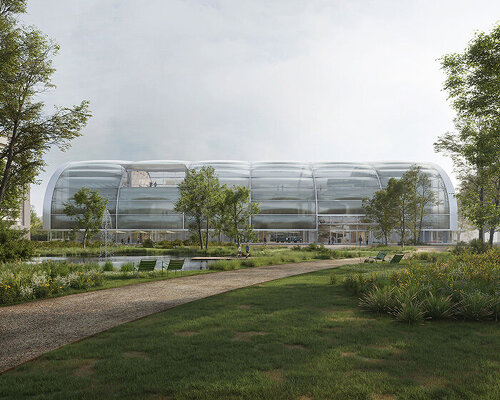
Together with Frade Arquitectos, Luca Poian Forms envisions this EMT Museum as a landmark building dedicated to the transit history of Madrid. Conceived as a large civic presence on the site of the former Vicente Calderón Stadium, the project approaches its setting with measured geometry and a lightweight facade. Its scale reads as infrastructural, yet its profile and materiality remain soft.
The exterior is wrapped in a translucent ETFE skin that tempers the building’s physical weight. Daylight filters through the envelope, softening edges and producing shifting interior atmospheres across the day. From the river path, the museum appears permeable and luminous, its surface responding to changing weather and light rather than asserting a fixed image.
visualizations © Filippo Bolognese Images
a home for Madrid’s public transport history
The EMT Museum is planned by Luca Poian Forms and Frade Arquitectos as an institutional home for Madrid’s public transport history. It has been designed as part of an international competition, with a program to focus on movement, logistics, and collective memory. Industrial references drawn from depots and hangars inform the spatial organization, translated into a contemporary architectural language centered on efficiency and long-term adaptability. The building supports public exhibition areas alongside operational zones, arranged through clear circulation routes that support smooth daily use.
Visitors enter at ground level onto an open, flexible floor that can accommodate exhibitions, workshops, conferences, and civic gatherings. Circulation paths remain legible and generous, encouraging slow movement through the galleries while maintaining operational efficiency behind the scenes. The museum functions as an active public interior, capable of shifting with changing curatorial needs and public programming.
this EMT Museum is proposed for the site of a former stadium in Madrid
industrial durability balanced by visual lightness
At the heart of the EMT Museum, Luca Poian and Frade Arquitectos plan column-free exhibition halls to house historic buses at full scale. A reinforced concrete bridge system spans these spaces, supporting the loads required for both display and movement while maintaining spatial continuity. Above and around this structure, a lightweight metal framework supports the ETFE envelope to lend a contrast between industrial durability and visual lightness.
Material choices emphasize durability and performance. Concrete surfaces provide thermal mass and a tactile sense of permanence, while the ETFE facade introduces softness and translucency. The interplay between these systems produces interiors that feel expansive and calm, shaped by diffuse light and long sightlines across the exhibition floor.
a lightweight ETFE facade softens the industrial urban fabric
environmental approach and future use
Environmental performance is integrated directly into the building’s systems. The ETFE air-cushion facade functions as a passive climatic layer, regulating light and heat while reducing energy demand. Its lightweight and recyclable nature supports long-term sustainability goals without compromising spatial quality or durability.
Digital tools form a parallel layer within the physical architecture. Augmented reality and interactive media are embedded throughout the museum to support interpretation and engagement, and are integrated to extend the visitor experience beyond static displays.
the ground level opens onto a flexible space for exhibitions and conferences
column-free exhibition halls will house historic buses at full scale
the ETFE air-cushion facade regulates light and heat while reducing energy demand
project info:
name: EMT Museum
architecture: Luca Poian Forms | @lucapoianforms, Frade Arquitectos | @fradearquitectos
location: Madrid, Spain
engineer: PROINTEC
area: 10,620 square meters
visualizations: © Filippo Bolognese Images | @filippobolognese.images
The post luca poian plans transit history museum in madrid with lightweight, inflatable facade appeared first on designboom | architecture & design magazine.