
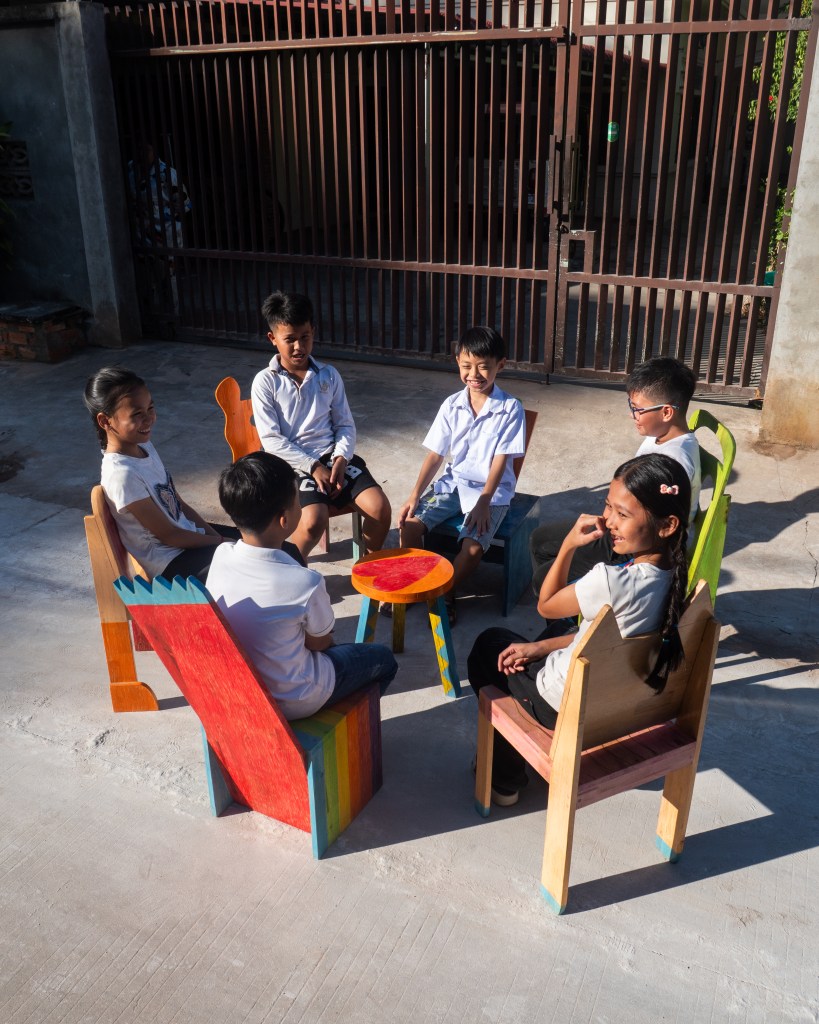
What would design look like if kids were calling the shots? What sort of magic could be created if a child’s imagination was in charge?
Designer Taekhan Yun found this out firsthand through his inspired project “Chairs for Kids,” which he conducted at his parents’ English school in Siem Reap, Cambodia. Taekhan taught 70 of their students about the beauty and possibilities of the design process by allowing each to design their own chair, especially built for their own bodies. Taekhan identified that most furniture design is created with adult bodies in mind, and he wanted to change that for these kids. In doing so, he also wanted to expose them to the importance of imperfection and making mistakes. In an Instagram post he shared about the project he wrote:
Many children ask, “Can we use a ruler?” Each time, I tell them that nothing in this world is perfect, so it’s okay if the lines are crooked. I show them different kinds of playful chair references and tell them: Anything can become a chair. I want to see your imagination.
Over the span of the two-month project, 140 chair sketches were created, followed by 80 clay prototypes “filled with the children’s bodies, thoughts, teamwork, and clumsiness.” Ultimately, seven full-scale chairs were built to completion by the children under Taekhan’s guidance. In a final reflection on Instagram he shared:
Watching the children draw, revise, and repaint without hesitation, the work came to focus more on the process than the outcome. In that process, I discovered their complete immersion and joy. I learned from them, and with that, this project was completed.
Taekhan reflects further on the project below.
Where did your idea for the Chairs for Kids project come from?
When visiting an English school run by my parents in Cambodia, I observed young children attending classes while adjusting their bodies to chairs designed for adults. That scene felt like more than a simple inconvenience. It revealed how furniture and space are routinely designed around adult standards, while children are expected to adapt and remain compliant within those environments.
Although this project began as an attempt to create chairs for children, it ultimately aimed to allow them to experience a process in which their own bodies and choices become the basis for design.
Although this project began as an attempt to create chairs for children, it ultimately aimed to allow them to experience a process in which their own bodies and choices become the basis for design.
Did any challenges come up working with kids in this way? What was the hardest part for you?
Many of the children drew very small sketches, or tried hard to “draw well” by using rulers or repeatedly erasing and redrawing. Although I told them that there are no wrong drawings and that making mistakes is important, it seemed difficult for them to fully accept this idea. Letting go of the need for a correct answer was the most challenging part.
What were your favorite parts of collaborating with kids? What did you learn from working with children? What surprised you the most?
When I asked the children about their height in order to determine the chair dimensions, most of them did not know it. This unexpected situation led me to change the plan and move on to measuring their bodies directly.
Working with children rarely followed the original plan, and this unpredictability often led the project in a better direction.
Working with children rarely followed the original plan, and this unpredictability often led the project in a better direction. It reminded me that responding is sometimes more important than controlling.
How did it feel watching these children bring their own chair designs from sketches to reality? Looking at the completed chairs that were produced by the end of the project, what emotions did you experience?
The children took part in every stage of the design process, freely revising and redrawing without hesitation. Mistakes were not treated as something to avoid, but as an integral part of moving forward. Watching this, the chairs came to feel less like finished objects and more like traces of adjustment, iteration, and shared involvement. The value of the project lay not in a fixed outcome, but in the ongoing process of change and refinement itself.
The value of the project lay not in a fixed outcome, but in the ongoing process of change and refinement itself.
What was the most rewarding aspect of this project for you?
The most rewarding aspect of this project was seeing the children begin to understand design as a process rather than a finished outcome. By moving together through body measurement and making, they came to recognize that design is shaped through collaboration, not individual expression alone.
They came to recognize that design is shaped through collaboration, not individual expression alone.
When they realized that their choices directly affected structure and use, the project clearly moved beyond a simple making workshop and began to function as a form of design education. Witnessing the moment they started thinking from the position of a “maker” was the most meaningful outcome for me.
The post Built From Giggles and Big Ideas: “Chairs for Kids” Celebrates Children’s Imagination appeared first on PRINT Magazine.