
A cabin stepping with the slope
Mork-Ulnes Architects takes to a forested hillside above South Lake Tahoe, California to design its Staggered Cabin, hiding four cedar volumes among the area’s Jeffrey pines and outcrops of granite.
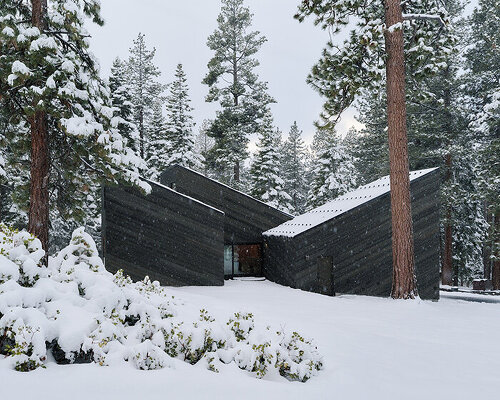
From the road, the house appears as a series of dark, angled forms that shift in height and orientation, their shed roofs cutting crisp lines against snow and sky. Each volume lands at a slightly different elevation, creating a composition which reads as a cluster of small cabins gathered together, scaled to the trees and the terrain, with narrow courts opening between them.
The work of Mork-Ulnes often bridges Scandinavian and Northern Californian sensibilities, and this project continues that conversation. The shed-roof silhouettes recall Nordic cabins as well as the A-frame lineage common to the Sierra. At the same time, the layout reflects a contemporary approach to family life, with flexible spaces and careful use of compact square footage.
images © Joe Fletcher
staggered volumes for outdoor pockets
The Staggered Cabin is designed by Mork-Ulnes Architects to step up the gentle slope and allow existing boulders and trees to remain in place. Instead of a single platform carved into the hillside, the footprint breaks apart into compact plates. Exterior rooms emerge in the gaps, protected from wind and catching pockets of sun. These courts extend daily life outdoors through much of the year, whether used for a morning coffee or for children playing between snowbanks.
This approach also shapes the way the cabin meets the ground. Foundations stay close to grade, and the volumes weave around site features. The effect feels deliberate and restrained, with the architecture behaving as a guest within the alpine landscape rather than as an imposing object. Through the winter months, snow gathers along the roof edges and cedar walls to soften the sharp geometries.
four cedar volumes step down the forested slope outside Lake Tahoe
mork-ulnes designs for an alpine climate
Rough-sawn western red cedar clads the Staggered Cabin’s exterior in a deep, dark stain, selected by Mork-Ulnes Architects for its visible grain. The boards run diagonally, emphasizing the pitch of the roofs and the directional movement down the hill. Over time, the finish weathers toward the tones of bark and shadow, allowing the cabin to sit quietly among the evergreens.
Standing-seam metal roofs cap each form. Engineered snow guards hold a continuous layer of snow in place, adding insulation and moderating melt. From a distance, the roofs appear thick and substantial, a practical response to the climate that also gives the silhouettes a certain weight.
dark stained rough sawn cedar siding blends the cabin with bark and shadow
inside the lake tahoe home
Inside the 1,400-square-foot home, circulation centers on a shared living and dining space positioned at the middle of the composition. From here, short passages lead to bedrooms, baths, and a mudroom. Sliding glass doors open on both sides, aligning the great room with the courts and the trees beyond. Movement through the house feels direct, with few leftover spaces.
The staggered arrangement allows rooms to maintain privacy while preserving visual connections. Looking across the interior, one catches glimpses of another volume through a window or a doorway, then of forest beyond. The sequence creates depth without relying on size. The house feels larger through overlap and adjacency rather than through expansion of floor area.
the staggered plan preserves boulders and Jeffrey pines across the site
wood interiors and built-in elements
Douglas fir plywood lines walls and ceilings, wrapping surfaces in a consistent tone that reflects light with a soft warmth. Face-framed cabinets with flush fronts, open shelving, and concealed lighting keep the palette simple. The joinery reads as precise and workmanlike, with details integrated into the architecture rather than added later.
Built-in pieces handle many of the functions that furniture might otherwise take on. A sofa with storage tucks against the wall. A ladder leads to a mezzanine office tucked beneath the high point of a roof. In the children’s room, a small loft and climbing wall turn the vertical dimension into usable space. These elements support daily life while keeping the plan open and easy to move through.
Douglas fir plywood interiors lend warmth and a continuous material language
architecture to harness the environment
Narrow floor plates and paired operable windows encourage cross ventilation during warmer months. Clerestory openings draw daylight deep into the interior, reducing reliance on artificial lighting. The shed roofs, angled toward the sun, easily capture winter light and shed heavy snow.
Water management stays equally considered. Melt and rain flow toward infiltration elements on site, reducing runoff toward Lake Tahoe. Minimal hardscape keeps soil permeable, and felled trees found new use as site furnishings or remain to decompose. The environmental strategies remain practical and low-key, woven into the building’s form.
a central great room connects living spaces to the landscape on both sides
built-in storage and mezzanines maximize space within a modest footprint
shed roofs manage snow loads while improving insulation and solar exposure
project info:
name: Staggerd Cabin
architect: Mork-Ulnes | @morkulnesarchitects
location: Lake Tahoe, California
area: 1,400 square feet
completion: June 2025
photography: © Joe Fletcher | @josephfletcher
design team: Casper Mork Ulnes, Lexie Mork Ulnes, Colin Griffin
structural engineer: Riva Engineering & Consulting
builder: Sierra Sustainable Builders
The post cedar-clad ‘staggered cabin’ by mork-ulnes steps down a forested slope above lake tahoe appeared first on designboom | architecture & design magazine.