
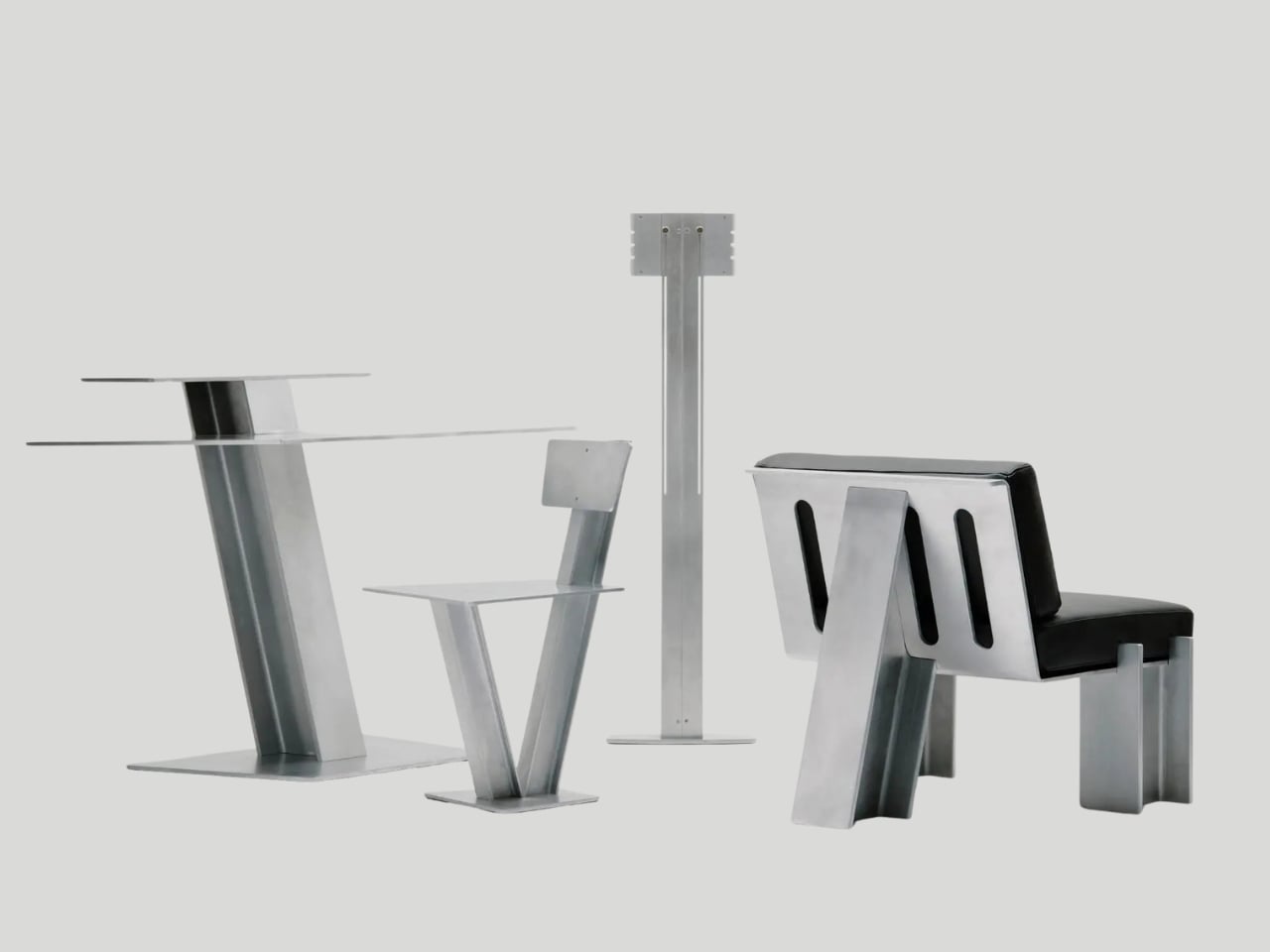
There’s something beautifully rebellious about taking the skeleton of a building and turning it into something you’d actually want in your home. That’s exactly what designer Marquel Williams has done with his Beams collection, a furniture series that proves industrial components can have serious aesthetic game.
Williams built this entire collection around one specific element: the I-beam. You know, those steel supports that hold up skyscrapers and warehouses. The same component that was patented back in 1849 by Alphonse Halbou and has been refined over nearly two centuries to become the gold standard for structural efficiency. But instead of leaving these beams to do their usual heavy lifting in the background, Williams pulled them into the spotlight and transformed them into chairs, lamps, desks, and lounge seating.
Designer: Marquel Williams
The collection includes five distinct pieces, each one using the I-beam as its structural foundation alongside metal sheets and black leather upholstery. What makes this approach so compelling is how Williams managed to create such diverse pieces from a single standardized part. Each item has its own personality despite sharing the same DNA.
Take the Beam Chair, for instance. It’s monochromatic metal at its finest, with precisely angled I-beams and laser-cut aluminum sheets. The whole thing is treated with a waxed finish that balances rigid industrialism with actual functionality. Looking at it, you might think it would be uncomfortable with all that sharp geometry and metal, but there’s an intentional restraint in its design that makes it striking.
Then there’s the Chaise Longue, which takes an entirely different approach. While the chair feels rigid and precise, the chaise has this relaxed, almost delicate equilibrium going on. The leather upholstery softens the whole vibe, making it feel more approachable while still maintaining that industrial edge.
But the real showstopper might be the Floor Lamp. This piece gets technical in the best way possible, featuring adjustable height shades with a cantilever system. Here’s the kicker: the electrical cord isn’t hidden away like usual. Instead, it’s framed right inside the beam as a visible design detail. It’s that kind of thoughtful touch that shows Williams isn’t just using industrial materials for aesthetic novelty; he’s actually thinking about how to integrate every functional element into the design language.
Williams’s philosophy here is all about standardization and what you can do when you commit to a single industrial component as your foundation. The I-beam represents nearly 200 years of industrial production refinement, the absolute peak of standardized structural efficiency. By using it in unexpected ways, Williams subverts its typical purpose and transforms it into a vehicle for creativity and self-expression.
This approach isn’t entirely new in the design world. Italian designer Enzo Mari explored similar territory with his own I-beam experiments (called “putrella” in Italian), creating bowls and trays for dining tables by simply bending the extremities upward. Mari’s research into semi-finished products aimed to highlight the formal worth of industrial components and transform them into contemporary design icons. Williams is working in that same tradition but pushing it further by creating an entire cohesive furniture system.
The collection is handcrafted by Caliper in Spain and produced in very limited quantities, which makes sense given the level of craftsmanship required. These aren’t mass-produced pieces; each one requires careful fabrication and finishing to achieve that balance between industrial rawness and refined design.
What Williams has ultimately created is a collection that makes you rethink the materials around you. Those structural supports holding up buildings? They have untapped aesthetic potential. That standardized industrial component? It can be the basis for something truly unique. The Beams collection proves that creativity isn’t about reinventing the wheel; sometimes it’s about looking at the wheel differently and imagining what else it could become.
The post These Chairs Are Made From the Steel That Holds Up Buildings first appeared on Yanko Design.