
A Myrtle Bank Garden For The Birds, Bees + Heatwaves
Gardens
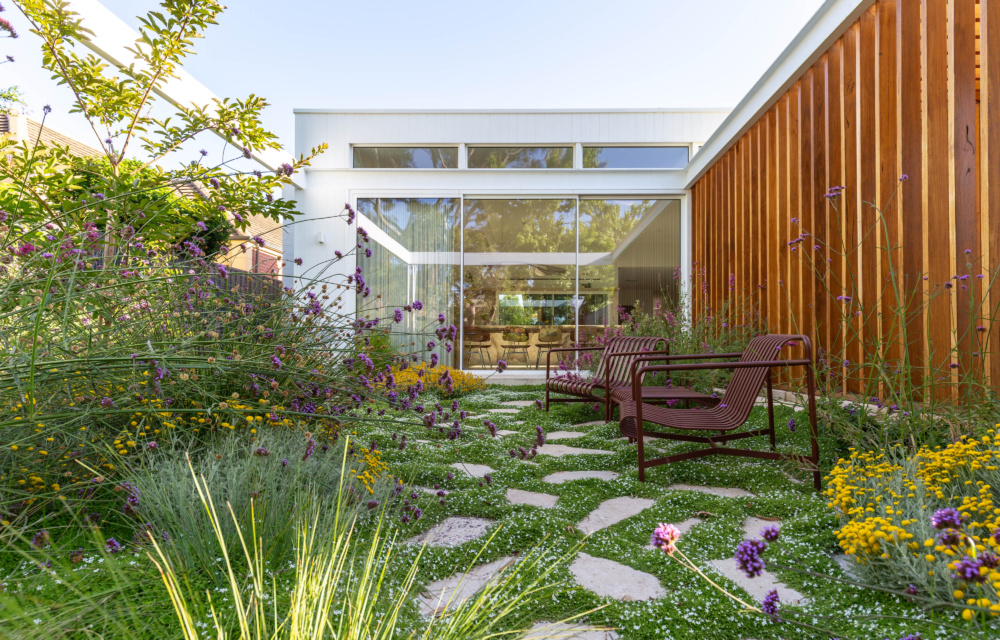
Key plants include lavender-cotton (Santolina chamaecyparissus), tall Verbena (Verbena bonariensis), mat rush (Lomandra ‘Lime Tuff’), and trailing Pratia (Pratia pedunculata).
The northern courtyard highlights a strong vertical timber element introduced in the entry arbour.
Palissade Lounge Chair Low by HAY.
The northern courtyard provides a sitting space, and an area for kids to explore and pick flowers. Yellow and purple flowers add contrast.
Semi-defined zones respond to how the property is used, catering for shifts in sun and shelter throughout the day.
A young crepe myrtle provides height and dappled shade in the young garden, and will grow to form a living canopy to further shelter the sitting space.
The tall native evergreen hedge along the eastern rear boundary creates a lush, year-round outlook. Pockets of planting carry the same whimsical mix from front to back, while larger native shrubs provide textural contrast where they have space to breathe.
The entry path to the porch features oversized organic limestone steppers surrounded by silver birch trees. Taller ornamental grasses add further movement.
The entry point to the home reveals the first glimpse of the gardens to come. A bagged brick garden wall separates the zones and creates privacy.
Key plants include New Zealand Lily, common everlasting (Chrysocephalum apiculatum), mat rush (Lomandra ‘Lime Tuff’), and trailing Pratia (Pratia pedunculata).
The front entry sequence, viewed from the front door. The shaded microclimate created by the entry arbour allows for pockets of lush greenery.
The owners of this Adelaide property bought the house in 2015 for its potential, envisioning a new home and garden on the generous Myrtle Bank site.
Four years later, they began working with architect Murray Britton to design a new house, with their future garden front of mind throughout the design process.
Murray Britton designed a single-storey home with strong internal viewpoints of the garden to come. ‘That created a great canvas for the planting to shine, and the generous space to the north, east, and around to the south meant we could create distinct zones that each felt purposeful, not incidental,’ says Tom Easton, landscape designer of Easton Design Studio.
Tom was entrusted with further enhancing the experience of ‘bringing the outside in’ while attracting local birds, bees, and butterflies. ‘Something a little wild, colourful [and] with a sense of discovery’ was the vision, in the words of the client. ‘A sanctuary for our family to discover, enjoy and explore through every season.’
The key drivers were catering for family and function; integrating feel and movement, and selecting hardy, climate appropriate planting.
‘The biggest challenge was designing for South Australia’s intense summer heat and heatwaves, without creating a garden that needs constant attention,’ says Tom. ‘We addressed that through a few key choices, keeping the planting selection climate appropriate, building in shade and shelter where we could, and improving soil and extensive irrigation zones so that the garden could establish properly and run efficiently long term.’
Tom’s design comprises semi-defined zones tailored to the microclimate and clients’ desires throughout the day.
The front garden is broken into two experiences: an entry path that draws the user toward a timber porch, and a more private courtyard outside the main kitchen and living area. ‘That courtyard has a loose stepper path and pockets of textured planting, designed to read as a “living picture” from inside, but also to be a space you naturally step into and use,’ says Tom.
The rear garden is designed to work hard for a young family. ‘It provides open space for two energetic boys to run and play, while carrying through the softer, whimsical planting from the front. In the rear we could also lean into lusher greenery in the right microclimates, so the outlook stays calming and green year round,’ says Tom.
There’s also an internal courtyard, which is more minimal and architectural, comprising a small feature tree, simple ground layer, and creeping fig (Ficus pumila) intended to gradually grow up and cover the walls.
Throughout these zones is a restrained base of natives and hardy Mediterranean-leaning plants for an overall contemporary Australian garden aesthetic. Planting is layered and textural, with pockets of looser perennials and grasses for movement, balanced by a calmer evergreen structure in more the more protected nooks, and soft permeable surfaces (natural limestone steppers, gravel mulch, and hardwood timber) across the hardscaping. ‘It’s designed to feel natural and relaxed, but intentional,’ says Tom.
Feature plants include mass planted low native shrubs, such as common everlasting (Chrysocephalum apiculatum), mat rush (Lomandra longifolia), knobby club-rush (Ficinia nodosa), and coastal rosemary provide a hardy, textural base.
Feather reed grass (Calamagrostis ‘Karl Foerster’) provides mid-level movement and a soft, warm backdrop through the seasons, while silver birch (Betula pendula) and Natchez crepe myrtle (Lagerstroemia ’Natchez’) introduce height, filtered shade, and seasonal interest.
Pratia ground cover surrounds steppers, creating a soft green carpet that helps suppress weeds as it knits in.
Flower colour is incorporated in a restrained manner, ensuring the garden never feels too busy. Tall Verbena (Verbena bonariensis) and Agastache ‘Sweet Lili’ highlights soft purples, complemented by contrasting yellow flowers and silver foliage of common everlasting (Chrysocephalum apiculatum).
The finished garden speaks to both the climate and the clients’ lifestyle, calling them to spend time outdoors regardless of the time of day. ‘The north courtyard directly off the kitchen and living area is my favourite. It’s the space that people naturally gravitate toward, and it feels incredible to sit in. It changes subtly through the seasons, and gets daily use as part of the home,’ says Tom.
The garden is most alive in the late afternoon into evening, when the light softens and the plants sway in the breeze.