
mofa studio design biomorphic eila art retreat
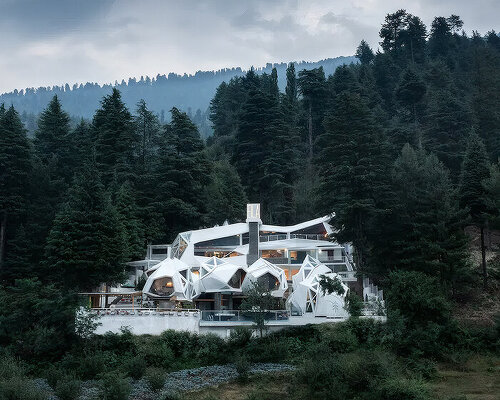
Perched on a steep hillside overlooking Naggar valley in Himachal Pradesh, India, Eila is an art retreat that functions as an extension to the terrain rather than a static object. Designed by MOFA Studio, the project champions fluid architecture through advanced computational design, realizing a structure that mimics the landscape. The site’s masterplan adopts a stepped strategy that preserves topsoil and rainwater runways, organizing the resort as a gradual, terraced descent. The resulting pod-like volumes, crafted from lightweight steel and thin concrete shells, appear to grow out of the slope, embodying a high-performance response to complex topographical constraints.
Eila, Tree of Life resort, is an art retreat perched on a steep hillside in India’s state of Himachal Pradesh | all images courtesy of MOFA Studio
mofa studio challenges through five-dimensional fluidity
Founded in 2007 by architect Manish Gulati, MOFA Studio is a collective of optimistic non-conformists who prioritize possibility over rigid systems. The practice operates through a five-dimensional framework – Spatial, Ecological, Social, Temporal, and Systemic fluidity – to ensure architecture responds to life rather than dictating it. By integrating AI as a creative collaborator alongside a dedicated research cell, the studio optimizes environmental performance while maintaining human intuition. This systems-led approach allows the multidisciplinary team to resolve complex constraints through efficient detailing. The landmark Elia project reflects the MOFA Studio’s nearly two decades of innovation in non-conformist, systems-led architecture.
MOFA Studio designed the project to champion fluid architecture through advanced computational design
elia’s biomorphic shells and visual instruments
The architecture of Eila is defined by its biomorphic shells, where pod-like cottages extend across the sloping site to capture 360-degree views of Naggar valley below. These lightweight steel and concrete volumes act as insulated enclosures that reduce energy loads while maintaining a low-carbon footprint. A defining gesture of the design is the treatment of openings as visual instruments. These windows and skylights are positioned to pull in the exterior, deep into the interior life. Each aperture frames the valley as a living mural, ensuring the architecture remains in constant conversation with the mountains.
Biomorphic shells – pod-like cottages – extend across the sloping site to capture 360-degree views of Naggar valley below
Rather than décor, art is treated as the core at Eila, integrated into façade screens, interior murals, and the choreography of the site. Under the art direction and interior styling of the client, Shri Rama Shankar Singh, a renowned educationist in India and his daughter, Palak Singh, the interiors reflect a lived-in curatorial approach that embeds creativity into daily rituals. The journey begins at the Gate of Confluence, a stone-inscribed pavilion, leading to the Kitaabkhana (library) where light filters through jaali and embroidery-frame lamps. This art-led threshold transitions into communal spaces, including an open-air amphitheatre and a heated infinity pool aligned with the horizon. Even the masterplan is displayed as an artwork, reinforcing the premise that art, architecture, and life occupy a single, continuous field.
the site’s masterplan adopts a stepped strategy that preserves topsoil and rainwater runways
architecture with local materiality and ecological absorption
Its materiality leans heavily on local sourcing to reduce transport emissions and embed the retreat within regional construction cultures. The lightweight frame and thin shell system minimize material intensity, allowing the resort’s profile to remain visually quiet against the sensitive Himalayan backdrop. MOFA Studio conceived the concrete shells with the potential to host local landscape growth over time, suggesting an architecture that is not finished at handover but is gradually absorbed by the ecology. This origin story, born from a 20-year collaboration between Manish Gulati and Shri Rama Shankar Singh, represents a constant questioning of form until every line resonates with the landscape’s history and spirit.
the resort is organized as a gradual, terraced descent, starting with the Gate of Confluence pavilion
rather than décor, art is treated as infrastructure at Elia
the Kitaabkhana (library) where light filters through jaali and embroidery-frame lamps
Shri Rama Shankar Singh and Palak Singh curate the interiors to reflect creativity as daily rituals
each aperture frames the valley, ensuring the architecture remains in constant conversation with the mountains
Manish Gulati, Principal Architect and Co-founder of MOFA Studio
project info:
project name: Eila
design studio: MOFA Studio I @mofa_studio
design team: Manish Gulati, Shri Rama Shankar Singh (patron/curator), and Palak Singh (art direction)
location: Naggar Valley, Himachal Pradesh, India
The post eila by MOFA studio realizes biomorphic art retreat in india through fluid architecture appeared first on designboom | architecture & design magazine.