
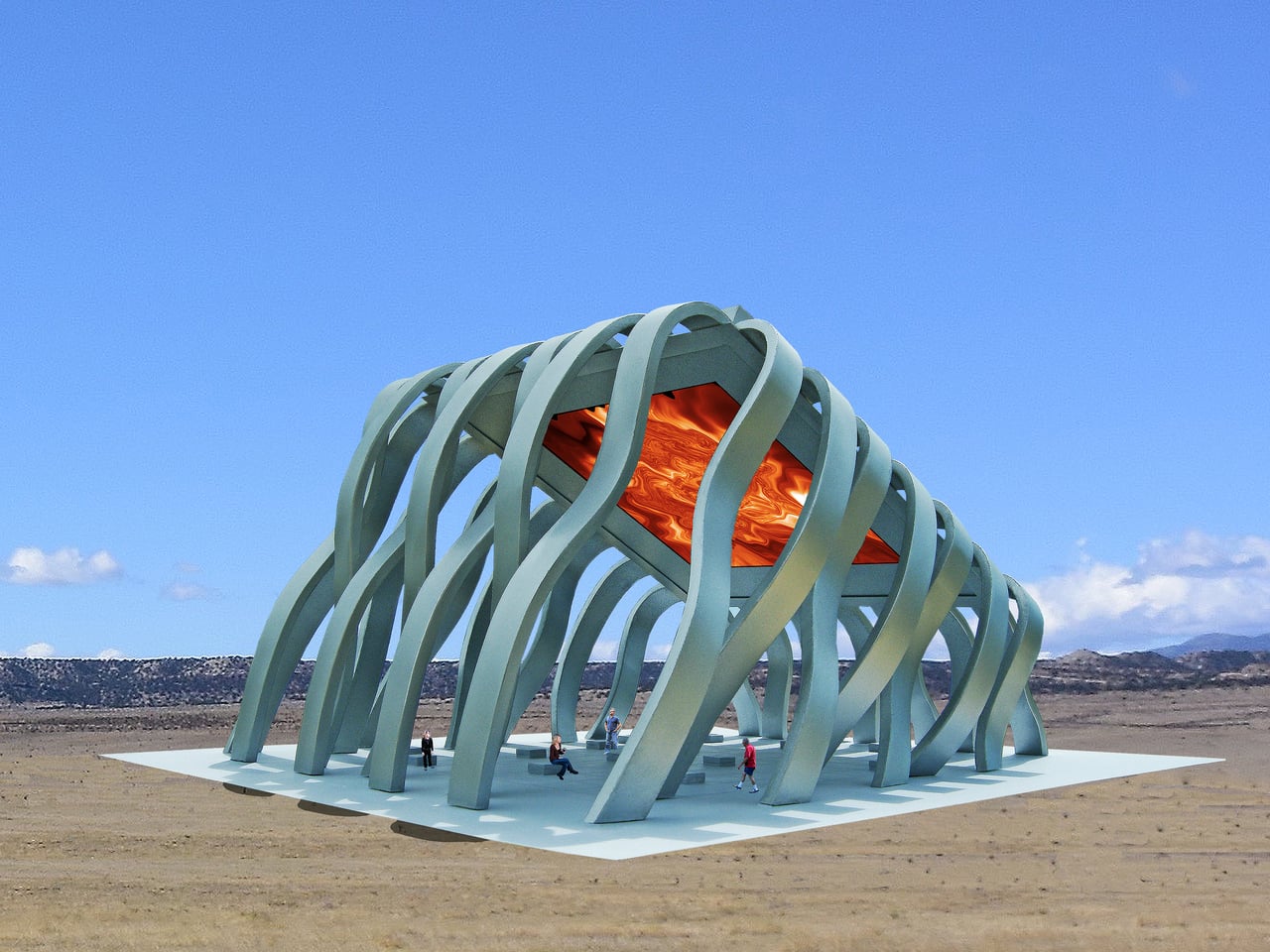
Most solar infrastructure is treated as background hardware, panels on roofs or fields that quietly feed the grid while public life happens somewhere else. That separation makes renewable energy feel abstract, a number on a bill rather than an experience. The Solar Eclipse Pavilion imagines a different approach, where the act of harvesting sunlight becomes the centerpiece of a place where people actually gather, making energy visible and social at the same time.
The Solar Eclipse Pavilion is a large steel public art structure that doubles as a small power plant. A 7,000 square foot photovoltaic array forms its roof, converting energy from the sun into electricity for the surrounding community. Some of that power goes straight into the local grid, while some is reserved to run a low-energy LED display mounted on the underside of the canopy, turning the ceiling into a kind of artificial sun overhead.
Designer: Michael Jantzen
The LED surface does not just loop a stock animation. Sensors embedded in the solar array continuously record variations in light and heat across the surface, and those fluctuations drive the graphics and sound. The ceiling shows graphic color images of the sun that morph in response to clouds, temperature shifts, and the angle of light, while an electronic soundscape shifts along with them, making the invisible behavior of the sun legible as color and tone.
After sunset, the photovoltaic cells stop generating power, but the pavilion does not go dark. Pre-recorded images and sound, captured from earlier solar activity, play back through the night until the sun rises and takes over the controls again. For special public events, the default sun imagery and audio can be swapped out for other content, turning the LED ceiling into a programmable media surface for performances, data visualizations, or civic messages.
The solar array shades a large plaza beneath, with built-in seating that invites people to sit, talk, or lie back and watch the ceiling. The pavilion becomes a place for markets, concerts, or informal hangouts, with the energy infrastructure quietly doing its work overhead. Instead of separating technical function from social function, the project fuses them, so the same structure that generates electricity also generates shade, spectacle, and a reason to linger.
The designer describes the pavilion as a gigantic computer chip, a surface where information and energy are manipulated to do work for the people who use it. In that reading, the photovoltaic modules are like transistors, the LED ceiling is like a display bus, and the plaza is the user interface. It is a speculative project, but it points toward a future where renewable energy systems are not hidden away, but turned into civic landmarks that make the sun’s power feel tangible, shared, and even a little theatrical.
The post Lie Under This Solar Roof and Watch the Sun Move in Real-Time first appeared on Yanko Design.