
House of Elements: A Sequential Zoological Pavilion for Łódź Zoo
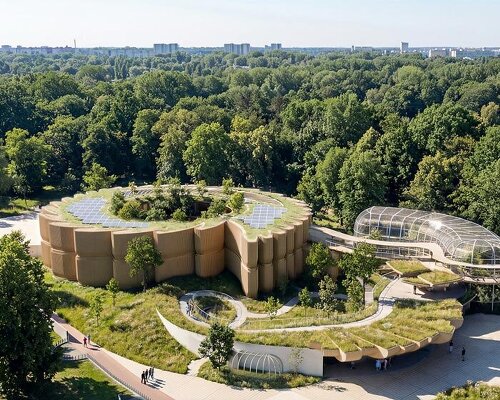
The House of Elements is a proposed zoological pavilion, designed by Bangkok-based VMA Design Studio for Orientarium Zoo in Łódź, Poland. Conceived as a continuous architectural sequence, the project connects spatial organization, environmental performance, and narrative structure. The 6,000-sqm project interprets the role of natural elements in shaping life on Earth through a multi-level visitor route integrated with animal habitats.
The pavilion was developed in response to an international architectural competition organized by Holding Łódź, which called for a building structured as a sequential journey through thematic zones. Each zone corresponds to a different element: Earth, Ice, Water and Fire, Air, and Future, forming a coherent progression rather than a series of isolated enclosures. VMA’s winning proposal, titled One Seed — A Thousand Growths, is based on a single generative architectural logic that adapts to varying spatial, environmental, and programmatic requirements across the site.
Rather than repeating a uniform envelope, the design introduces a timber-based system that transforms according to context. The structure functions alternately as an entrance canopy, a facade screen, a terraced enclosure surrounding the sea lion courtyard, and a series of planted roof decks and ramps serving the café and aviary. These elements share a common architectural language while responding individually to enclosure, shading, circulation, and landscape integration.
all images courtesy of VMA Design Studio
A Continuous Route Linking Public Space and Animal Habitats
The project by Bangkok-based architecture firm, VMA Design Studio, also establishes a new public open space that links the zoo’s main entrance, the existing Orientarium complex, and the new pavilion. A ticket hall is positioned along this axis and remains publicly accessible, allowing movement through the site without entering the exhibition areas. A central courtyard serves the café and educational facilities and is located outside the ticketed zone, enabling the pavilion to function both as a destination and as a connective element within the zoo.
Visitor circulation begins with a descent into a sunken Earth zone, followed by a gradual ascent along a continuous spiral ramp with a 5% slope. This path wraps approximately two and a half times around a central sea lion pool, forming the spatial core of the building. Along the route, visitors encounter spectacled bear enclosures, Antarctic penguin habitats with underwater viewing, and large-scale manatee aquariums with tanks extending above head height. Upper levels accommodate volcanic giant tortoise enclosures beneath an ETFE canopy, double-height habitats for spider monkeys and tree kangaroos, and a canopy-level aviary. The sequence concludes in the Future zone, incorporating moss walls, reflective surfaces, still water, and capybara habitats.
Material and environmental strategies are integrated throughout the design. The facade is clad in high-density engineered bamboo, thermally modified for exterior durability and installed as a ventilated rainscreen. Green roofs extend planted surfaces across the building profiles, reinforcing continuity between architecture and landscape. The Earth zone uses earth-sheltering strategies to support thermal stability, while the sea lion courtyard incorporates layered acoustic treatments to manage sound within the building’s central space. The House of Elements follows the completion of the Orientarium Southeast Asian wildlife complex in 2022 and represents the second major development at Łódź Zoo. The project is currently advancing to the next phase of the competition process toward realization.
the café and bistro above the gateway pavilion overlook the central garden
profiles rising like tall planters, capped with green roofs, shape the timber bark facade
the design interprets the role of natural elements in shaping life on Earth
at the air zone canopy habitat, visitors circulate at treetop level above the monkeys
capybara habitat, living moss walls, and chrome sculptures outline the future zone
designed by VMA Design Studio, the project is organized as a continuous architectural sequence
the evolutionary journey begins underground at the sunken earth passage
the penguin habitat in the ice zone features panoramic curved glass for underwater viewing
manatee habitat in the water zone with circular voids connects to the air zone above
volcanic terrain and elevated walkways trace along the giant tortoise habitat in the fire zone
project info:
name: House of Elements, Orientarium Zoo Łódź
architect: VMA Design Studio | @vmadesignstudio
location: Łódź, Poland
designboom has received this project from our DIY submissions feature, where we welcome our readers to submit their own work for publication. see more project submissions from our readers here.
edited by: christina vergopoulou | designboom
The post the four elements inform modulated zoological pavilion proposal in poland appeared first on designboom | architecture & design magazine.