
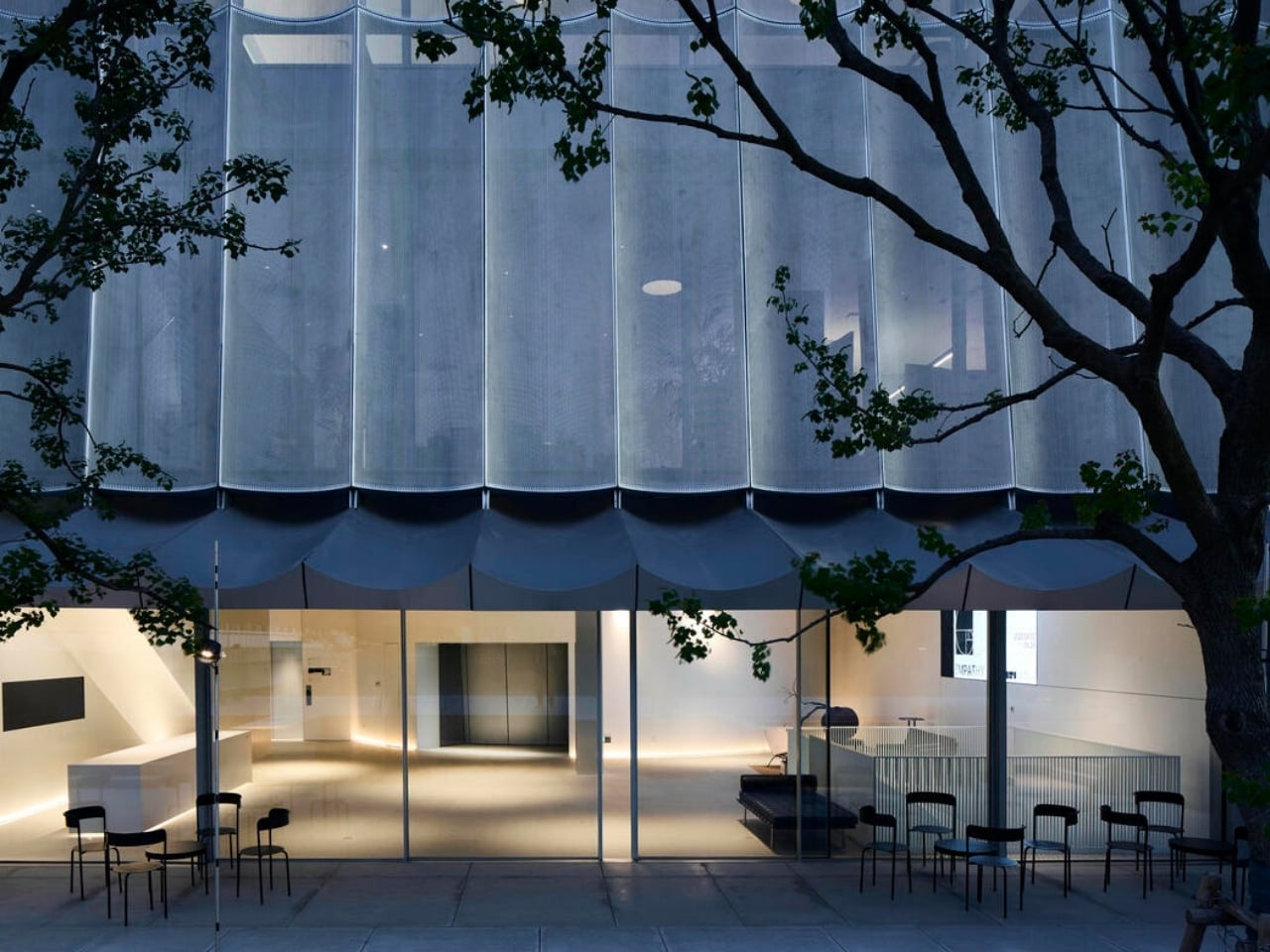
Sometimes the best architecture happens when designers refuse to accept what’s been left behind. The Hangzhou Empathy Museum, completed in 2025 by TAOA, is one of those rare projects that transforms architectural leftovers into something genuinely captivating. What started as an abandoned community project in Hangzhou’s Xiaoshan District has become a striking contemporary art space that seems to hover above the ground.
The museum’s exterior is its boldest statement. TAOA wrapped the structure in wave-like stainless steel and anodized aluminum panels that create this hypnotic, continuous curve around the building. It’s the kind of facade that changes throughout the day as light hits it from different angles, turning reflections into part of the architectural experience. The transparent curved panels don’t just look beautiful, they give the building its own visual rhythm that sets it apart from the typical boxy structures you’d expect in a residential neighborhood.
Designer: TAOA
At just 1,628 square meters total, with only 570 square meters above ground, this isn’t a sprawling cultural complex. It’s intentionally compact, which actually works in its favor. The smaller footprint means every space has to earn its place, and architect Tao Lei’s team made that constraint part of the design philosophy. Instead of spreading out horizontally, the museum digs down with two basement levels dedicated to exhibition space while the upper floors handle reception areas and more intimate gathering spots.
What makes this project particularly interesting is how it solves the problem most underground galleries face: the dungeon effect. Nobody wants to view art in a windowless concrete box that feels disconnected from the outside world. TAOA created a vertical void that cuts through the building, tapering as it moves up through each floor. This central opening brings natural light down into those basement galleries, so even when you’re two floors below street level, you’re not completely cut off from daylight and sky.
The interior spaces balance openness with intimacy. The first floor serves as the main reception and leisure area, easing visitors into the experience before they descend to the exhibition spaces. On the second floor, stairs hide behind decorative louvers that add texture and filter light. By the time you reach the third floor, you find an island platform and a lounge area, perfect for those moments when you need to step away from the art and just process what you’ve seen.
The material palette is restrained but sophisticated. Alongside the stainless steel and aluminum exterior, TAOA incorporated aluminum mesh, stone, and rock panels throughout the building. These aren’t flashy choices, but they create subtle variations in texture and light that keep the spaces from feeling monotonous. It’s the kind of design thinking that doesn’t announce itself loudly but rewards people who actually spend time in the space.
What’s refreshing about the Hangzhou Empathy Museum is its purpose. This isn’t a vanity project or a billionaire’s private collection disguised as public culture. It’s genuinely meant to serve the community, with a focus on contemporary art exhibitions that will rotate and evolve. The name itself, Empathy Museum, suggests an intention to create connection rather than just display objects behind glass.
The renovation took three years from initial design in 2022 to completion in 2025, which seems reasonable given the complexity of converting an unfinished shell into a functioning cultural space. TAOA collaborated with specialists in curtain walls, structural engineering, landscape design, lighting, and construction to pull this off, which explains the cohesive feel of the final result.
Architecture like this matters because it shows what’s possible when designers look at incomplete or abandoned structures not as problems to demolish but as opportunities to reimagine. Every city has these half-finished projects, relics of changed plans or economic shifts. Most get torn down or sit empty. The Hangzhou Empathy Museum proves that with the right vision, these spaces can become community assets that add beauty and culture to their neighborhoods.
The post An Abandoned Building Just Became China’s Most Reflective Museum first appeared on Yanko Design.