
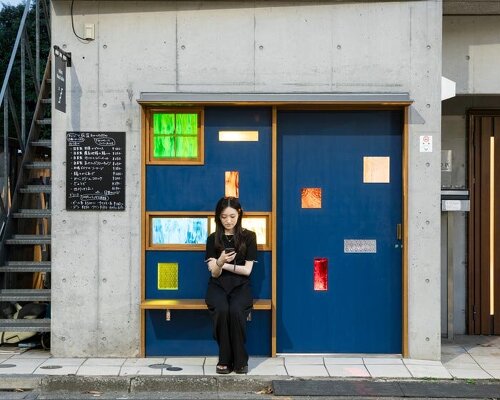
Ogikubo Bar’s renovation focuses on the entrance door
Renovated by Ateliers Mumu Tashiro, Ogikubo Bar is a modest neighborhood bar located within a residential area in Ogikubo, Suginami-ku, Tokyo, Japan. Approximately ten years after its opening, the project underwent its first architectural intervention, limited intentionally to the replacement of the entrance door. The renovation explored how a single architectural element could alter spatial perception, presence, and interaction without modifying the existing interior layout. Originally established in a domestic garage setting, the bar developed gradually into a well-used local venue. To preserve the familiarity of the interior atmosphere and avoid extended closure, the scope of renovation was constrained to the entrance. This limitation became the central design premise, positioning the door as both an architectural and spatial device rather than a purely functional threshold.
all images by SOBAJIMA, Toshihiro
Mumu Tashiro uses the door as an architectural device
Ateliers Mumu Tashiro began the design process with an investigation into the color blue. Widely present in Japanese cultural and material traditions, such as indigo and navy, blue was selected for its visibility and legibility in low-light conditions, making it suitable for a nocturnal program like a bar. Multiple pigment combinations were tested, including blends with gray, black, green, and yellow. Ultimately, a single, unmodified blue was chosen for its clarity and consistency. While appearing vivid in daylight, the color softens under street lighting and subtly shifts as it interacts with the lauan plywood substrate, allowing the wood grain to influence the surface appearance. Set against an existing concrete facade, the blue door functions as a visual marker within the residential streetscape, establishing a distinct identity while remaining limited in scale.
The door incorporates ten individual glass panes, each varying in color, texture, transparency, and origin. Sourced from a specialty glass supplier, the panels were manufactured in Japan, the United States, France, and Germany. Their placement was carefully calibrated according to height, scale, and usability, ensuring that each piece retained visual independence while contributing to the overall composition. As daylight fades into evening, interior lighting activates the glass, revealing layered reflections, silhouettes, and movement. The small apertures allow partial visibility between inside and outside, creating a mediated relationship rather than full exposure. Push-out and sliding window elements were introduced to accommodate three-dimensional interaction, with prefabricated wooden frames adjusted on site to match varying glass thicknesses. This combination of standardized components and manual adaptation reflects a pragmatic approach to contemporary craftsmanship.
the blue door acts as an architectural device rather than a functional threshold
Architecture is treated as an ongoing process
Beyond its role as an entry point, the door incorporates a fold-out bench, extending its function into seating and pause. This element draws from architectural and furniture precedents that integrate utility with spatial expression. The bench enables informal use patterns, including waiting, resting, and brief social interaction, allowing the door to operate as a small-scale public interface rather than a fixed boundary. Observed use over time demonstrated a range of behaviors not strictly prescribed by the design, reinforcing the door’s role as an adaptable object responsive to everyday life.
The Blue Door represents the first phase of a planned, incremental renovation strategy for Ogikubo Bar. Future interventions are intended to occur in stages, minimizing disruption while allowing visitors to observe the ongoing transformation of the space. Within this framework, the door functions as both an autonomous architectural element and a surface with depth, composed of color, glass, movement, and use. Rather than signaling completion, the project frames architecture as a continuous process. Through a single intervention, the renovation by Ateliers Mumu Tashiro examines how decoration, material specificity, and human interaction can expand the role of a door beyond its conventional definition, positioning it as a spatial and social device within the urban neighborhood.
the entrance features ten glass panels, each differing in color, texture, and transparency
the neighborhood bar is embedded within a residential streetscape
the bright blue surface interacts with lauan plywood grain
partial visibility mediating interior and exterior spaces
glass panel placement is calibrated by height, scale, and usability
the door is conceived as a visual marker against an existing concrete facade
project info:
name: The blue door – Ogikubo bar 1st renovation
architect: Mumu Tashiro/Ateliers Mumu Tashiro
location: Ogikubo, Suginami-ku, Tokyo, Japan
photographer: SOBAJIMA, Toshihiro | @sobajima_toshihiro
designboom has received this project from our DIY submissions feature, where we welcome our readers to submit their own work for publication. see more project submissions from our readers here.
edited by: christina vergopoulou | designboom
The post colored glass apertures reveal tokyo bar’s lively interior through bright blue entrance appeared first on designboom | architecture & design magazine.