
The creative industry doesn’t just feel different lately—it is different. Boundaries between disciplines continue to thin, workflows are more hybrid than ever, and conversations about authorship, ethics, and AI have moved from panels and think pieces into daily practice. Against this backdrop, Adobe’s newly announced Creative Collective lands at an interesting moment—and, from a design practitioner’s perspective, a necessary one. Not only as a forum for responsible innovation, but as a practical investment in helping creatives navigate change, sustain their work, and build resilient careers in an evolving creative industry and economy.
Building on a focus (or re-focus) that Adobe’s heralded over the past year (see past reflections on Adobe MAX), this initiative—driven by Adobe leadership including Eric Snowden, SVP of Design—is much less a brand program and is, instead, an important attempt to convene a cross-section of creative thinkers around a central question: What does creative responsibility look like now and how can it translate into long-term creative viability, opportunity, and economic stability?
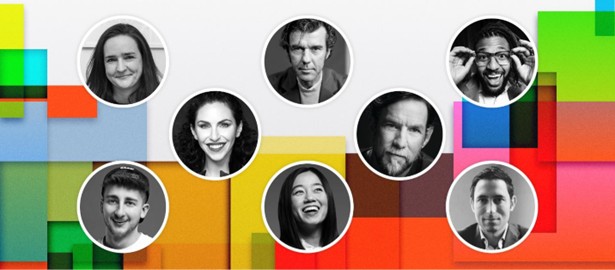
Adobe’s Creative Collective Clockwise from Upper Left: Tina Roth Eisenberg, Stefan Sagmeister, Don Allen Stevenson III, Scott Belsky, Tim Tadder, Karen X. Cheng, Lindsay Adler, Brandon Baum
The founding Creative Collective group includes a wide range of voices: photographer Lindsay Adler, digital VFX creator Brandon Baum, product and design leader Scott Belsky, filmmaker Karen X Cheng, community builder Tina Roth Eisenberg, design icon Stefan Sagmeister, creative technologist Don Allen Stevenson III, and visual artist Tim Tadder. The range is notable: commercial and conceptual, analog and emerging tech, individual practice and large-scale community building.
We wanted to make sure we had a diverse set of members and diverse set of disciplines. The world is changing for everyone, but in nuanced ways for every discipline and at different velocities. Having that a broad perspective was really important for us.
Eric Snowden
That breadth of perspectives matters, because the central tension designers are navigating right now isn’t technical, it’s philosophical—and increasingly, professional. How do you stay competitive, credible, and creatively fulfilled when tools and expectations are changing so quickly?
No one person knows exactly were we are headed, but bringing expert creatives together allows us to discuss a myriad of important issues including ethics, authorship, compensation, environmental impact, efficiency, evolution, and the meaning (and value) of human creativity.
Lindsay Adler
AI is already reshaping the designer’s role—not by replacing creative thinking, but by shifting where that thinking sits. Designers are spending less time purely “making” and more time framing problems, guiding systems, editing outputs, and making ethical calls. As generative tools accelerate, questions of originality, attribution, and cultural respect move front and center. Integrity becomes infrastructure. One of the interesting parts of Collective’s framing is its insistence that innovation and care are not opposites—that speed without thought is a creative liability, not an advantage.
All of this change doesn’t have to signify a loss of authorship. However, it does demand a more visible moral compass as a practitioner and a deeper commitment to ethical, workflow and business training in educational environments. To that end, Adobe’s program also leans into the idea that valuable learning today isn’t only confined to institutions. It’s happening in communities—peer-led networks, collaborative studios, creative gatherings, and cross-disciplinary exchanges. That perspective aligns closely with the ethos of CreativeMornings, founded by Collective member Tina Roth Eisenberg, and reflects a broader shift toward distributed, relationship-based learning.
The future of learning is distributed. It’s happening wherever people are practicing, questioning and creating in community, with moral clarity and care for the humans on the other side of the design.
Tina Roth Eisenberg
Adobe plans to surface conversations and insights from the Collective through events, shared resources, and gatherings, including the return of the Adobe 99U Conference in June, 2026 in NYC. Whether the Collective becomes a true forum for critical dialogue or stays closer to inspiration remains to be seen. But the premise—that the future of design is as much about values as it is about tools—is one that we can all champion and support
For the next generation, the implied message is clear. Technical fluency is the scaffolding, not the architecture. What differentiates a designer now is cultural awareness, ethical grounding, and the ability to design with empathy. Philosophy, history, art, and lived experience become practical tool—helping creatives consider who benefits, who could be harmed, and what values are embedded in the systems they help shape.
Brand new technologies always offer a slew of opportunities and a plethora of pitfalls. We have to create more of the former and mitigate much of the latter.
Stefan Sagmeister
Looking ahead, Adobe’s Creative Collective should be primed to explore how traits that have always defined strong designers but now feel newly urgent—taste, the ability to connect disparate ideas, deep listening, and moral clarity—can be baked-in to our practice and our purpose. Trust, generosity, and respect for the people and cultures behind the work matter as much as outputs.
Tools evolve. The questions we ask about how and why we use them are what will shape the work and determine how the industry remains vibrant, relevant, responsible, and meaningful in the future—for both creative expression and creative livelihoods.
The post Collaboration, Curiosity, Community: Adobe’s New Creative Collective appeared first on PRINT Magazine.