
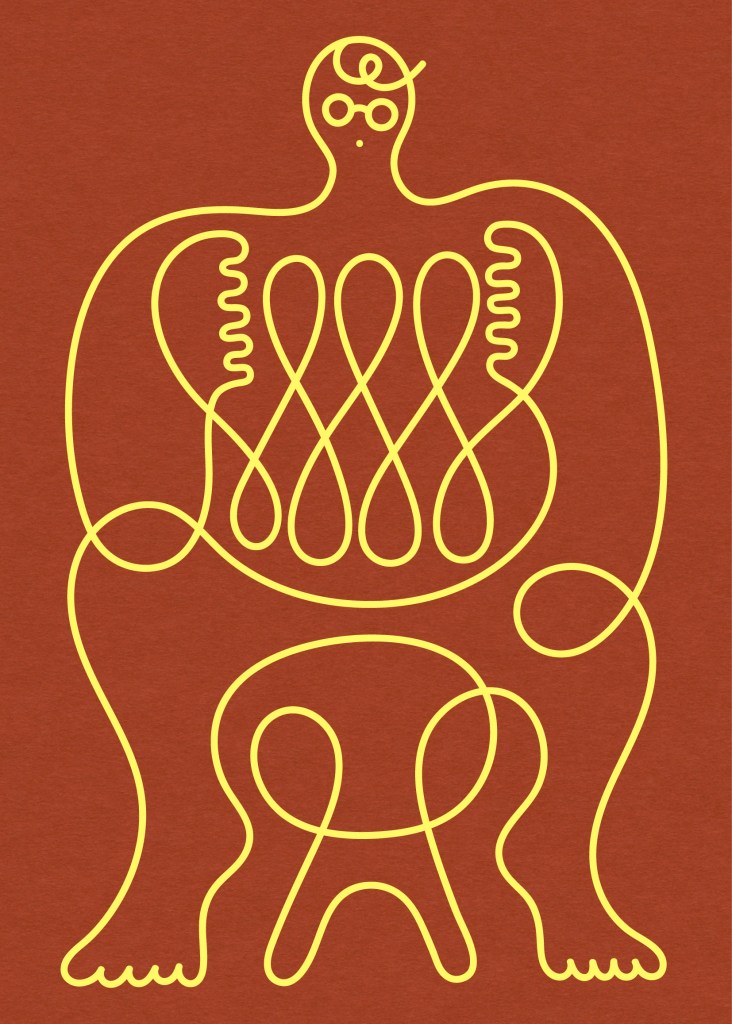
I was smitten when I saw Olimpia Zagnoli’s new book, Building Briges: An Illustrated Conversation With Gio Ponti, which forges a bond between Zagnoli and the aesthetics of the renowned Italian architect through 32 illustrations. Created for an exhibition organized at the Italian Cultural Institute in Stockholm, it’s a perfect blend of art and architecture celebrating Milan in the second half of the 20th century with the irony and color that defines Zagnoli’s work.
I asked her to discuss this sublime marriage of art interweaving past and present into a vibrant narrative.
How and when did you become interested in Gio Ponti?
I grew up surrounded by objects and buildings designed by Gio Ponti. Without even realizing it, I became familiar with his design in small, gradual sips. From the “Pirellina” lamp in my parents’ home inspired by the Pirellone skyscraper that rises in the center of Milan, to the church in the neighborhood where I grew up, and finally to the apartment where I live now, designed by him in 1933.
Explain “A Ship in the Garden” for us.
In many of his projects, Gio Ponti focused on the relationship between interiors and exteriors, using the term “Città Giardino” to describe an urban environment that embraces green spaces and maintains a constant dialog with nature and its surroundings.
On the street where I live, there are several buildings designed by Ponti, each surrounded by small gardens. The architecture is essential but at times its rigor is softened by arched windows or portholes that open outward like ships moored in a garden, with balconies serving as lifeboats.
Living here can sometimes feel like being on a cruise.
What is the underlying relationship between Ponti and your drawings?
Gio Ponti’s work is vast and multifaceted. He worked with ceramics, concrete, glass, textiles and, of course, paper, drawing, writing books and founding iconic architecture magazines such as Domus.
My relationship with the extraordinary legacy he left us lies in preserving my curiosity toward different disciplines, in nurturing a dialogue with craftsmanship and materials and in caring for every detail, whether designing a four-meter-high installation or drawing a simple greeting card.
Who are some of your other inspirations that have impacted your work?
I believe my work draws inspiration as much from the artistic Avant Gardes of the 20th century as from my childhood in the late 1980s. There are elements I recognize as coming from the applied arts, from Art Deco, and from advertising illustrations, just as much as from TV commercials for toy cars that change color under hot water, glow-in-the-dark slime or candies that crackle as soon as you put them in your mouth.
Some of the artists who, for me, embodied this insatiable curiosity to leap conceptually from one realm to another are Bruno Munari, Keith Haring and Pablo Picasso.
How do you feel about Giovanni Bellucci’s words in relation to your work and aesthetics: “The essentiality of the graphic sign marked by a few lines that tell the story of both spaces and furnishings … leads back to Ponti’s aesthetic research of the mid-1930s in perfect balance between elitist Art Deco references and a more democratic reality”?
I believe what I do is elastic and can take on any form it desires. Personally, I love working on projects of completely different natures, from a unique piece exhibited in a museum to illustrations for a line of tissues sold for .90 cents.
I like to think that anyone can be exposed to art in whatever measure feels most digestible to them. Sometimes I’m surprised when I’m showing work in a gallery and passersby ask if they’re allowed to come in. Please! The door is open!
What does putting this work together in such a pristine vessel do for you emotionally and artistically?
Every now and then, it’s necessary to clear things out, metaphorically and otherwise. To gather the sheets of paper, dust them off, and place them in a folder or, in this case, in a book. The rigor and cleanliness of this book do not reflect the state of my desk, but I felt it was necessary to create a small sacred space as a tribute to a great author and to the traces that the work of masters leaves on those who come after them. Emotionally, it feels good. Almost as if I had tidied up a room or struck a gong and can now focus on new projects.
The post The Daily Heller: A Visual Dialogue With Gio Ponti appeared first on PRINT Magazine.