
Drawing Architecture Studio revisits imperial clocks in china
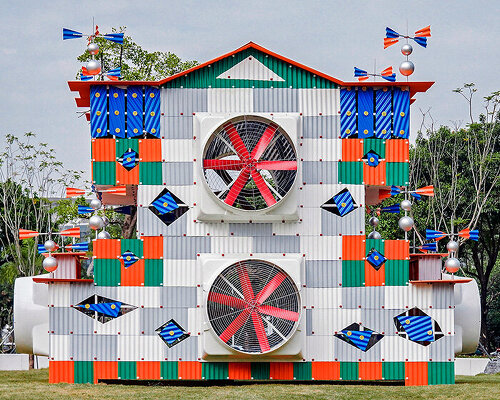
Drawing Architecture Studio presents The Clock House No.2 at the 7th Shenzhen Bay Public Art Season in Shenzhen, Guangdong Province, China, on view until April 19th, 2026. Commissioned for the public art program, the Beijing-based practice reinterprets the historical automaton clock as architecture, using low-cost industrial components to construct a structure that chimes and glows every fifteen minutes.
Where the clocks once gifted to emperors represented technical virtuosity and expensive craftsmanship, this installation adopts a deliberately rough and economical construction. It is assembled from corrugated PVC panels, ventilation fans, lightning rods, wind-driven bird deterrents, plastic insulation anchors, and LED light strips, all mass-produced industrial elements sourced online at low cost.
By cutting and recombining corrugated sheets in varied configurations, the architects work directly with the inherent texture, color, and visual rhythm of the material. Ventilation fans signal the position of the clock face, lightning rods and bird deterrents operate as ornamental extensions, and LED strips glow from within the structure, visible through openings in the facade.
all images by Shangqi Art
The Clock House No.2 frames timekeeping as cultural exchange
In the late Ming and early Qing dynasties, Western missionaries introduced automaton clocks to China, mechanical devices capable of marking time with precision and theatrical movement. Known as Zì Míng Zhōng, meaning ‘the clock that rings automatically,’ these objects entered the imperial court as diplomatic instruments before gradually embedding themselves in domestic life.
Guangdong Province, historically Canton, served as one of the Qing dynasty’s principal maritime gateways. European clocks arrived through this region along global trade routes, positioning Shenzhen within a layered history of technological transfer and cultural exchange. The Beijing-based team at Drawing Architecture Studio situate their project precisely at this intersection, linking mechanical timekeeping, architecture, and trade.
Drawing Architecture Studio presents The Clock House No.2 at the 7th Shenzhen Bay Public Art Season
from utensil to building
The project draws on Aldo Rossi’s reflections on architecture and ordinary utensils, objects that accumulate ‘forms of memory’ through repeated use and cultural continuity. For Rossi, the boundary between the domestic object and the architectural artifact is porous. The Clock House No.2 extends this thinking by turning the clock into a building and the building into a clock, collapsing scale distinctions between furniture and facade.
The structure references the layered organization and tiled facades typical of everyday dwellings in Guangdong, while adopting the ornamental and structural logic of historical automaton clocks, retaining the recognizable silhouette of a mantel clock while expanding it into an inhabitable scale.
the Beijing-based practice reinterprets the historical automaton clock as architecture
ceremonial time, translated
Although it contains no intricate mechanical movement, The Clock House No.2 incorporates a contemporary interpretation of timekeeping through sound and light. Every fifteen minutes, an automated musical chime is triggered while LED strips illuminate the structure in shifting hues. In doing so, the installation preserves the ceremonial quality of traditional automaton clocks, translating it into a contemporary sensory language that relies on electrical rhythm.
Through this symbolic reversal, imperial craftsmanship is set against contemporary industrial standardization. The project examines how different eras of production and consumption shape architectural form, aesthetic taste, and material culture. Drawing Architecture Studio proposes low-cost architecture as a framework for rethinking how memory, ornament, and time can be constructed in the present.
low-cost industrial components construct a structure that chimes and glows every fifteen minutes
the architects work directly with the inherent texture, color, and visual rhythm of the material
ventilation fans signal the position of the clock face
lightning rods and bird deterrents operate as ornamental extensions
the project draws on Aldo Rossi’s reflections on architecture and ordinary utensils
the structure merges two spatial and tectonic languages
retaining the recognizable silhouette of a mantel clock while expanding it into an inhabitable scale
project info:
name: The Clock House No.2
architects: Drawing Architecture Studio | @drawingarchitecturestudio
location: Shenzhen, Guangdong Province, China
design team: Li Han, Hu Yan, Zhang Xintong
photographer: Shangqi Art | @shangqiart
The post industrial components assemble glowing clock-house by drawing architecture studio in china appeared first on designboom | architecture & design magazine.