
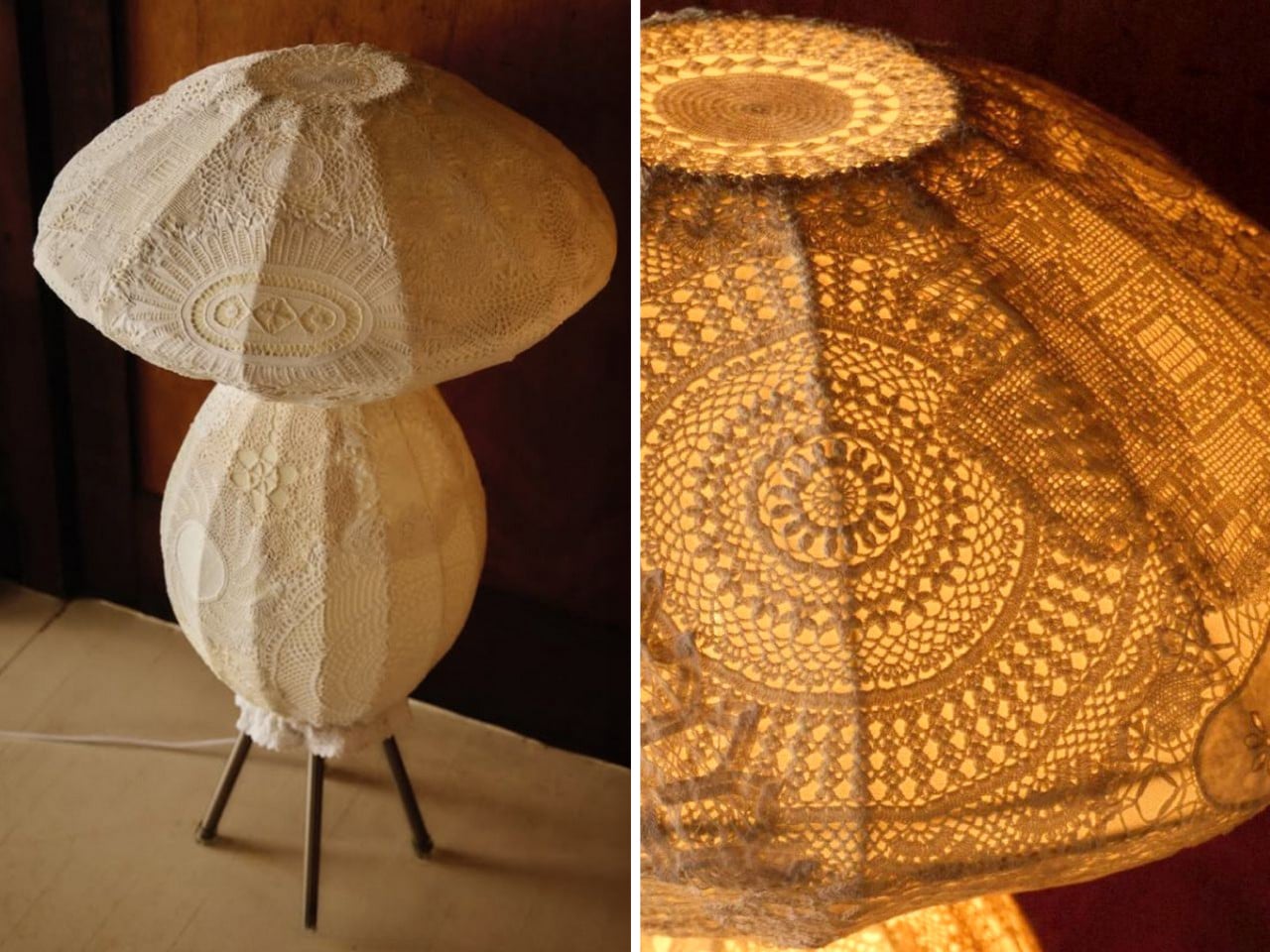
In Lana Launay’s Kinship series, light does more than illuminate space. It acts as a living archivist, revealing, preserving, and narrating stories embedded within inherited textiles. Through works such as Kinship I and Kinship II, the artist transforms antique doilies, lace fragments, and stockings passed down through generations into sculptural lighting forms that do not simply display history but actively project it into the present.
At a distance, the sculptures appear softly abstract, glowing with fluid patterns that seem almost atmospheric. As viewers move closer, those patterns resolve into delicate lace surfaces. The forms are constructed by stretching and wrapping textile fragments across stainless steel frameworks, which are then illuminated from within using LED elements housed in aluminum structures. This meeting of industrial material and fragile cloth establishes a compelling tension between permanence and delicacy, between manufactured precision and inherited memory.
Designer: Lana Launay
Each textile used in the works carries its own lineage. These are not fabrics chosen for decoration, but heirlooms gathered from families who preserved them across generations. Once domestic objects that quietly occupied tables, drawers, or cabinets, the doilies and fabrics are repositioned as visible ancestral surfaces. In their new form, they shift from private keepsakes to shared visual artifacts, allowing personal histories to exist within public space.
The transformation becomes most evident when light passes through the textiles. When unlit, the sculptures appear restrained, their patterns subtle and quiet. When illuminated, the surfaces come alive. Light filters through each stitch and fiber, projecting intricate webs of shadow across surrounding walls. The negative spaces within the lace become as expressive as the threads themselves, creating an interplay in which absence holds as much presence as material.
Stockings layered across the frameworks introduce an additional dimension. Their woven fibers soften and diffuse the light, allowing it to seep gently outward rather than shine directly. Overlapping fabrics create layered visual grids in which lines intersect and reconnect, resembling maps or diagrams. These networks evoke relationships and generational links, suggesting that the textiles themselves chart histories of connection, care, and continuity.
Every sculpture is assembled by hand, ensuring that each piece remains unique. The steel frame adapts to the dimensions of the textile rather than forcing the fabric into a predetermined shape. Signs of age, such as fading, discoloration, and repair, remain visible, reinforcing the idea that time is not erased but honored. The inherited material determines the structure, allowing memory to guide design.
Through the Kinship series, Launay proposes that preservation does not require stillness. Instead, history can be animated. Light becomes a tool that activates memory rather than simply revealing form. These sculptures function as living archives where ancestry is not stored away but made visible, where inherited textiles continue to participate in the present. In this way, the works suggest that memory, like light, does not disappear. It travels, expands, and quietly illuminates everything it touches.
The post These Lace-Shade Lamps Transform Family Heirlooms Into Memorable Floor Lighting first appeared on Yanko Design.