
steel installation translates deep-sea phenomenon of whale fall
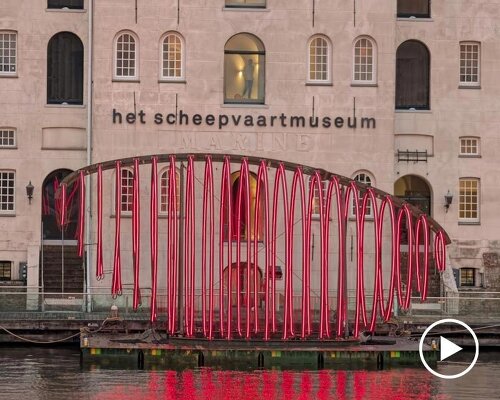
Installed in front of Amsterdam’s Het Scheepvaartmuseum, with NEMO Science Museum in the background, Whale Fall is a light installation by XYTOPIA translating the deep-sea ecological phenomenon of a whale fall into a spatial structure accessible to the public. The project was selected through a two-stage international open competition with more than 700 entries, organised by the Amsterdam Light Festival under the theme ‘Legacy.‘ Developed over eighteen months between Sydney, Beijing, and Amsterdam, the installation examines how legacy is defined and by whom.
The work references the biological process in which a whale’s body becomes a sustaining ecosystem on the ocean floor. This transformation serves as a conceptual framework for examining continuity, decay, and regeneration. Rather than presenting legacy as monument or static remembrance, the installation interprets it as a process of material and ecological transition.
By drawing parallels between oceanic micro-ecologies and broader planetary systems, the project situates human impact within extended temporal scales. The installation’s lighting sequence reinforces this reading: during the day, the structure appears as a skeletal steel framework; at night, it emits a uniform crimson glow. The shift in color and illumination marks a transition from structural exposure to atmospheric immersion, aligning the visual experience with the conceptual theme of transformation.
image by XYTOPIA
curved steel portal frames create Whale Fall’s rhythmic space
Whale Fall is composed of a sequence of curved steel portal frames forming an accessible corridor. The ribs, fabricated in raw steel, are dimensioned across varying heights and spans, creating a rhythmic spatial progression. The corridor is mounted on a ramped platform to ensure universal accessibility and allow close interaction with the structure.
The installation is aligned parallel to the adjacent waterway, enabling views from both land and boat tours. From the water, the tilted frames and layered ribs generate changing visual alignments as viewers move past, producing a parallax effect. The structural base was designed to accommodate alternative siting conditions, including buried foundations, surface-mounted platforms, or buoyant systems for water-based installation.
XYTOPIA studio adapted the material strategy to Amsterdam’s winter climate. The untreated steel surface is designed to withstand wet and cold conditions while maintaining structural integrity. Integrated lighting and concealed cable routes support a constant, low-glare crimson illumination calibrated for outdoor durability.
image by XYTOPIA
XYTOPIA translates the skeletal concept into robust installation
Site constraints informed the project’s development, including heritage waterfront regulations, restricted access windows, heavy boat traffic, and seasonal weather. Sightlines toward Het Scheepvaartmuseum and navigation routes shaped the alignment and staging sequence.
Engineering and fabrication were executed in partnership with local teams in Amsterdam. The structure was transported fully assembled on pontoons and positioned beside the museum during a coordinated night operation, minimising disruption to the city’s infrastructure. The delivery required the temporary opening of a rail bridge at 3:00 a.m., allowing the installation to reach its final position via canal.
The project integrates repeatable steel joints, jig-based fabrication tolerances, and accessible service points for maintenance. These measures translate the initial skeletal concept into a technically robust installation suited to public and climatic demands.
image by XYTOPIA
On 14 January 2026, XYTOPIA’s Whale Fall served as the setting for a water-based concert marking the entry into force of the Global Ocean (High Seas) Treaty. Pianist-composer Iris Hond and percussionist Gijs Anders van Straalen performed from a floating pontoon in front of the museum. The event was organised in collaboration with Greenpeace Netherlands and Het Scheepvaartmuseum.
The performance connected the installation’s thematic focus on ecological cycles and intergenerational responsibility with a contemporary policy milestone. By situating a cultural event within the installation’s illuminated structure, the project linked spatial design, public gathering, and environmental governance within a shared urban setting.
image by XYTOPIA
image by XYTOPIA
image by Janus van den Eijnden
image by Janus van den Eijnden
image by XYTOPIA
image by XYTOPIA
image by Gosse Bouma
image by Gosse Bouma
image by Gosse Bouma
project info:
name: Whale Fall
designer: XYTOPIA | @xytopia.design
lead designer: Xinyi Wang
event: Amsterdam Light Festival | @amsterdamlightfestival
location: Amsterdam, Netherlands
photographers: Janus van den Eijnden, XYTOPIA, Gosse Bouma
designboom has received this project from our DIY submissions feature, where we welcome our readers to submit their own work for publication. see more project submissions from our readers here.
edited by: christina vergopoulou | designboom
The post whale skeletal light installation glows red for amsterdam light festival appeared first on designboom | architecture & design magazine.