
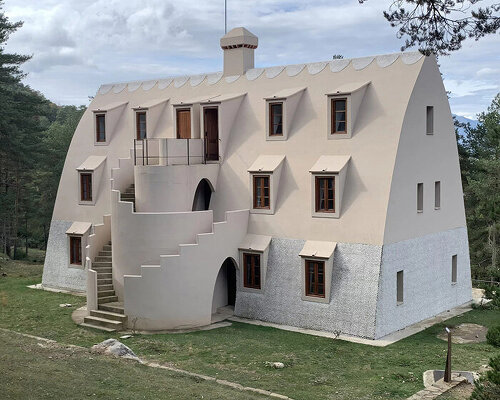
study confirms antoni gaudí as author of chalet in catalonia
The Catalan Department of Culture has formally confirmed that Antoni Gaudí is the author of the project for the Xalet del Catllaràs in La Pobla de Lillet in Catalonia, resolving a long-standing attribution question surrounding the industrial-era chalet. The conclusion follows a scientific study led by Galdric Santana Roma, director of the Gaudí Chair at the Universitat Politècnica de Catalunya (UPC), which identifies geometric, structural, and compositional evidence consistent with Gaudí’s methodology, including funicular arch calculations and the use of a 45-degree interior distributor.
Designed between 1901 and 1908 to house engineers working in the nearby Catllaràs mines, part of the industrial network supplying the Asland cement factory, the 396-square-meter chalet was embedded within a broader productive landscape. While the research affirms Gaudí as the designer, it also clarifies that he did not direct the building’s execution, which diverged structurally from the original proposal and may explain why he never publicly claimed the work.
all images via Turisme Lillet, unless stated otherwise
research by galdric santana clarifies long-debated attribution
Commissioned in 2023 by the Generalitat de Catalunya’s Directorate General for Cultural Heritage, the study situates the design of the chalet between 1901 and 1908, coinciding with the construction of the nearby Asland cement factory. During this period, Gaudí was simultaneously engaged in multiple commissions for Eusebi Güell. According to the report, it was not uncommon at the time for architects to refrain from signing works that were not executed faithfully to their plans. This context may explain why Gaudí never publicly claimed authorship of the Catllaràs project.
Beyond the recent confirmation of authorship, the Xalet del Catllaràs emerges from a clearly defined industrial logic. Located in La Pobla de Lillet and measuring 396 square meters, the building was commissioned by Spanish entrepreneur Eusebi Güell and Bacigalupi to house engineers working in the Serra del Catllaràs mines. The extracted material supplied the kilns of the Asland cement factory at Clot del Moro, the fourth cement factory built in Spain in 1901. The chalet was therefore not conceived as an isolated architectural experiment, but as infrastructure embedded within an expanding industrial network. Its program responded to the logistical and geographic demands of a mountainous mining environment, a condition that may have influenced later structural adjustments.
the Catalan Department of Culture has formally confirmed that Antoni Gaudí is the author of the Xalet del Catllaràs
analysis reveals divergence between design and built form
Santana’s investigation combines archival documentation with advanced constructive analysis, including 3D surveys and comparative drawings aligned with other verified works by Gaudí. Particular attention is given to the transverse section of the building and the geometry of its principal arch, where the study distinguishes between parabolic and catenary forms, closely associated with Gaudí’s structural language. The report also examines the now-lost cloister vault annexed to the chalet, described as typologically characteristic of Gaudí, as well as the use of 45-degree interior distributors, a spatial strategy present in contemporaneous works such as Bellesguard.
Despite this alignment, the constructed building departed from the original design. The study concludes that the execution and subsequent modifications were carried out by third parties, potentially including Gaudí collaborator Juli Batllevell. Over time, additional alterations further transformed the structure, contributing to the ambiguity surrounding its authorship.
the study identifies evidence consistent with Gaudí’s methodology | image via ROA Arquitectura
restoration and historical reconstruction by ROA Arquitectura
The contemporary understanding of the building is also shaped by early 21st-century restoration efforts. In 2001, research led by Roger Orriols, founder of ROA Arquitectura, in collaboration with the municipality of La Pobla de Lillet and Barcelona’s University of Building Engineers, brought renewed attention to the house and framed it as an unpublished Gaudí work.
Subsequent documentation describes a historical and constructive study aimed at reconstructing the original state of the building through plan restitution. ROA Arquitectura identifies the property as a patrimonial intervention commissioned by the municipality, centered on archival analysis and structural interpretation.
The first phase of restoration was completed in 2016, marking a critical step in stabilizing and re-reading the structure. These efforts repositioned the chalet within heritage discourse years before the current scientific confirmation of authorship.
the Xalet del Catllaràs emerges from a clearly defined industrial logic
new attribution framework emerges amid 2026 commemorations
‘Today we celebrate news of enormous value for our cultural heritage,’ states Sònia Hernández, Catalonia’s Minister of Culture, presenting the findings. ‘This academic research enriches the legacy of our most universal architect, who continues to surprise us a century after his death,’ she adds, emphasizing the importance of methodological rigor in attribution processes.
For Santana, the study extends beyond a single case. In the absence of technical precedents for architectural attribution, unlike in painting, the research proposes a method adaptable to other works whose authorship remains unverified. Each case, he notes, requires singular analysis grounded in documentary and constructive evidence.
The announcement forms part of the official Gaudí 2026 commemorations, marking the centenary of the architect’s death. The program aims to foreground the scientific and interdisciplinary dimensions of Gaudí’s work, expand awareness of lesser-known projects, and foster unified approaches to conservation and interpretation. With the confirmation of the Xalet del Catllaràs project, the Berguedà region enters the broader map of Gaudí’s architectural legacy.
the building was commissioned to house engineers working in the mines | image via Catalan Department of Culture
over time, additional alterations further transformed the structure
the constructed building departed from the original design | image via ROA Arquitectura
the research proposes a method adaptable to other works | image via Catalan Department of Culture
the announcement forms part of the official Gaudí 2026 commemorations | image via ROA Arquitectura
project info:
name: Xalet Del Catllaràs
architect: Antoni Gaudí
restoration architect: ROA arquitectura | @roa_hub
location: La Pobla de Lillet, Berguedà, Catalonia, Spain
researcher: Galdric Santana Roma
research: here
The post antoni gaudí is author of industrial-era miners’ chalet in catalonia, scientific study confirms appeared first on designboom | architecture & design magazine.