
Paul&Albert examine history as a continuously revised construct
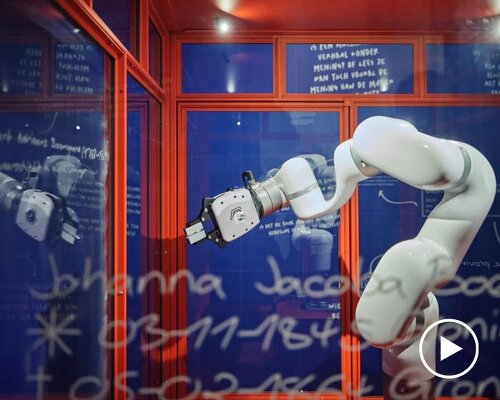
Writing History by Paul&Albert is an autonomous art installation developed for Museum aan de A in the Netherlands. The project examines history as a dynamic and continuously revised construct through a robotic system that writes and erases content directly onto glass.
At the center of the installation is an industrial robot arm housed within a custom-engineered glass and steel enclosure. The robot repeatedly inscribes text and images onto the glass surface using a marker, then removes them with a sponge. This cyclical action renders visible the process through which present events transition into recorded history, emphasizing the instability and revisability of historical narratives.
The robot operates independently, drawing from a database that includes historical facts, dates, and illustrations related to Groningen. In parallel, the system integrates real-time data such as water levels, traffic conditions, and weather information. By combining archival material with live inputs, the installation continuously generates updated compositions, positioning history as a convergence of past records and present conditions.
all images by Roelof Bos
a Robotic Arm installation Reconstructs Historical Narrative
The technical development by Dutch design duo Paul&Albert required iterative testing and calibration. Research focused on marker durability, sponge moisture levels, and the impact of minor tolerances in the glass surface on robotic precision. A custom magnetic spring mechanism was engineered to regulate pressure between the marker, robotic gripper, and glass, ensuring legible writing without damaging the surface. The surrounding display structure, constructed from approximately 200 kilograms of steel, was designed to absorb the mechanical forces generated during continuous operation.
Although industrial in nature, the robotic arm incorporates programmed micro-behaviors that introduce subtle variation into its operation. Brief pauses, rhythmic movements, self-corrections, and moments of apparent hesitation are embedded within its sequences. These gestures establish a contrast between mechanical precision and performative presence, reinforcing the installation’s central proposition: history is produced through repetition, selection, and ongoing revision rather than fixed permanence.
an autonomous system continuously inscribes and erases historical text
the robotic arm writes directly onto a transparent glass surface
the installation is housed within a custom glass and steel enclosure
the glass surface becomes a site of constant revision
real-time inputs from Groningen’s archival database inform the composition
historical facts merge with live environmental data
marker and sponge alternate in a programmed writing cycle
the sponge removes each inscription before the next begins
programmed pauses introduce subtle behavioral variation
industrial precision contrasts with performative gestures
project info:
name: Writing History
designer: Paul&Albert | @paulalbertcom
client: Museum aan de A | @museumaandea
location: Groningen, Netherlands
programming, robotics, kinematics: Leander van Boven
data: Groninger Archives, Museum aan de A
data feed/management system: Tapart
display case production: Edobode
other production: Jaap Zandt, Bart Kempinga, Gerard van der Beek, Klaas van Driezum, Luminoxx
photographer: Roelof Bos | @roelof_bos_fotografie
video: Koen Leerink | @koenleerink
designboom has received this project from our DIY submissions feature, where we welcome our readers to submit their own work for publication. see more project submissions from our readers here.
edited by: christina vergopoulou | designboom
The post autonomous robotic installation writes and erases history in real time appeared first on designboom | architecture & design magazine.