
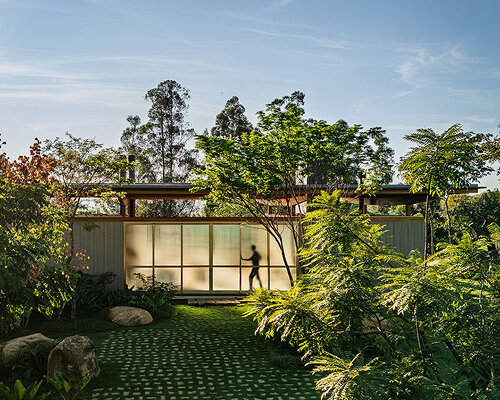
itupeva house design follows local topography
Itupeva House is a single-family residence in Brazil by UNA MUNIZVIEGAS. Throughout the project, the design treats trees, rocks, and water as integral spatial elements. During construction, builders temporarily relocated the site’s large boulders and later returned them to their original positions. In some cases, they cut and reused the stones as exterior paving. Responding to the topography, a horizontal ground floor pavilion, built in glued laminated timber, houses the main living areas. Below, a series of bedrooms for the two children embeds into the slope in reinforced concrete, forming a solid base that reads like one of the existing boulders on the property. Above this concrete plinth, a swimming pool rests as a reflective plane, mirroring the surrounding forest and completing the project’s new landscape configuration. The house defines itself through three primary elements: wood, concrete, and water.
all images by pedro kok
layout by una munizviegas arranged in two volumes
The layout allows the home to function both as a private residence and as a gathering place when hosting guests. The upper pavilion supports daily life with open and transparent living spaces, while the lower level provides more contained and intimate rooms. This dual organization balances seclusion and sociability without compromising either condition. Material choices reinforce this contrast. The elevated timber structure appears light and permeable, opening toward distant views. In contrast, the concrete base remains grounded and protective, partially concealed by the terrain. Each construction phase remains legible, clearly expressing how the building comes together through structural layers and material transitions.
the porch leads directly into a single story pavilion
home in brazil creates indoor-outdoor living space
The main entrance occupies the elevated northwest edge of the site, operating like a porch that leads directly into the single story pavilion. This position lifts the primary living spaces above the ground plane and secures expansive views across the landscape. The largest areas of the house extend outdoors, forming covered terraces that connect to gardens and the pool. Given the region’s climate, these shaded exterior spaces support extended daily use while providing protection from both sun and rain.
A system of generous eaves and projecting balconies defines most of the timber roof. Inside, a secondary ceiling layer creates a ventilated air cavity that improves thermal performance and reduces reliance on mechanical cooling. The roof also collects rainwater and contributes to passive temperature control, lowering interior temperatures by up to ten degrees. This process integrates the natural landscape into the architectural composition, ensuring that the house does not erase the terrain but reorganizes it into a cohesive living environment.
project info:
name: Itupeva House
architects: UNA MUNIZVIEGAS | @unamunizviegas
location: Sao Paolo, Brazil
photography: Pedro Kok | @kokpedro
designboom has received this project from our DIY submissions feature, where we welcome our readers to submit their own work for publication. see more project submissions from our readers here.
edited by: claire brodka | designboom
The post oversized boulders and native trees determine footprint of timber pavilion in brazil appeared first on designboom | architecture & design magazine.