
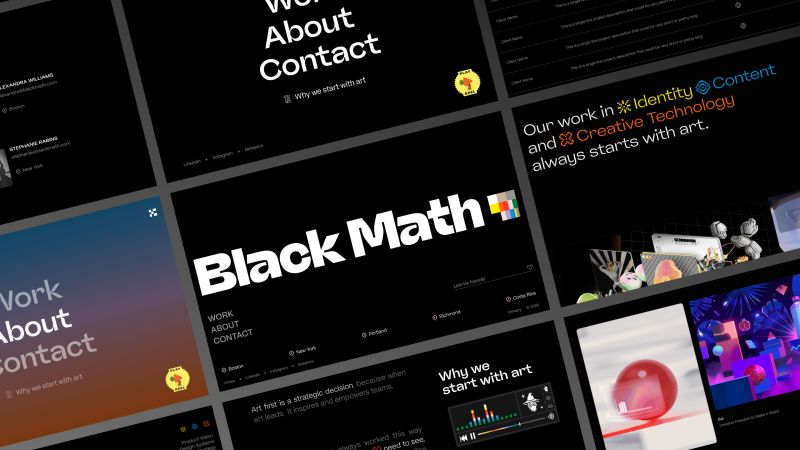
I recently came across a brief exchange on social media revisiting the perennial debate: design versus art. It’s a conversation that resurfaces every few years, reshaped by new tools, new economics, and new anxieties about what creative work is supposed to do. At PRINT, we’ve arguably been exploring design as art for more than 80 years—but it’s always worth reconsidering where that line blurs, especially as the industry continues to evolve.
The recent rebrand of the design studio Black Math feels like a direct response to that ongoing dialogue. Rather than choosing sides, it collapses the distinction. With its articulation of an “art first” philosophy and a visual system that stresses expression over neutrality, Black Math’s rebrand isn’t simply about how the studio looks. It’s about how it believes creative work should function. More specifically, it positions art as infrastructure.
And that move places the studio inside a broader, quieter trend: the return of aesthetic authorship as the structural core of design practice.
Founded in 2012 as a boutique animation studio in the heart of Boston, Black Math has since evolved into a globally connected practice working at the intersection of design and technology. That trajectory—from focused craft studio to expansive creative partner—makes its recent rebrand feel less like a routine refresh and more like a statement of intent.
On the surface, the new identity is confident and expressive. It leans into bold typography, dynamic motion, and a visual language that feels authored rather than templated. Nothing about it reads as neutral or trend-chasing. It reads as deliberate—an articulation of perspective rather than a bid for broad appeal.
But what makes the rebrand interesting isn’t simply the aesthetic shift. It’s the philosophical framing: art is foundational to how the studio thinks, builds, and collaborates. That framing matters. In an era when branding language is saturated with terms like optimization, scalability, and performance, to lead with art is to push against the dominant narrative of design as purely functional problem-solving.
Art First
When a studio says it is “art first,” it risks sounding romantic—or vague. But in the context of today’s design economy, the phrase becomes strategic. Over time, many creative studios have framed themselves as problem-solvers, facilitators, or innovation partners. The tone is collaborative, flexible, and adaptive. Arising out of that positioning, design studios have increasingly created identity systems focused on modularity with flexible design elements and frameworks that can scale across platforms, markets, and internal departments. These systems are efficient. They are replicable. But they can sometimes be indistinguishable from one another.
The rise of generative AI tools has accelerated this flattening. Logos can be prompted. Layouts can be auto-generated. Brand guidelines can be templated. By reclaiming art as its core infrastructure, Black Math is staking its value not on mechanical execution but on aesthetic conviction. Similar to what we recently reported about ArtCenter’s AI policies in design education that encourage experimentation and use of new technologies while keeping human judgment, voice, and responsibility where they belong, Black Math’s rebrand asserts that what differentiates a studio today is not its ability to produce assets—but its ability to decide what should exist in the first place.
We’re here to lead the conversation on craft and art as the differentiator in elevating what clients should be demanding from creative partners today. As new tools reshape the landscape, we’re leaning into the frontier of creative technology, in service of creating more resonant, meaningful experiences.
Black Math Co-founder Evan Fellers
Jeremy Sahlman, Co-Founder Black Math
Evan Fellers, Co-Founder Black Math
Art as a Competitive Advantage
As design production becomes increasingly commoditized, differentiation becomes harder. Clients can access capable design execution at lower cost and faster speed than ever before. The mechanics of layout, logo design, and motion graphics are no longer rare skills. What is prized, and will continue to remain so however, is cohesive aesthetic judgment. As Justin Ahrens wrote recently for PRINT, “The best work still comes from listening, seeing, and noticing. It comes from presence. It comes from the years you’ve spent honing taste, sensitivity, and restraint. AI can’t touch those things. In fact, AI makes those skills more valuable.”
By embedding art into its infrastructure, Black Math is reinforcing a value proposition that is difficult to automate. Generative tools can mimic styles, but they cannot originate worldview. They cannot sustain coherent taste across years of evolution.
Tools will keep changing. Taste is the constant. ‘Start with Art’ is how we lead.
Black Math Co-Founder Jeremy Sahlman
Artistic sensibility, when deeply embedded, becomes important territory to stake a claim to. A studio grounded in aesthetic infrastructure can evolve without losing identity. It can adapt tools without surrendering taste. It can navigate technological shifts while maintaining coherence.
Black Math’s rebrand positions the studio for that future. It does more than refresh the website, it models an alternative blueprint for creative studios where art is not the finishing touch, but the structural core.
The post Why Black Math’s Rebrand Signals a Return to Art as Infrastructure appeared first on PRINT Magazine.