
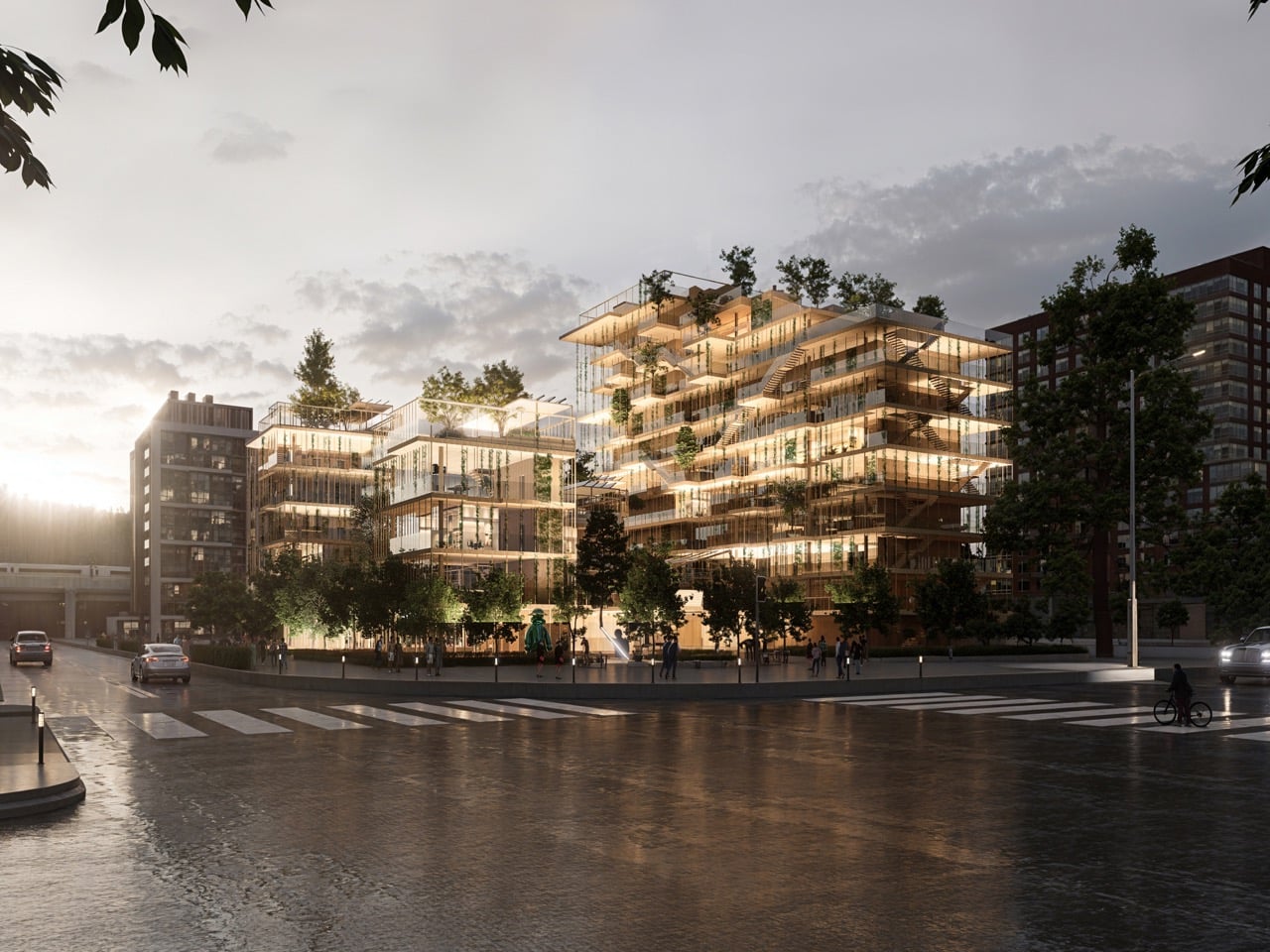
China loses farmland to urbanization at a pace that makes most planners nervous, and the usual architectural response is to pour a slab and move on. Wei Dou took a different position with the Verdant Syndicate, a mixed-use complex in Henan designed around the premise that the agricultural identity of a site deserves to survive its redevelopment. The project occupies 4,269 square meters of former farmland and organizes itself as two offset stepped volumes flanking a shared courtyard, wrapped in warm timber cladding and draped in cascading vertical vegetation from ground level to roofline.
What makes the building function as a living system is a tenant-operated planting board system, where modular growing panels connect directly to embedded water and nutrition lines. People who work and gather inside the building are also tending it, turning every terrace and balcony into a productive growing surface. A gravity-powered rainwater collection system handles irrigation without mechanical pumping, closing the resource loop on a plot that once fed the surrounding community through entirely different means.
Designer: Wei Dou
Splitting the program across two volumes instead of one monolithic block gives the courtyard between them genuine solar access, which matters enormously when your facade is a vertical farm. The stepped terrace profile on the taller volume echoes terraced agricultural landscapes without being literal about it, and the offset placement of the two blocks creates a ground-level commons that functions as the social spine of the whole complex. At 60 by 71 meters, the site is compact enough that every planning decision carries weight, and Dou clearly understood that.
Tenants can install, reconfigure, or remove individual planting panels, each one tapping into water and nutrient lines built directly into the structure. The building’s productive surface is never fixed, it adapts to whoever is using it and what they want to grow, season by season. Most biophilic buildings treat greenery as a fixed aesthetic layer applied during construction and maintained by a facilities team. Here the maintenance is distributed, social, and intentional, which is a fundamentally different model and one that actually has a chance of working long term.
The facade runs slim vertical members in a warm timber tone, with terraces wide enough to support real planting depth rather than cosmetic window boxes. Solar panels sit integrated into a mid-level roof deck canopy under a mature tree, handling shade and energy harvesting simultaneously without dedicating separate real estate to either function. The ground floor activates with retail, and the renders show it occupied and commercially legible, not the ghostly pedestrian utopia that kills most concept presentations.
Henan is a province with deep agricultural history and rapid urbanization pressure, which makes it exactly the right place to ask whether a building can carry both realities at once. The Verdant Syndicate backs that argument with a gravity-fed water loop, a modular tenant farming system, GIS and CAD-optimized solar orientation, and a courtyard massing strategy that keeps the whole thing from tipping into greenwash territory. Whether the planting board system performs in practice the way it does in simulation is the real open question. The framework is sound, and the building looks extraordinary doing it.
The post This Self-Sustaining Building in China Grows Food on Every Floor, And It Was Built On A Farmland Plot first appeared on Yanko Design.