
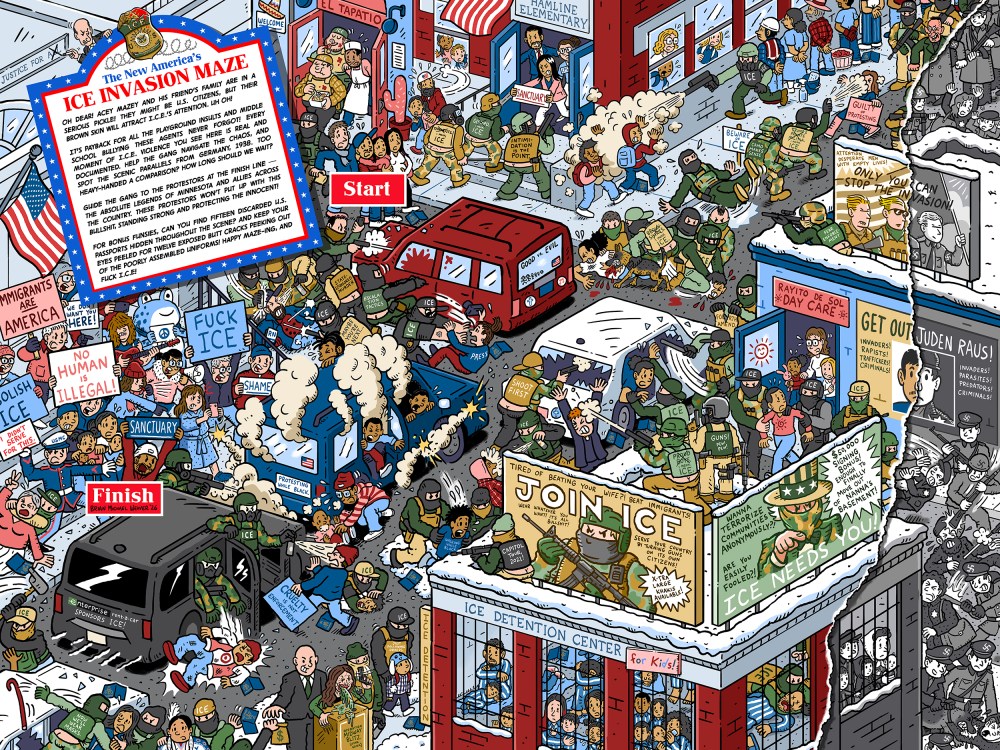
Brian Michael Weaver is an illustrator and cartoonist known for his densely packed scenes and visual gags. He has created hundreds of Hidden Pictures puzzles for Highlights for Children, and has contributed artwork to books, animation and editorial projects. For the moment, however, he has turned his attention away from solely children and has been producing large-scale satirical crowd scenes exploring contemporary American politics. This includes the Insurrection Maze and the ICE Invasion Maze, which Weaver discusses below. (If you’re looking for Kristi Noem, she’s there … but don’t bother.)
What inspired you to do these massive images? Where’s Waldo?
Oh my goodness, YES. Martin Handford’s Where’s Waldo? books—especially the first four—are my North Star. His ability to build compositions that work both from across the room and up close, while packing every inch with small stories and gags, completely mesmerized me as a kid. Finding Waldo was a blast, but the real fun was getting lost myself in the crowd scenes!
I’d already been drawing crowded battle scenes as a kid—Ghostbusters, Mario, Ninja Turtles—anything that let me fill a page with activity. So when I started feeling angry and helpless about the direction of the country, it clicked that this was my language. The dense scenes and search elements gave me a way to channel that energy.
How do you go about choreographing your pieces?
I start by figuring out what absolutely has to be in the image. I make a list of the key moments or characters, and the whole composition grows around those. In the Insurrection puzzle, for example, the Q-Anon Shaman had to be central—he’s such an unforgettable, moronic figure from that day. The tunnel confrontation was another anchor, because a lot of people don’t realize how violent that moment was, and I wanted to highlight that as well.
Similarly, with the ICE Invasion poster, I knew certain moments had to anchor the piece—Renée Good’s killing, the protests, traffic stops, school incidents and detention conditions. From there it becomes a hierarchy, building the rest of the image outward around those ideas.
Once those core elements are set, I do a small thumbnail to test the composition and start blocking areas where different scenes will live. I basically map out little zones across the page and build outward from there. After years of drawing crowd scenes, I’ve developed a feel for how much can fit, but there’s always improvising as I go, shifting things around and discovering new gags while the drawing grows. For example, Alex Pretti’s murder happened while I was already mapping out the scene, but a few easy shifts and I was able to get that crucial moment of history in there.
Where and how do you intend these to be seen?
Originally, I was thinking about specific online communities as the audience. Places like Reddit, where people were already documenting and processing what was happening, whether it was the pandemic, Jan. 6, or immigration enforcement. Posting there felt like sharing the work with people who were paying close attention and cared about accountability.
More broadly, though, I want the pieces to live where people can spend time with them: online, in print, even as jigsaw puzzles. The density slows you down. Instead of a quick headline or image you scroll past, viewers start noticing the details and realizing most of these moments—sometimes violent, sometimes outrageously stupid—are depicting REAL events.
What other political or social phenomena do you have planned using this approach?
I’ve just started the next one, tentatively called The Trump Fuck-Ups Maze. It will have a hundred or so versions of Trump in the Oval Office, each highlighting a different blunder, controversy or idiotic moment from the past several years. Some depressing, some just stupid.
Structurally it will be very similar to the others, but thankfully I won’t have to draw as much violence. This one will be sillier, I imagine—even though the ramifications of these blunders, tantrums and crimes are horrible, I think it will be fun to depict him. I can already envision Stormy Daniels spanking him with a magazine on the couch in the middle of the Oval Office.
But unfortunately, the list of subjects probably won’t run out any time soon!
Do you have a specific goal for your audience?
I don’t buy the idea that no one can change their mind. Some people are still forming their views, and art can nudge them to look a little closer. My hope is that someone comes for the humor or the puzzle and then notices that the scenes are rooted in real events.
The post The Daily Heller: An ICE Meltdown in Anytown, USA appeared first on PRINT Magazine.