
Tobia Zambotti & Hildiberg reimagine industrial waste as a lamp
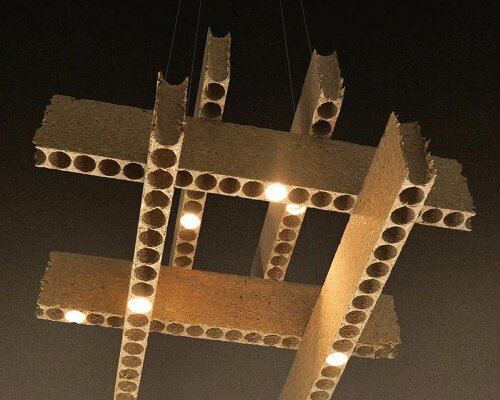
The OOOOOlamp by designers Tobia Zambotti and Hildiberg repurposes hollow-core door waste into a lighting object. The project uses discarded particleboard cores from hollow-core doors, an industrial byproduct typically removed during manufacturing, to form the structure of the lamp. Characterized by a sequence of circular perforations, these panels become the basis for a lighting system that integrates illumination directly within existing voids.
During the production of hollow-core doors, circular cutouts are introduced to reduce weight and accommodate hardware such as handles or fittings. The resulting perforated boards are usually discarded. In the OOOOOlamp, these elements are retained and reinterpreted as structural and visual components. The rhythmic pattern of circular openings establishes the lamp’s primary geometry while also determining the placement of its light sources.
all images courtesy of Tobia Zambotti and Hildiberg
hollow-core door waste transforms into a lighting sculpture
potlights are installed within the existing perforations, allowing each void to function as a light aperture. Through this approach, the design converts negative space into a source of illumination. The pattern of openings distributes light across the surface, emphasizing the repetitive geometry created during the door manufacturing process.
The project by interior designer Tobia Zambotti and creative studio Hildiberg highlights the material qualities of the particleboard panels, preserving their raw industrial character while introducing a precise lighting intervention. Rather than concealing the origin of the material, the design maintains the visible traces of production, allowing the perforations and structural composition of the board to define the object’s visual identity.
By reworking discarded door cores into a functional lighting element, the OOOOOlamp demonstrates how manufacturing byproducts can be integrated into design processes. The project frames reuse not as an added feature but as a central design strategy, where existing material conditions inform both the form and performance of the final object.
in door production, circular sections are cut out to reduce weight and allow space for handles and fittings
each empty circle, once considered waste, is reinterpreted as a chamber designed to hold light
integrated spotlights fill the holes, converting absence into illumination and imperfections into design features
the piece combines raw industrial textures with minimalist aesthetics while emphasizing sustainability
door boards, punctured by a repeating pattern of round openings, form the structural base of the lamp
the project repurposes the inner cores of hollow chipboard doors, materials that are usually discarded
project info:
name: OOOOOLamp
designers: Tobia Zambotti | @tobia_zambotti & Hildiberg | @hildiberg_design
designboom has received this project from our DIY submissions feature, where we welcome our readers to submit their own work for publication. see more project submissions from our readers here.
edited by: christina vergopoulou | designboom
The post hollow-core door waste finds new life as luminous design object appeared first on designboom | architecture & design magazine.